Ho Chi Minh City announces 134 free bus routes

From July 1, the city will cover the full ticket cost for passengers using 134 operating bus routes, comprising 109 subsidised by the municipal budget and 25 non-subsidised ones.

Ho Chi Minh City (VNA) – Ho Chi Minh City’s centre for public transport management announced on June 22 the implementation of a programme to provide 100% bus fare support from July 1 through December 31.
5.jpg
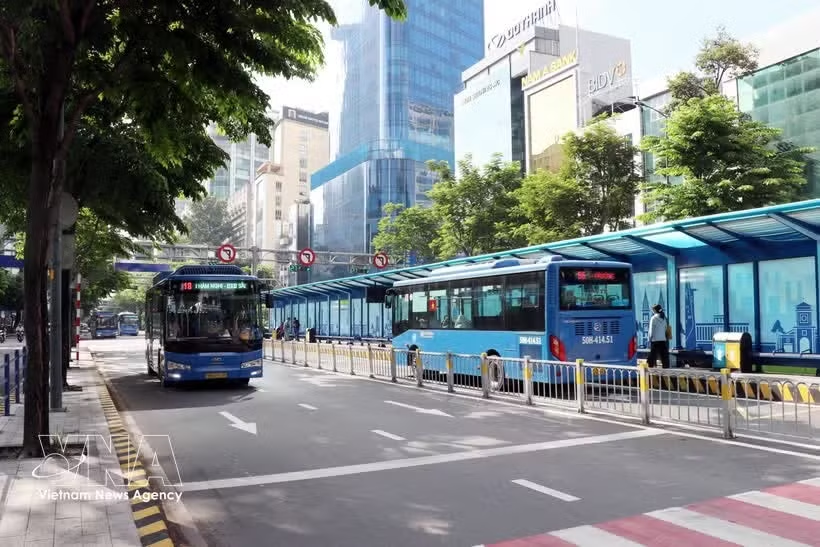
Currently, Ho Chi Minh City operates 2,432 buses, including 1,649 electric and green-energy buses, accounting for 67.8% of the fleet. (Photo: VNA)

Under the scheme, residents will be able to travel free of charge on 134 bus routes.

From July 1, the city will cover the full ticket cost for passengers using 134 operating bus routes, comprising 109 subsidised by the municipal budget and 25 non-subsidised ones.

The policy does not apply to interprovincial bus routes, open-top sightseeing buses for tourists, airport connection bus services, or those passing through other provinces or cities but operating similarly to interprovincial services. Accordingly, Route 172 (Vung Tau bus station – Ba Ria administrative centre – Sai Gon bus station) is not included because part of its route passes through Dong Nai city.

The centre said the fare-support policy follows the principle of “free but controlled, convenient for users and manageable for authorities” and will be implemented in two phases.

Phase 1 (July 1 – September 30) offers completely free travel for bus users, with no passenger authentication or identification required. It focuses on helping residents adapt to bus use while completing database, technology infrastructure and the e-ticketing system.

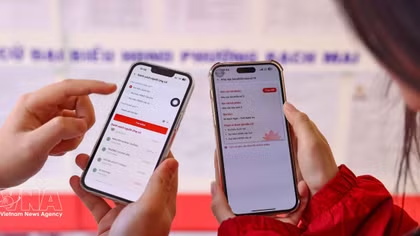
Phase 2 (October 1 – December 31) will see free fares linked to passenger registration, authentication or identification through methods such as ID cards, the VNeID app, bank cards, e-wallets and the MultiGo application. Specific guidance will be provided for elderly people, those with disabilities, children, students, visitors and other special groups.

The city also plans to continue upgrading bus stops and shelters during 2026–2027.

Currently, Ho Chi Minh City operates 2,432 buses, including 1,649 electric and green-energy buses, accounting for 67.8% of the fleet.

By the end of 2026, the southern metropolis expects to convert 624 additional buses to electric operation, bringing the share of electric and green-energy vehicles on intra-city routes to 100% by early 2027.

During 2027–2028, interprovincial bus routes using compressed natural gas (CNG) and other fuels are also planned for conversion to electric vehicles, with the goal that all buses operating in the city will be electric by early 2029./.

en.vietnamplus.vn

Other News

Hanoi ready to implement Capital Law 2026, unlocking new development momentum

Hanoi ready to implement Capital Law 2026, unlocking new development momentum

The effectiveness of the Capital Law 2026 will be measured not by the number of legal documents issued but by tangible improvements in governance and public administration, better services for people and businesses, faster administrative procedures, stronger investment attraction and higher economic growth.

Vietnamese students earn honours at ROBOG Asia Cup 2026

Vietnamese students earn honours at ROBOG Asia Cup 2026

Three teams from Chu Van An Secondary School in Vietnam’s Thai Nguyen province have earned First Prize honours and advanced to the quarterfinals at the ROBOG Asia Cup 2026, a regional robotics and artificial intelligence (AI) competition for students held in Hong Kong, China.

Hanoi sets out new investment blueprint with century-long development vision

Hanoi sets out new investment blueprint with century-long development vision

As of early June, Hanoi had attracted 74.6 billion USD in foreign direct investment (FDI) through more than 9,250 valid projects. FDI inflows in the first six months were projected at 3.2 billion USD, surpassing the annual target by 116%, while nearly 16,000 new businesses were established in the first five months, up 34.4% year-on-year.

Vietnam promotes legal cooperation and rule of law at global forum

Vietnam promotes legal cooperation and rule of law at global forum

Vietnam’s development and international integration have gone hand in hand with the improvement of its legal system, the incorporation of international commitments into domestic legislation, and legal reforms aimed at fostering development, openness and global integration. The country regards international law as an essential instrument for building fair, mutually beneficial relations among nations.

Hanoi to hold investment promotion event on June 29

Hanoi to hold investment promotion event on June 29

At the event, Hanoi authorities plan to grant investment policy decisions and investment registration certificates to 20 exemplary projects in the fields of transportation infrastructure, industrial parks, urban development, social housing, environment, science and technology, and foreign investment attraction.

Hanoi's Red River urban area development draws widespread attention

Hanoi's Red River urban area development draws widespread attention

Located south of the Red River and extending from the historic inner city to newly developing areas in the south and the west, the central urban area along Red River’s right bank covers approximately 45,317 hectares and is projected to accommodate around 6.365 million residents by 2045 and 6.455 million by 2065.

Hanoi's Red River urban area development draws widespread attention

Hanoi's Red River urban area development draws widespread attention

Located south of the Red River and extending from the historic inner city to newly developing areas in the south and the west, the central urban area along Red River’s right bank covers approximately 45,317 hectares and is projected to accommodate around 6.365 million residents by 2045 and 6.455 million by 2065.

Regional cooperation strengthened to combat cross-border drug crime

Regional cooperation strengthened to combat cross-border drug crime

Vietnam, China, Laos and Myanmar face common challenges as drug syndicates increasingly exploit the Mekong River, cross-border transport networks, e-commerce platforms, international logistics services, cyberspace and cryptocurrencies to organise drug transactions and smuggling operations.