Education ministry targets five digital technology incubators at universities

A key target under the new plan is the establishment of five digital technology incubators, or Deeptech Hubs, at universities and research institutes with strong potential. The education ministry also plans to launch a training programme for 1,000 outstanding technology entrepreneurs and develop criteria for selecting and supporting startup ecosystems within educational institutions.

The Ministry of Education and Training has issued a plan to implement a programme on supporting student entrepreneurship in the 2026-2035 period, aiming to develop a comprehensive startup ecosystem across the education sector.
Education ministry targets five digital technology incubators at universities -0
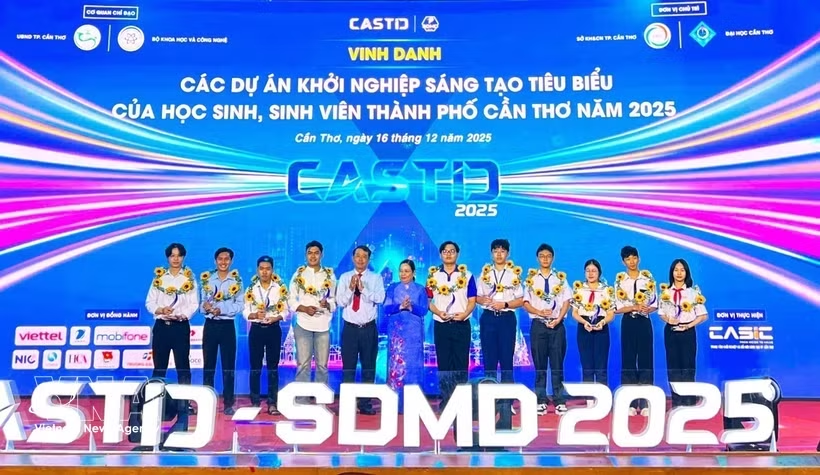
Students in the Mekong Delta city of Can Tho are honoured for their outstanding performance in startup activities. (Photo: VNA)

The new plan builds on the outcomes of the previous project while shifting the focus from individual startup activities to the development of an integrated and sustainable entrepreneurship ecosystem.

Unlike the earlier phase, which mainly concentrated on communications campaigns, training programmes, startup competitions, entrepreneurship festivals, support centres and funding assistance, the new strategy seeks to strengthen links among schools, businesses, investors and localities, while promoting startup models within educational institutions.

One notable feature of the plan is the introduction, for the first time, of controlled pilot mechanisms, or “sandboxes”, for startup and spin-off enterprises established within educational institutions. The ministry will also issue guidance on intellectual property rights, management and benefit-sharing mechanisms related to research products and startup projects developed by teachers and students.

The programme also includes measures to support small- and medium-sized enterprises originating from educational institutions, while expanding networks of mentors, businesses, angel investors, alumni and startup support organisations. Sector-based mentor-investment-commercialisation chains are expected to be gradually established to better support startups throughout their development process.

A key target under the new plan is the establishment of five digital technology incubators, or Deeptech Hubs, at universities and research institutes with strong potential. The ministry also plans to launch a training programme for 1,000 outstanding technology entrepreneurs and develop criteria for selecting and supporting startup ecosystems within educational institutions.

Compared to the previous phase, the 2026-2035 plan places greater emphasis on standardising entrepreneurship support activities across schools and training institutions.

The ministry will develop a list of minimum support services, evaluation criteria for innovative startup activities, and entrepreneurship competency standards for consultants, lecturers, teachers and students. Teaching materials, training resources and startup support personnel will also be standardised.

In addition, the education sector plans to introduce digital platforms supporting entrepreneurship, including information portals, monitoring and reporting systems, databases of projects and mentors, and shared data systems serving programme management and implementation.

The programme will prioritise key technical fields, strategic technologies, cultural industries, green startups and the circular economy, while promoting entrepreneurship education linked with career orientation, experiential learning and STEM and STEAM education at schools.

VNA

Other News

Hanoi ready to implement Capital Law 2026, unlocking new development momentum

Hanoi ready to implement Capital Law 2026, unlocking new development momentum

The effectiveness of the Capital Law 2026 will be measured not by the number of legal documents issued but by tangible improvements in governance and public administration, better services for people and businesses, faster administrative procedures, stronger investment attraction and higher economic growth.

Vietnamese students earn honours at ROBOG Asia Cup 2026

Vietnamese students earn honours at ROBOG Asia Cup 2026

Three teams from Chu Van An Secondary School in Vietnam’s Thai Nguyen province have earned First Prize honours and advanced to the quarterfinals at the ROBOG Asia Cup 2026, a regional robotics and artificial intelligence (AI) competition for students held in Hong Kong, China.

Hanoi sets out new investment blueprint with century-long development vision

Hanoi sets out new investment blueprint with century-long development vision

As of early June, Hanoi had attracted 74.6 billion USD in foreign direct investment (FDI) through more than 9,250 valid projects. FDI inflows in the first six months were projected at 3.2 billion USD, surpassing the annual target by 116%, while nearly 16,000 new businesses were established in the first five months, up 34.4% year-on-year.

Vietnam promotes legal cooperation and rule of law at global forum

Vietnam promotes legal cooperation and rule of law at global forum

Vietnam’s development and international integration have gone hand in hand with the improvement of its legal system, the incorporation of international commitments into domestic legislation, and legal reforms aimed at fostering development, openness and global integration. The country regards international law as an essential instrument for building fair, mutually beneficial relations among nations.

Hanoi to hold investment promotion event on June 29

Hanoi to hold investment promotion event on June 29

At the event, Hanoi authorities plan to grant investment policy decisions and investment registration certificates to 20 exemplary projects in the fields of transportation infrastructure, industrial parks, urban development, social housing, environment, science and technology, and foreign investment attraction.

Hanoi's Red River urban area development draws widespread attention

Hanoi's Red River urban area development draws widespread attention

Located south of the Red River and extending from the historic inner city to newly developing areas in the south and the west, the central urban area along Red River’s right bank covers approximately 45,317 hectares and is projected to accommodate around 6.365 million residents by 2045 and 6.455 million by 2065.

Hanoi's Red River urban area development draws widespread attention

Hanoi's Red River urban area development draws widespread attention

Located south of the Red River and extending from the historic inner city to newly developing areas in the south and the west, the central urban area along Red River’s right bank covers approximately 45,317 hectares and is projected to accommodate around 6.365 million residents by 2045 and 6.455 million by 2065.

Regional cooperation strengthened to combat cross-border drug crime

Regional cooperation strengthened to combat cross-border drug crime

Vietnam, China, Laos and Myanmar face common challenges as drug syndicates increasingly exploit the Mekong River, cross-border transport networks, e-commerce platforms, international logistics services, cyberspace and cryptocurrencies to organise drug transactions and smuggling operations.