
The year 2016 has seen significant achievements and efforts from the entire education sector, helping boost its growth.
 |
However, to successfully implement the policy of comprehensively renovating the education sector, a range of problems need to be resolved, particularly by reforming examinations and enrollment at all levels and ensuring the effective deployment of improved personnel training programmes to meet the needs of national socioeconomic development.
Examinations and enrollment have yet to meet expectations
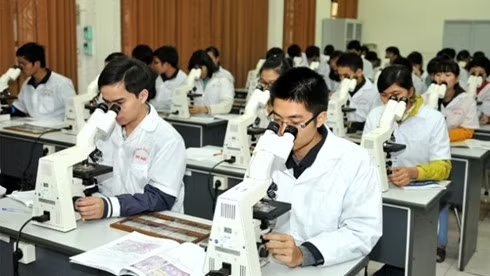
2016 is the second year the Ministry of Education and Training (MOET) has organised the national high school exam towards efficiency and reducing the pressure on students and their families, as well as the burden on society.
The exam has two purposes: evaluating prospective high school graduates based on their exam results and using such results for university and college admissions.
There were 120 exam venues, including 70 hosted by universities and colleges and 50 by local Departments of Education and Training, for a total of 887,404 registered candidates to sit their exams this year.
This year’s national high school exam addressed several limitations of last year’s event, but there are still some shortcomings, such as the fact that two types of exam venues still exist, forcing a large number of teachers and lecturers from universities and colleges to move to local venues to superintend the exam; that the exam’s questions still did not cover the majority of textbook curricula; that the long exam time, especially on longer exam dates, has made it difficult for students to adapt; and that exam assessments for essay tests seemed not to ensure absolute objectivity as the assessment still depended heavily on the teachers who mark the tests.
In addition, the fact that the number of “virtual candidates” had not been updated and the number of registered candidates has not been made public caused difficulties for universities and colleges in admission.
In 2017, the MOET intends to make several reforms to the exam, including applying objective questionnaire testing methods to most of the tests (except for those in literature) to create technical barriers to ensure more reliable test results while eliminating most of the negatives that may arise during examinations and their assessment.
Pondering educational renovation schemes and projects
Along with the renewal in examination and evaluation, 2016 also marked the end of the whole or several stages of a number of the sector’s major comprehensive educational innovation projects.
In particular, the Vietnam’s new school model, the Vietnam Escuela Nueva (VNEN) project, officially launched in 2013 with a total capital of US$87.6 million, ended this year.
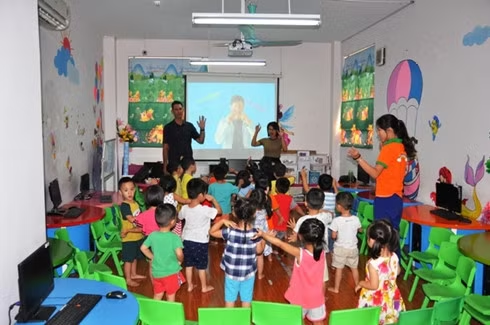
VNEN aimed at renovating methods of teaching, learning and student assessment, as well as making changes to classroom organisation and the involvement of families and the community in the educational process.
After three years of implementation, the model was applied in 4,437 primary schools, plus 1,161 secondary schools implementing VNEN for their sixth graders and 1,035 adopting it for seventh grade classes.
The model has helped to create a friendly and democratic education environment in schools and classrooms, to facilitate students in becoming more active in self-study and improving the enhanced relationship among the schools, students’ parents and the community.
However, the project also proved unsuitable for conditions in several locales, while educational managers and staff have not been well prepared for the model’s deployment, and its mass application even in locales with difficulties in teaching staff and educational facilities caused concern among the public.
Therefore, the MOET has encouraged educational institutions to deploy the VNEN model on a voluntary basis, ensuring its practical effects and maintaining its deployment throughout the school level for the benefit of students.
 |
Along with the new school model project, 2016 also marked the end of the first phase of the VND9.4 trillion (US$413.6 million) project on facilitating foreign language teaching and learning in the national education system during 2008-2020. In its first period, from 2008-2015, the scheme was allocated over VND3.8 trillion.
It aims to raise the domestic foreign language qualification framework to match the six degree criteria set by the Association of Language Testers in Europe.
Accordingly, students graduating from primary education could achieve the first proficiency level, from secondary education achieving the second qualification level, and those graduating from the high school level and from non–foreign language study universities could reach the third level in the foreign language capability framework.
Despite generating great expectations, by the end of 2016, the project revealed some overreached objectives compared with the reality. During its implementation, foreign language testing and evaluation has not been taken seriously. Foreign language teaching methods seemed to be obsolete, with a lack of foreign language teachers and their uneven capacity in different regions and locales.
Such factors had resulted in foreign language tests’ negative results after the 2016 national high school exam, with the average score at only 3.43 points.
Of those, 399,429 examinees achieved fewer than 5 points (84%) and only 74,566 candidates achieved 5 points or more (16%). For that reason, in the 2016-2020 period, MOET made several changes to the project’s objectives and implementation methods.
A “push” for training quality
In 2016, many universities have improved their teaching quality and ensured that graduates have suitable jobs, meeting the requirements of the labour market.
As of October 2016, Vietnam has 239 tertiary education facilities, including 179 public and 60 private ones.
MOET has continued to closely manage the opening of training programmes, putting a stop to the opening of some training branches with signs of excess manpower, such as training for teaching staff at universities and colleges or accounting, business administration and banking and finance degrees at facilities in Hanoi and Ho Chi Minh City.
The ministry also halted training programmes in the form of remote training for teachers, declined enrolment for lower levels in universities and reorganised doctoral degree training to improve training quality.
Implementing the policies mentioned above, the training size in colleges and universities during the 2015-2016 academic year were down by 7% from the previous year.
In particular, the form of joint working and studying (dual studies) training and tertiary level distance training were down by 13% and 16.3%, respectively.
Notably, 2016 also marked a milestone in the cooperation between the MOET and the Government on a project to promulgate the Vietnam National Quality Framework, serving as a basis on which for training facilities to build up graduation standards for their students and modify and supplement training programmes to suit the requirements of the country’s socioeconomic development in the context of regional and international integration.
Changes in the last academic year made in higher education have helped result in considerable progress. The rankings of domestic universities in the region and around the world continue to improve.
According to QS University Rankings Asia, in 2016 the Vietnam National University, Hanoi jumped to No. 139 (compared with 191 in 2015 rankings), while Vietnam National University, Ho Chi Minh City, ranked No. 147. Meanwhile, according to the Webometrics Ranking of World Universities, many universities in Vietnam are on the list of the best schools in Asia.
So far, 44 training programmes have been verified as meeting the standards of the ASEAN University Network (AUN), sixteen programmes as approaching the standards of the French Engineering Degree Commission (CTI) and two programmes with standards set by the US’s leading prestigious Accreditation Board for Engineering and Technology (ABET).
It can be said that 2016 is about to end with encouraging results in the fundamental and comprehensive renovation of education in Vietnam. However, these renovations remain difficult and require the sector to accept criticism and develop more effective methods for 2017.

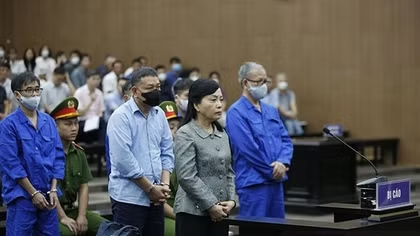
The Supreme People’s Court’s appellate panel had been scheduled to deliver its verdict on September 30 afternoon. However, before the verdict, defence lawyers and defendants asked the panel to postpone the hearing to allow them more time to prepare additional payments.

The International Day of Older Persons 2026, themed “The Age of Longevity: Rethinking Systems for Longer Lives,” highlights the need to develop healthcare, social security, labour-market and social-service systems in response to increasing life expectancy. For Vietnam, rapid population ageing is not only a demographic issue but also a development challenge.

The Vietnam Maritime Search and Rescue Coordination Centre on September 29 safely brought ashore an unconscious sailor from the Liberian-flagged MSC HERMES III, who was suspected of inhaling toxic gas, for further medical treatment.

This year, lessons will weave Vietnamese culture, history and everyday life into the curriculum, tailored to each age group.

Among the key transport and conference projects, the runway expansion at Phu Quoc International Airport has been completed, while the VIP terminal is 96% complete and Terminal 2 is 72% complete.
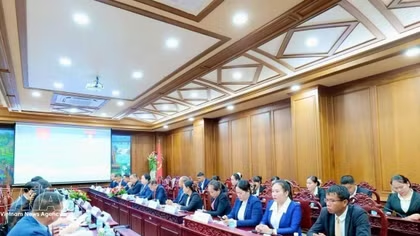
Both sides agreed to keep educating officials, Party members, youth union groups and the broader public, especially young people in both provinces, on the great friendship, special solidarity, comprehensive cooperation and strategic cohesion between Vietnam and Laos.

Standing Deputy Prime Minister Pham Gia Tuc on September 27 inspected Huu Nghi – Chi Lang and Dong Dang – Tra Linh expressway projects, urging local authorities, investors and contractors to speed up construction to connect the two routes before the Lunar New Year (Tet) 2027.

General Secretary and President Lam stressed that bilateral friendship and cooperation have been nurtured by people living and working in both countries, with the Vietnamese community in Canada playing an important bridging role.

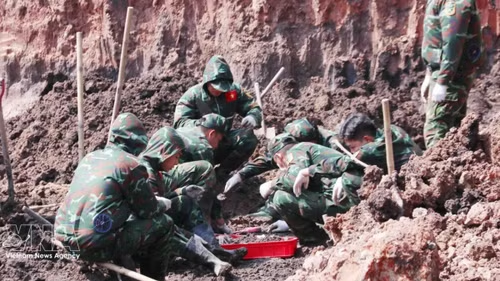
Of the total, 631 were individual sets of remains, while 33 were recovered from eight mass graves. Personal artifacts were found with 298 sets of remains.
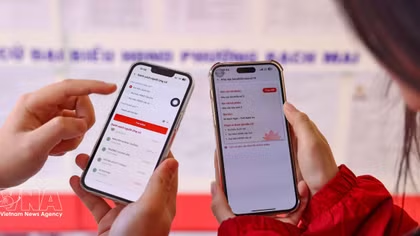
Vietnam plans to connect its national digital identification application VNeID with the electronic identification systems of Singapore and Laos, with a view to expanding the connection to other ASEAN countries.

Such assessments, however, need to be viewed in the context of Vietnam’s starting point in 1986 and the broader trajectory of its development. A country emerging from prolonged wars, facing severe socio-economic difficulties and economic embargo has undergone profound changes over the past four decades.

The floods have left three people dead, destroyed eight houses and damaged 111 others, while nearly 20,000 houses have been inundated, with more than 5,000 in riverside and low-lying areas of Hanoi and Ninh Binh currently remaining flooded.

The captain discovered water entering ballast tanks No. 4, 5 and 6 on the port side, causing the vessel to list slightly. Initial assessments indicated that the vessel may have struck an underwater rock formation while underway.

Publishing copyright is entering an entirely new phase. As AI becomes increasingly capable of generating text, summarising books, mimicking writing styles and producing content at enormous speed, ensuring copyright protection is becoming more difficult.
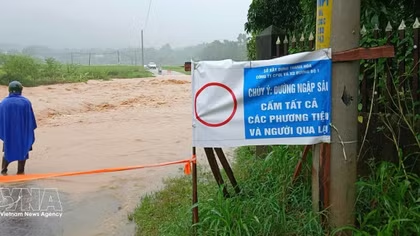
Authorities urged residents in the eight provinces and cities - Son La, Phu Tho, Lao Cai, Tuyen Quang, Thai Nguyen, Quang Ninh, Thanh Hoa and Nghe An - to remain alert for a high risk of flash floods and landslides on September 17.
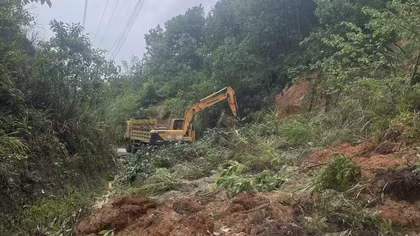
Prolonged heavy rains from September 13–17 have caused flooding and landslides, damaging homes, crops, roads and infrastructure in Phu Tho and Thanh Hoa provinces, with local authorities mobilising forces for emergency response.
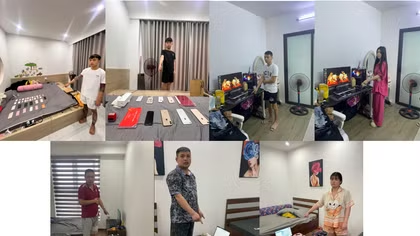
Quang Ninh city's Public Security Department warned individuals, agencies and businesses not to publicly disclose or provide personal information or bank account details on social media, and urged organisations and businesses to strictly comply with regulations on protecting customers’ personal data.

From a weekend support activity, the “Zero-dong stall” has grown into a widely recognised community initiative, helping ease living costs while fostering solidarity and compassion among local residents.

The continued recovery of martyrs’ remains provides valuable information and further evidence of those who fought and sacrificed their lives for national independence and freedom. It also encourages search teams to persist in locating fallen soldiers still lying on former battlefields, contributing to the effective implementation of the 500-day campaign and reflecting Vietnam’s long-standing tradition of gratitude.

Vietnam will launch nationwide screening for five groups of school-related diseases and health conditions among students from preschool through high school from 2028, including overweight and obesity, refractive errors, spinal curvature, oral diseases and mental health disorders.