First instance trial on exam cheating scandal in Hoa Binh opens

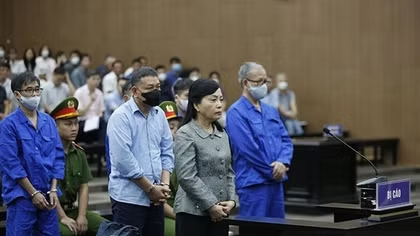
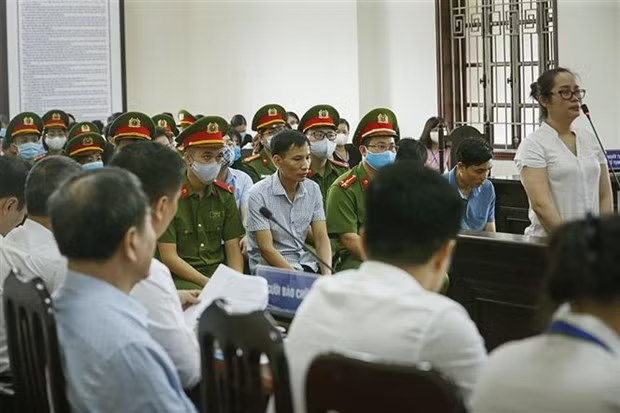
The People’s Court of Hoa Binh province on May 11 opened the first instance trial on the 2017-2018 national high school exam cheating scandal in which dozens of candidates had their exam scores increased so they could graduate high school and attend universities or colleges.
At the trial (Photo: VNA)

At the trial (Photo: VNA)

The People’s Court of northern Hoa Binh province on May 11 opened the first instance trial on the 2017-2018 national high school exam cheating scandal in which dozens of candidates had their exam scores increased so they could graduate high school and attend universities or colleges.

Thirteen out of 15 defendants who are former education officials, teachers and police officers in the province are being tried for abuse of power while performing their official duties to inflate the exam scores of students.

Among the defendants are Nguyen Quang Vinh, born in 1966, residing in Hoa Binh city, former head of the Testing and Quality Assurance Division under the provincial Department of Education and Training; Diep Thi Hong Lien, born in 1974, residing in Hoa Binh city, former vice head of the Testing and Quality Assurance Division; and Khuong Ngoc Chat, born in 1975, residing in Hoa Binh city, former head of the Internal Political Security Division under the provincial Department of Public Security.

Do Manh Tuan, born in 1979, residing in Lac Thuy district, Hoa Binh province, former vice principle of Lac Thuy District Secondary and High Boarding School, is also charged for receiving bribes in addition to abuse of power.

Ho Chuc, born in 1975, residing in Phu Thanh commune, Lac Thuy district, former teacher of Thanh Ha High school in Lac Thuy district is charged for giving bribes.

According to the indictment by the provincial People’s Prosecuracy, the defendants abused their power and made use of their relationships to collude and intervene to raise the marks of candidates in the national high school exam in 2017 and 2018.

The intervention raised marks for 65 candidates who sat for the national exam in 2018 and one candidate who sat for the national exam in 2017.

Of the candidates benefiting from the scheme, 45 were forced to quit school after their exams were re-marked objectively, ten others could continue their university courses as their remarked scores were eligible for university admission.

Six other candidates did not attend university courses even though their remarked scores met universities’ requirements, one candidate failed to get university admission while another candidate did not apply for any university or college.

The trial will run until May 18

VNA

Other News

Hanoi ready to implement Capital Law 2026, unlocking new development momentum

Hanoi ready to implement Capital Law 2026, unlocking new development momentum

The effectiveness of the Capital Law 2026 will be measured not by the number of legal documents issued but by tangible improvements in governance and public administration, better services for people and businesses, faster administrative procedures, stronger investment attraction and higher economic growth.

Vietnamese students earn honours at ROBOG Asia Cup 2026

Vietnamese students earn honours at ROBOG Asia Cup 2026

Three teams from Chu Van An Secondary School in Vietnam’s Thai Nguyen province have earned First Prize honours and advanced to the quarterfinals at the ROBOG Asia Cup 2026, a regional robotics and artificial intelligence (AI) competition for students held in Hong Kong, China.

Hanoi sets out new investment blueprint with century-long development vision

Hanoi sets out new investment blueprint with century-long development vision

As of early June, Hanoi had attracted 74.6 billion USD in foreign direct investment (FDI) through more than 9,250 valid projects. FDI inflows in the first six months were projected at 3.2 billion USD, surpassing the annual target by 116%, while nearly 16,000 new businesses were established in the first five months, up 34.4% year-on-year.

Vietnam promotes legal cooperation and rule of law at global forum

Vietnam promotes legal cooperation and rule of law at global forum

Vietnam’s development and international integration have gone hand in hand with the improvement of its legal system, the incorporation of international commitments into domestic legislation, and legal reforms aimed at fostering development, openness and global integration. The country regards international law as an essential instrument for building fair, mutually beneficial relations among nations.

Hanoi to hold investment promotion event on June 29

Hanoi to hold investment promotion event on June 29

At the event, Hanoi authorities plan to grant investment policy decisions and investment registration certificates to 20 exemplary projects in the fields of transportation infrastructure, industrial parks, urban development, social housing, environment, science and technology, and foreign investment attraction.

Hanoi's Red River urban area development draws widespread attention

Hanoi's Red River urban area development draws widespread attention

Located south of the Red River and extending from the historic inner city to newly developing areas in the south and the west, the central urban area along Red River’s right bank covers approximately 45,317 hectares and is projected to accommodate around 6.365 million residents by 2045 and 6.455 million by 2065.

Hanoi's Red River urban area development draws widespread attention

Hanoi's Red River urban area development draws widespread attention

Located south of the Red River and extending from the historic inner city to newly developing areas in the south and the west, the central urban area along Red River’s right bank covers approximately 45,317 hectares and is projected to accommodate around 6.365 million residents by 2045 and 6.455 million by 2065.

Regional cooperation strengthened to combat cross-border drug crime

Regional cooperation strengthened to combat cross-border drug crime

Vietnam, China, Laos and Myanmar face common challenges as drug syndicates increasingly exploit the Mekong River, cross-border transport networks, e-commerce platforms, international logistics services, cyberspace and cryptocurrencies to organise drug transactions and smuggling operations.