 |
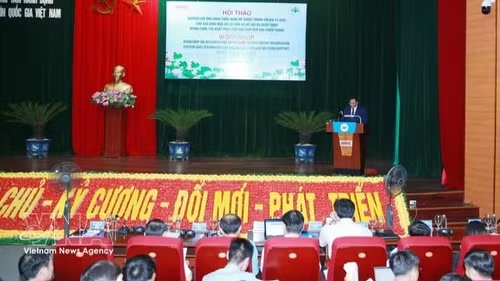
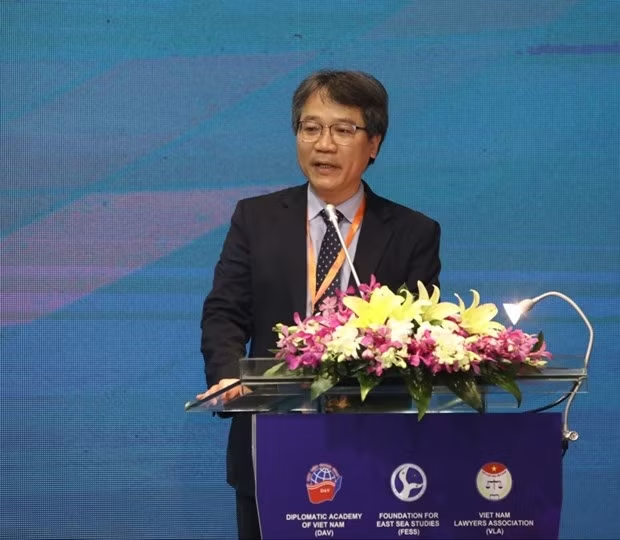
| President of the Diplomatic Academy of Vietnam Nguyen Vu Tung speaks at the opening ceremony of the conference (Source: VNA) |
Leading foreign experts have voiced their concerns over China’s recent actions in the South China Sea, which is called the East Sea in Vietnam, while speaking at the ongoing 11th South China Sea International Conference in Hanoi.
Addressing the first plenary session entitled “South China Sea State of Affairs: Threats, Risks and Opportunities”, Greg Poling, Director of the Asia Maritime Transparency Initiative at the US-based Center for Strategic & International Studies, said the most important development in the South China Sea over the last year has been the growth in the number of China Coast Guard and maritime militia vessels China has deployed to the Spratly archipelago.
These ships are now patrolling every part of the nine dash line continuously and are becoming more aggressive in harassing Southeast Asian states' normal activities including oil and gas work, fishing, and resupply of their outposts, he said.
“If the situation continues, it will soon be too risky for regional actors to engage in any normal activity without Chinese participation,” he stressed.
During the session, delegates identified threats, risks and opportunities in the South China Sea in relation to regional peace and stability. Particularly, they also assessed the past year’s behavior and activities of all parties concerned and how they would affect inter-state relations and strategic seascape in the waterway of strategic importance.
Meanwhile, Dr. Nicola Casarini from the Istituto Affari Internazionali of Italy said at the second plenary session on “The South China Sea in Competing Visions” that Beijing continues to challenge the rules-based order in the area by building artificial islands with military facilities and weapons systems, drilling for oil and gas, and chasing off its Southeast Asian neighbours’ fishing vessels from waters where they have the rights to fish in accordance with the United Nations Convention on the Law of the Sea (UNCLOS).
The EU is scaling up its security engagement in and with Asia, in line with EU global strategy’s objective to support a rules-based international order, Casarini told the participants.
In the second plenary session, participants examined the importance of the South China Sea in major players’ grand strategies or regional visions in a way to mapping out how the South China Sea is connected with their security and economic prosperity. Also, they mapped out the differences and similarities in the major players’ interests in and approaches to the South China Sea to better understand the nature of their cooperation and competition over the relevant issues at this moment and time to come.
The panelists were requested to examine the South China Sea from the perspectives of their countries’ policies and strategies, either Belt and Road Initiative or Free and Open Indo-Pacific, or their respective regional policies.
Dr. Ekaterina Koldunova, Deputy Dean at the School of Political Affairs and Associate Professor at the Department of Asian and African Studies under the MGIMO-University of Russia, said the region has witnessed not only the reminiscence of the great power rivalry but also a contestation of regional and trans-regional visions and competition of projects at the nexus of economy, politics, security and infrastructural development. China’s Belt and Road Initiative (BRI) had multiple unintended results as long as more and more countries started to speculate what it really means to be included or not included in the BRI, she said.
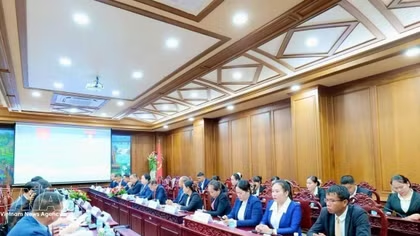
The 11th South China Sea International Conference is being jointly organised on November 6 and 7 by the Diplomatic Academy of Vietnam (DAV), the Foundation for East Sea Studies (FESS) and the Vietnam Lawyers Association (VLA), drawing the participation of more than 50 speakers and around 250 officials, scholars and diplomats of Vietnam and foreign countries.
For the past decade, since its first edition in 2009, the conference has become one of the most prominent forums which have gathered leading experts to brainstorm a wide range of issues from maritime security, international law, marine-based economic development, and marine ecology, which are deemed important to regional peace, development and environmental sustainability. Ongoing developments have shown the South China Sea issue to be intractable. There have been more military exercises and encounters over the last year than ever before. The standoff over hydrocarbon resources escalated in various areas. Competition for fishing grounds has been intense throughout the year.
Without signs of fatigue, the 11th conference builds up the tradition of candid and open exchange established over the last 10 years and will be upgraded with a number of new features. First and foremost, the format of the discussion has been adapted to reflect greater interests in the South China Sea issue from a wider audience, particularly the need to engage more extensively with policy practitioners and make deliberations more policy relevant. In other words, the conference is aimed at establishing a comfortable zone for bridging Track I and Track II to work out creative measures of practical nature to improve the situation at sea.
Second, it also looks at the South China Sea in broader geographical and political spaces, in which the maritime commons, as a continuum and an extension to the continental sphere, are interlinked and inseparable. As a result, this year’s conference includes three concurrent roundtables on the East China Sea, Indian Ocean, the Pacific and polar regions to map out connectivity, similarities, and differences among them.