
An increasing number of foreign investors are eager to invest in metro projects in Vietnam to cash in on the country's growing public transportation demands.
 |
On July 12, 2017, Keximbank leader Young Pyo Hong met with Minister of Transport Truong Quang Nghia to discuss the possibilities of investing in metro line projects in Ho Chi Minh City.
"With experience and strong financial capacity, Keximbank has built metro systems in South Korea. We are interested in metro lines in Ho Chi Minh City, especially the package linking to Tan Son Nhat International Airport, metro line 4, and metro line 5," said Hong.
German industrial giant Siemens is also interested.
At a meeting with Prime Minister Nguyen Xuan Phuc as part of his official visit to Germany during July 5-8, Siemens expressed interest in joining metro line projects in Ho Chi Minh City.
Andreas Mehlhorn, head of Siemens AG’s IT Solutions, Mobility and Logistics, once told VIR that Siemens had been pursuing the Metro Line 2 project in Ho Chi Minh City since 1993.
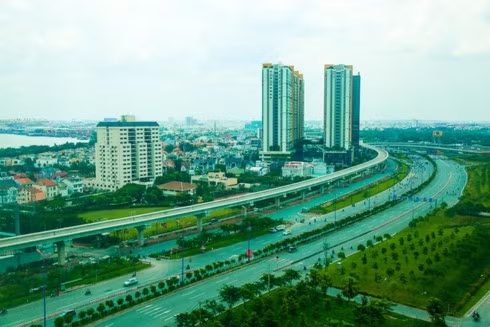
Under Siemens’ Metro Line 2 study, the 10.2-kilometre metro line will run mostly underground, beneath the busiest parts of the city and potentially handle two million passengers a day.
Siemens has worked on metro systems throughout the world, including Singapore, where Siemens’ signalling and electrification systems have been used.
Not only Keximbank and Siemens, but also Lotte Engineering & Construction Co., Ltd. a subsidiary of the fifth-biggest corporation in South Korea, Lotte Group, is venturing further into the Vietnam transport infrastructure segment, with metro lines in Hanoi and Ho Chi Minh City among the focuses of operation expansion.
Lotte E&C is also interested in the North-South Expressway, the North-South High-Speed Railway, Long Thanh International Airport.
"We want to invest in sustainable, long-term projects in Vietnam," a Lotte spokesperson for overseas investment projects noted.
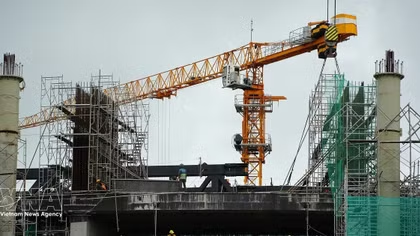
Vietnam has maintained robust growth, outperforming other Southeast Asian economies. Its ongoing government reforms aimed at streamlining the state apparatus, promoting the private sector, improving the institutional framework and developing capital markets will strengthen the country’s growth potential and economic resilience.
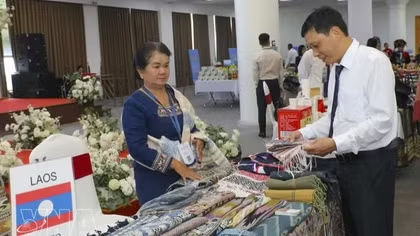
Vietnam and Laos aim to boost bilateral trade in 2026 towards the milestone of 10 billion USD by 2030, a target said to be challenging but feasible as both Governments work to remove trade barriers, improve border-trade mechanisms, and strengthen transport and logistics connectivity.

Deputy Minister of Industry and Trade Luong Hoang Thai outlined Vietnam's National Brand Programme 's achievements, the role of business community and plans for brand development in a press interview ahead of the 10th Vietnam National Brand Product recognition ceremony on October 16.
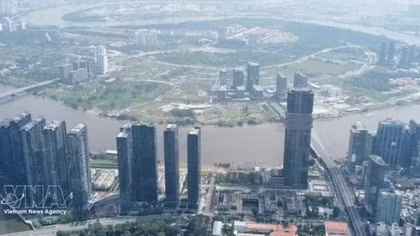
Under the decision, Vietnam aims to become a developing country with modern industry and upper-middle income by 2030, while building a competitive and effective governance system and a dynamic economy driven by science, technology, innovation and digital transformation.
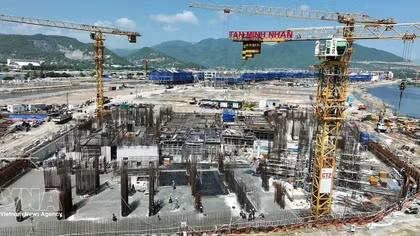
In the first nine months, Vietnam's GDP was estimated to increase 9.01% from the same period last year. Agriculture, forestry and fisheries grew 4.02%, contributing 5.35% to overall gross value added growth; industry and construction rose 11.21%, contributing 49.62%; and services expanded 8.69%, contributing 45.03%.
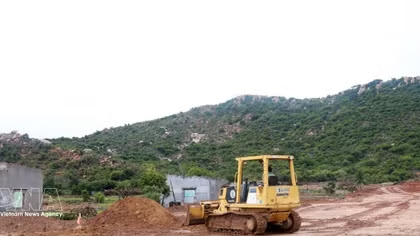
Decision No. 1012/QD-TTg on training and developing human resources for nuclear power development sets a requirement for around 1,920 personnel for the Ninh Thuan 1 nuclear power plant and around 1,980 for Ninh Thuan 2 by 2033 and 2035.
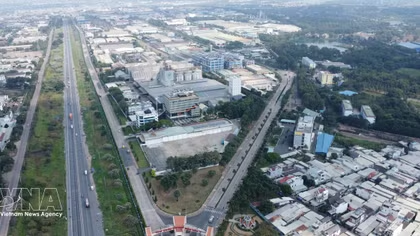
Vietnam recorded nearly 149,700 newly established enterprises in the first nine months of 2026, up 3.2% year-on-year, with total registered capital rising 32.7% to over 1.88 quadrillion VND (71.6 billion USD).

Under Document No. 10065/VPCP-KGVX, the Deputy PM agreed with proposals by the Ministry of Home Affairs for a one-day holiday for Vietnamese Culture Day in 2026, and a seven-day Tet holiday and a four-day National Day holiday in 2027.
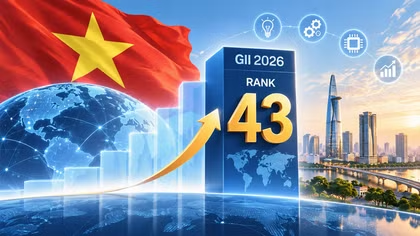
By 2030, Vietnam aims to rank among the world’s top 40 in the GII; raise total social investment in R&D to at least 2% of GDP, with non-State funding accounting for over 60%; increase international scientific publications by an average of 10% annually; and raise the number of patent applications and granted patents by an average of 16-18% annually.
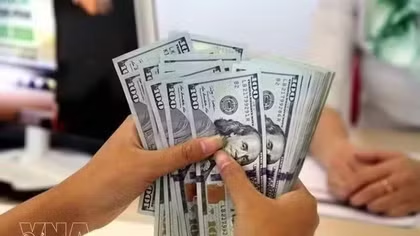
The State Bank of Vietnam set the daily reference exchange rate at 25,624 VND/USD on October1, down 3 VND from the previous day.
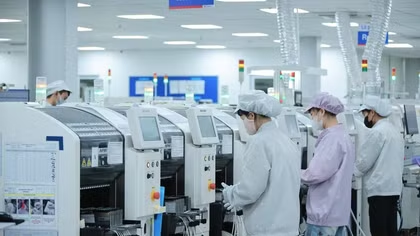
Quang Ninh's GRDP grew 15.04% in the third quarter, also leading the country.
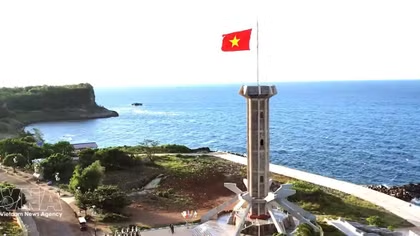
Vietnam needs flexible incentives and specialised green financial instruments, stronger inter-sectoral coordination, improved local governance capacity and a more complete MRV data system, said Ramla Khalidi, Resident Representative of the United Nations Development Programme (UNDP) in Vietnam.
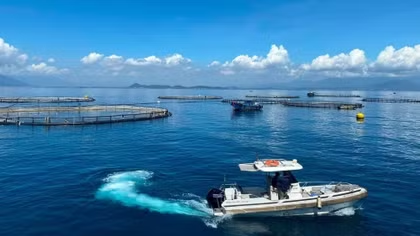
As the country enters a new development phase with greater demands for stronger marine-economy growth, institutional bottlenecks have emerged and need to be addressed.
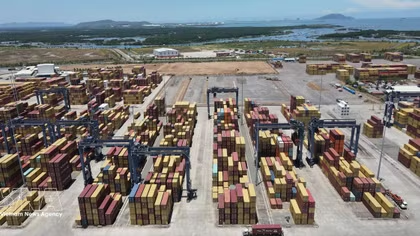
Experts from the Institute of Vietnam and World Economy under the Vietnam Academy of Social Sciences noted the quality of recent growth as the high growth rate has been recorded against an increasingly higher comparative base.

Vietnam's Halal exports remain modest at around 900 million USD a year, accounting for less than 1% of the global market. Most exports are still raw agricultural and seafood products. Only around 1,000–1,300 Vietnamese businesses obtained or maintained Halal certification during 2024–2026.
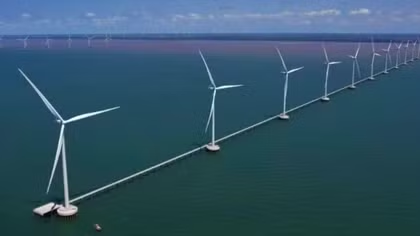
Vietnam needs a comprehensive policy framework to remove legal and procedural bottlenecks and create conditions for offshore wind power projects to access long-term investment capital, helping to unlock the country’s substantial offshore wind potential, said insiders.
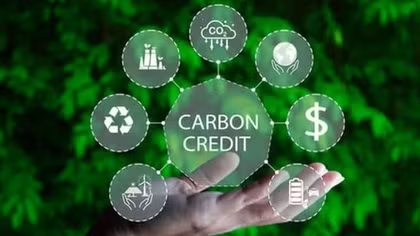
Under a decision of the municipal People’s Committee on establishing an inter-agency working group, departments and agencies are responsible for identifying facilities subject to greenhouse gas inventories, developing emissions-reduction plans and studying projects capable of generating carbon credits.
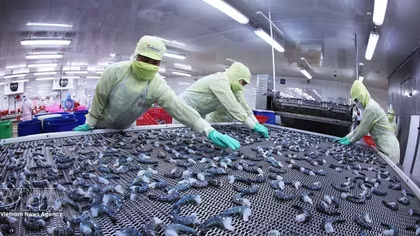
According to data from the Vietnam Customs cited by the Vietnam Association of Seafood Exporters and Producers (VASEP), shrimp exports reached 478.5 million USD in August, up 4.2% from the same month last year. The eight-month total stood at 3.3 billion USD, representing a year-on-year increase of 12%.
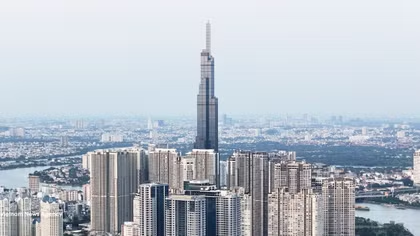
Vietnam is seen as a potential market, with considerable room for growth in real estate, particularly commercial property, compared with some regional markets. Strong Vietnam-Russia ties and opportunities to establish foreign-invested enterprises are also considered favourable for Russian investors.
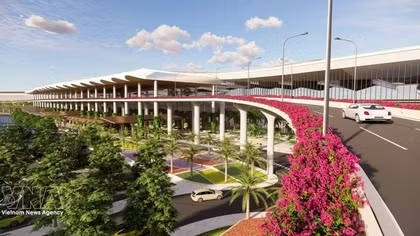
For 2021-2030, the Civil Aviation Authority of Vietnam proposed bringing forward the investment in a parallel taxiway system and a connecting taxiway north of Runway No. 2 at Phu Quoc International Airport, in order to connect with the aircraft maintenance and repair facility (hangar) planned for the northern area of the airport.