French court to hold hearing on AO lawsuit

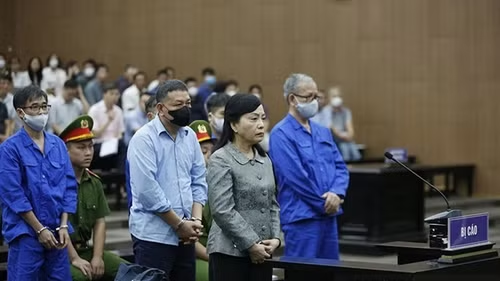
A French court will open a hearing on a lawsuit filed by Vietnamese-French Tran Thi To Nga against 14 multinational companies for producing and selling chemical toxins that was sprayed by the US army in the war in Vietnam, causing serious consequences for the community, her children and herself.

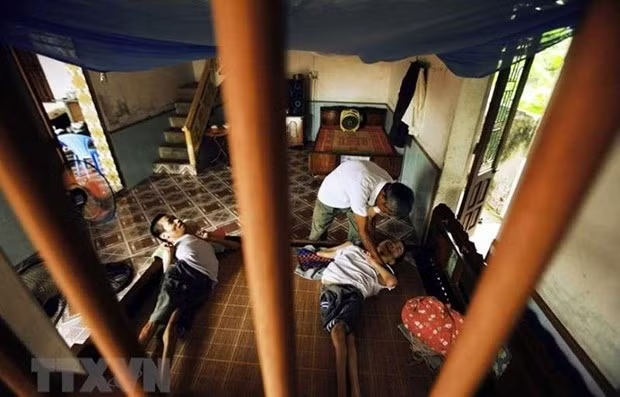
Mr. Lai Van Bien in Vu Thu district, Thai Binh province are caring for his sons affected by Agent Orange (AO)/Dioxin (Photo: VNA)

Mr. Lai Van Bien in Vu Thu district, Thai Binh province are caring for his sons affected by Agent Orange (AO)/Dioxin (Photo: VNA)

A French court will open a hearing on a lawsuit filed by Vietnamese-French Tran Thi To Nga against 14 multinational companies for producing and selling chemical toxins that was sprayed by the US army in the war in Vietnam, causing serious consequences for the community, her children and herself.

Nga, born in 1942, filed the lawsuit in May 2014. Among the companies named in her suit, there were such names as Monsanto (now under the German group Bayer) and Dow Chemical.

With the support of several non-governmental organizations, Nga accused the companies of causing lasting harm to the health of her, her children and countless others, as well as destroying the environment.

"I am fighting for not only myself, but also my children and millions of victims”, Nga stated.

Tran To Nga graduated from a Hanoi university in 1966 and became a war correspondent of the Liberation News Agency, now the Vietnam News Agency. She worked in some of the most heavily AO/Dioxin affected areas in southern Vietnam such as Cu Chi, Ben Cat and along the Ho Chi Minh Trail, ultimately experiencing contamination effects herself.

Among her three children, the first child died of heart defects and the second suffers from a blood disease.

In 2009, Nga, who contracted a number of acute diseases, appeared as a witness at the Court of Public Opinion in Paris, France against the US chemical companies.

On April 16, 2015, the Crown Court of Evry city in the suburb of Paris held the first hearing on the case, but since then, lawyers of the sued chemical companies tried every way to prolong the procedures.

As scheduled, the trial was supposed to be opened in October 2020, but it was postponed due to the COVID-19 pandemic.

From 1961-1971, US troops sprayed more than 80 million liters of herbicides—44 million liters of which were AO, containing nearly 370 kilograms of dioxin—over southern Vietnam.

As a result, around 4.8 million Vietnamese were exposed to the toxic chemical. Many of the victims have died, while millions of their descendants are living with deformities and diseases as a direct result of the chemical’s effects.
VNA

Other News

Hanoi ready to implement Capital Law 2026, unlocking new development momentum

Hanoi ready to implement Capital Law 2026, unlocking new development momentum

The effectiveness of the Capital Law 2026 will be measured not by the number of legal documents issued but by tangible improvements in governance and public administration, better services for people and businesses, faster administrative procedures, stronger investment attraction and higher economic growth.

Vietnamese students earn honours at ROBOG Asia Cup 2026

Vietnamese students earn honours at ROBOG Asia Cup 2026

Three teams from Chu Van An Secondary School in Vietnam’s Thai Nguyen province have earned First Prize honours and advanced to the quarterfinals at the ROBOG Asia Cup 2026, a regional robotics and artificial intelligence (AI) competition for students held in Hong Kong, China.

Hanoi sets out new investment blueprint with century-long development vision

Hanoi sets out new investment blueprint with century-long development vision

As of early June, Hanoi had attracted 74.6 billion USD in foreign direct investment (FDI) through more than 9,250 valid projects. FDI inflows in the first six months were projected at 3.2 billion USD, surpassing the annual target by 116%, while nearly 16,000 new businesses were established in the first five months, up 34.4% year-on-year.

Vietnam promotes legal cooperation and rule of law at global forum

Vietnam promotes legal cooperation and rule of law at global forum

Vietnam’s development and international integration have gone hand in hand with the improvement of its legal system, the incorporation of international commitments into domestic legislation, and legal reforms aimed at fostering development, openness and global integration. The country regards international law as an essential instrument for building fair, mutually beneficial relations among nations.

Hanoi to hold investment promotion event on June 29

Hanoi to hold investment promotion event on June 29

At the event, Hanoi authorities plan to grant investment policy decisions and investment registration certificates to 20 exemplary projects in the fields of transportation infrastructure, industrial parks, urban development, social housing, environment, science and technology, and foreign investment attraction.

Hanoi's Red River urban area development draws widespread attention

Hanoi's Red River urban area development draws widespread attention

Located south of the Red River and extending from the historic inner city to newly developing areas in the south and the west, the central urban area along Red River’s right bank covers approximately 45,317 hectares and is projected to accommodate around 6.365 million residents by 2045 and 6.455 million by 2065.

Hanoi's Red River urban area development draws widespread attention

Hanoi's Red River urban area development draws widespread attention

Located south of the Red River and extending from the historic inner city to newly developing areas in the south and the west, the central urban area along Red River’s right bank covers approximately 45,317 hectares and is projected to accommodate around 6.365 million residents by 2045 and 6.455 million by 2065.

Regional cooperation strengthened to combat cross-border drug crime

Regional cooperation strengthened to combat cross-border drug crime

Vietnam, China, Laos and Myanmar face common challenges as drug syndicates increasingly exploit the Mekong River, cross-border transport networks, e-commerce platforms, international logistics services, cyberspace and cryptocurrencies to organise drug transactions and smuggling operations.