 |
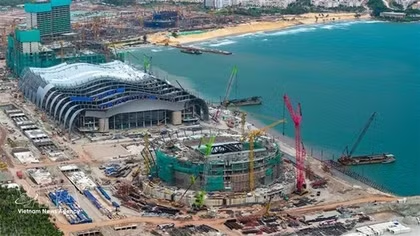
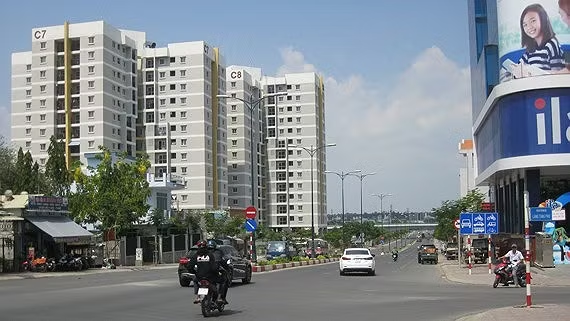
It is a step to pave the way for implementation of creative urban planning project in districts 2, 9 and Thu Duc where cover an area of 21,000 hectare and estimated population of nearly one million in the future.
As per the city’s general development strategy, the city will expand to four directions in the South, the North, the East and the West; however, it seemed that city authorities focus on infrastructure in the Eastern gateway more.
So far, major infrastructure constructions have been inplementing such as expansion project of Hanoi highway, Vo Van Kiet boulevard, Sai Gon tunnel, the ring belt road No.2, Pham Van Dong boulevard, the Ho Chi Minh City-Long Thanh-Dau Giay Expressway, the metro No.1 and the new Mien Dong Bus Station.
The municipal Department of Transport said that it will step up major traffic infrastructure constructions in 2018 to tackle the congestions and create a close urban traffic system in the city.
Major construction projects in the East will be on the top priority including building a road running parallel to HCMC-Long Thanh – Dau Giay Expressway on either direction; the ring belt No.2 from Phu Huu bridge to Go Dua intersection of Go Dua, My Thuy, An Phu, Thu Thiem bridge No.2; four roads surrounding Thu Thiem new urban; another intersection at My thuy to ease traffic jam for Cat Lai port.
Along with this, the bridge construction project through Kim Cuong island worth VND500 billion ($2.2 million) is to help connect Thanh My Loi in Cat lai port in district 2 with the metropolis area and scheduled to open in the yearend.
For the period 2018-2020, the Department of Transport will continue implementing expansion to the East such as widening Nguyen Duy Trinh street, constructing a path connecting Phu Huu bridge to Hanoi Highway; a connection path from Cat Lai port to the ring Belt No.2 as well as improving the Nguyen Thi Dinh street from Giong Ong To bridge to My Thuy bridge.
Transport Department director Bui Xuan Cuong said that from the beginning of 2018, the Department has beefed up investment formalities in order to start 22 new flyovers projects. Of these, the department will prioritize the ring belt No.2; Ben Luc –Long Thanh highway; the highway No.1; the road connecting HCMC and neighboring provinces in an effort to finish the city’s Eastern gateway with other provinces to facilitate travelling.
The city’s railway management board said that the construction of the Number 1 urban railway from Ben Thanh in district 1 to Suoi Tien in district 9 which is expected to be completed in this year will connect districts 1, Binh Thanh, with districts 2, 9 and thu Duc by 2020 even the southern provinces of Dong Nai and Binh Duong.
Additionally, the railway No.3b starting from the Cong Hoa intersection – Nguyen Thi Minh Khai- Xo Viet Nghe Tinh – the highway No.13 – Hiep Binh Phuoc will be formed in the future. The railway has the length of over 12 kilometer with ten stations. The railway cost is estimated around $1.87 billion.
The management board said that the railway is expected to connect with Thu Dau Mot town in the southern province of Binh Duong and the province’s railway No. 1. The project has been put in the list of projects used Japan’s official development assistance (ODA) in the period 2016 – 2018. At present, its design and landmark document are managed by local administration.
Lately, HCMC Party Chief Nguyen Thien Nhan wanted to build creative urban area connecting with three districts in the East into one, striving to pushing the creative movement amongst local young people. District 2 will be financial hub in the future with Thu Thiem new urban will develop technology especially hi-technology while Thu Duc district will become location of most universities.
Deputy Chairman of People’s Committee Tran Vinh Tuyen said that the aim of the creative urban is to develop the city’s economic situation in right direction as well as it will be scientific and administrative hub where will attract domestic and foreign investment projects.
In the future, the startups’ creative ideas of the urban will be put into practice to turn the city into a smart city with smart traffic system.
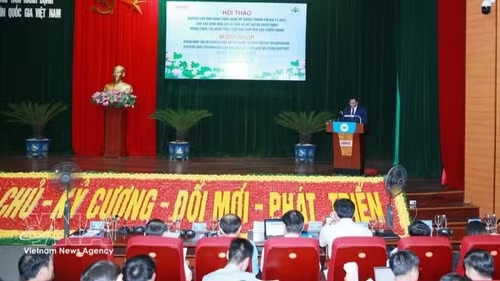
It is scheduled that in the next time, the city will convene a meeting to listen to experts’ opinions on planning and building creative urban.
Architect Ngo Viet Nam Son, an expert of urban traffic infrastructure, advised authorities to focus on building ring belt roads and paths through the city to form a traffic system in the South as well as pushing up railway construction projects, metro, and expanding ports, especially Cat Lai port.