Hundreds of foreigners apply for e-visas

As many as 490 foreigners have registered for electronic visas to enter Vietnam, 210 of whom have been issued with their visas, after the first week of the e-visa pilot scheme, the Ministry of Public Security’s Department of Immigration has said.

Major General Le Xuan Vien, head of the department, said that decree 07/2017/ND-CP, which allowed visitors from 40 countries to apply and receive Vietnamese visas online, took effect earlier this month.

Foreigners could apply for visas and pay fees through the website. The process takes only three days for an e-visa valid for 30 days without requiring letters of guarantee or invitation.
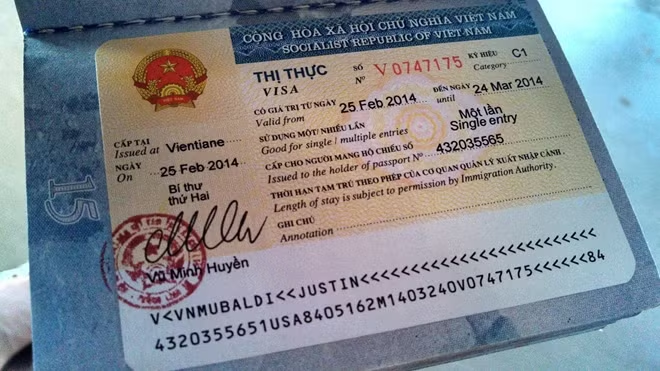
Hundreds of foreigners apply for e-visas.

The first foreigner to receive an e-visa was a British tourist. Britain was among the countries subject to visa exemption for stays of less than 15 days in Vietnam, he added.

Vien said the move was an effort by the Government to boost socio-economic development, making it more convenient for foreigners to enter the country without being guaranteed by certain organisations or individuals.

It also aimed to contribute to the development of the tourism industry, which hopes to attract between 15 and 20 million tourists in the next two years.

Foreigners can apply for e-visas via https://www.immigration.gov.vn.

Visitors from the following 40 countries can apply for Vietnam’s e-visas during the course of the pilot programme: Azerbaijan, Argentina, Armenia, Ireland, Poland, Belarus, Bulgaria, Brunei, the Republic of  Korea, Germany, Chile, Colombia, the Czech Republic, Cuba, Denmark, Timor Leste, the US, Hungary, Greece, Italy, Kazakhstan, Russia, the UK, Luxembourg, Myanmar, Mongolia, Japan, Panama, Peru, Finland, France, the Philippines, Romania, Spain, Sweden, China (not applicable for Chinese e-passport holders), Uruguay, Venezuela, Norway, and Slovakia.

Currently, about 30 nations issue e-visas. The Vietnamese procedures seem to be simpler than most other nations, as foreigners did not have to be fingerprinted, photographed, or interviewed, Vien said.

Visitors could conduct temporary residence declarations online when travelling with e-visas.

"E-visas can be accepted at most international airports and 28 border gates in Vietnam," he said.

In reply to questions on the management of e-visa holders, Vien said the issuance of e-visas only simplifies procedures for foreigners. The process of approving visas remained the same as before.

So far, the Vietnamese Government has signed more than 80 agreements on visa exemption for 13 nations, including Russia, Denmark, the Republic of Korea, Japan, Norway, Sweden, Finland, Belarus, Britain, France, Spain and Italy.


VNA

Other News

Hanoi ready to implement Capital Law 2026, unlocking new development momentum

Hanoi ready to implement Capital Law 2026, unlocking new development momentum

The effectiveness of the Capital Law 2026 will be measured not by the number of legal documents issued but by tangible improvements in governance and public administration, better services for people and businesses, faster administrative procedures, stronger investment attraction and higher economic growth.

Vietnamese students earn honours at ROBOG Asia Cup 2026

Vietnamese students earn honours at ROBOG Asia Cup 2026

Three teams from Chu Van An Secondary School in Vietnam’s Thai Nguyen province have earned First Prize honours and advanced to the quarterfinals at the ROBOG Asia Cup 2026, a regional robotics and artificial intelligence (AI) competition for students held in Hong Kong, China.

Hanoi sets out new investment blueprint with century-long development vision

Hanoi sets out new investment blueprint with century-long development vision

As of early June, Hanoi had attracted 74.6 billion USD in foreign direct investment (FDI) through more than 9,250 valid projects. FDI inflows in the first six months were projected at 3.2 billion USD, surpassing the annual target by 116%, while nearly 16,000 new businesses were established in the first five months, up 34.4% year-on-year.

Vietnam promotes legal cooperation and rule of law at global forum

Vietnam promotes legal cooperation and rule of law at global forum

Vietnam’s development and international integration have gone hand in hand with the improvement of its legal system, the incorporation of international commitments into domestic legislation, and legal reforms aimed at fostering development, openness and global integration. The country regards international law as an essential instrument for building fair, mutually beneficial relations among nations.

Hanoi to hold investment promotion event on June 29

Hanoi to hold investment promotion event on June 29

At the event, Hanoi authorities plan to grant investment policy decisions and investment registration certificates to 20 exemplary projects in the fields of transportation infrastructure, industrial parks, urban development, social housing, environment, science and technology, and foreign investment attraction.

Hanoi's Red River urban area development draws widespread attention

Hanoi's Red River urban area development draws widespread attention

Located south of the Red River and extending from the historic inner city to newly developing areas in the south and the west, the central urban area along Red River’s right bank covers approximately 45,317 hectares and is projected to accommodate around 6.365 million residents by 2045 and 6.455 million by 2065.

Hanoi's Red River urban area development draws widespread attention

Hanoi's Red River urban area development draws widespread attention

Located south of the Red River and extending from the historic inner city to newly developing areas in the south and the west, the central urban area along Red River’s right bank covers approximately 45,317 hectares and is projected to accommodate around 6.365 million residents by 2045 and 6.455 million by 2065.

Regional cooperation strengthened to combat cross-border drug crime

Regional cooperation strengthened to combat cross-border drug crime

Vietnam, China, Laos and Myanmar face common challenges as drug syndicates increasingly exploit the Mekong River, cross-border transport networks, e-commerce platforms, international logistics services, cyberspace and cryptocurrencies to organise drug transactions and smuggling operations.