Lang Son establishes clubs to preserve Then singing

Lang Son province has encouraged the establishment of local Then singing clubs to promote the development of this genre of traditional singing – a typical culture of Tay, Nung and Thai ethnic people in the northern mountainous region.
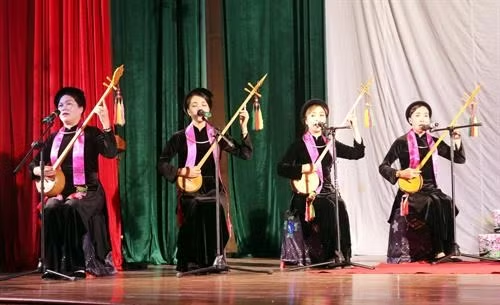
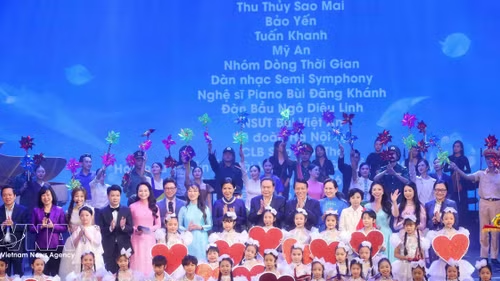
Lang Son artists in Then singing performance (Source: VNA)

Lang Son artists in Then singing performance (Source: VNA)

Head of the provincial traditional singing and musical instrument club Trieu Thuy Tien said that the establishment of these clubs is a practical movement to help preserve and promote the value of Then singing, which is always accompanied by a handmade gourd lute called “Dan tinh” or “Tinh Tau”, in the locality.

Since its formation in 2009, the club has attracted over 300 members. The birth of the club has motivated the establishment of other Then singing clubs in Lang Son’s districts.

According to the provincial Department of Culture, Sports and Tourism, the province is home to 65 clubs with around 1,400 members.

Hoang Thi Thuy, member of Noc Kham Khac club in Na Sam town, Van Lang district, said that after nearly 5 years, her club now has 26 members who love Then singing and Dan Tinh at all age groups, from 10 to 78 years old.

Thuy expressed her hope that local authorities will organise more exchange programmes for clubs in order to offer amateur artists chances to meet and share experience.

To preserve and promote the value of this genre of singing, Tien stressed the need to maintain Tay and Nung languages in Then songs.

For Tay, Nung and Thai people, Then singing is an indispensable part of their religious and spiritual lives, even back when the art was on the brink of falling into oblivion.

According to researchers, the word “Then” originates from “Thien”, which means sky or heaven. Therefore, Then singing is regarded as a tune of the Gods by local ethnic people.

Music theorist Nguyen Thi Minh Chau from the Vietnam Association of Composers said Then was created by Tay, Nung and Thai ethnic groups.

Then is considered a spiritual product reflecting the social and cultural life of people with a special combination of literature, music and dance, she said.

Those practicing Then are labourers who understand local customs and carry out important rituals for communities and individuals in important periods of life. Thereby, Then is believed to derive from the working life of people, she added.

The most important figures in a Then singing performance are “Ong Then” and “Ba Then” who can sing, dance and play a musical instrument at the same time during rituals while presenting offerings to God, helping the ethnic community to ask for good health, bumper crops, happiness and a long life.

Then singing is practised in many northern provinces, including Cao Bang, Bac Kan, Thai Nguyen, Lang Son, Ha Giang, Quang Ninh, Son La, Lai Chau, Lao Cai, Bac Giang and Yen Bai, and the Central Highlands province of Dak Lak. 

There are two types of Then singing: Then Ky Yen (praying for good things) and Then Le Hoi (Then festival). The first is performed at rituals while the latter is to bring cheer and drive away sorrow and hardships in life and is normally used in rituals to pray for good crops, enter a new home, or cap sac (coming-of-age). 

The sixth edition of the National Festival of Traditional Then singing will take place on May 12-14 in the northern mountainous province of Ha Giang, as part of national culture, sports and tourism activities to honour, preserve and develop this traditional art form.

Art troupes from 14 provinces and cities where many Tay, Nung and Thai ethnic people reside such as Cao Bang, Ha Giang, Tuyen Quang, Bac Kan, Lang Son, Thai Nguyen, Bac Giang, Quang Ninh, Yen Bai, Lao Cai, Son La, Dien Bien, Lai Chau and Dak Lak, will perform different types of Then singing.

A series of events will be held during the festival such as performances of Then singing, a photo exhibition on Then cultural heritage and introduction of traditional weaving of Tay, Nung and Thai ethnic groups. Ha Giang – the host of the event will also take this occasion to organise activities to promote its tourism.

Last year, the Ministry of Culture, Sports and Tourism signed a dossier on Then singing for submission to UNESCO asking for the recognition of this art form as part of world intangible cultural heritage.

VNA

Other News

Vietnam secure berth at FIFA U17 World Cup 2026 for first time

Vietnam secure berth at FIFA U17 World Cup 2026 for first time

Vietnam national U17 football team secured a place at the FIFA U17 World Cup 2026 for the first time after defeating United Arab Emirates national U17 football team 3-2 on in the final Group C match of the AFC U17 Asian Cup 2026 in Saudi Arabia on early May 14 (Vietnam time).

Vietnam’s most beautiful railway station twins with French counterpart

Vietnam’s most beautiful railway station twins with French counterpart

A twinning agreement between Da Lat Railway Station in Vietnam and Trouville-Deauville Railway Station in France was signed at the French Embassy in Vietnam on May 7, creating new opportunities for cooperation in station management and operations, as well as cultural and tourism promotion between the two sides.

Hanoi gains two more craft villages in World Crafts Cities network

Hanoi gains two more craft villages in World Crafts Cities network

The recognition of Chuyen My and Son Dong craft villages as members of the World Crafts Cities network represents international acknowledgement of the cultural value, artisanal techniques, creativity and sustainable vitality of Vietnam’s traditional craft villages, he said.

Thang Long - Hanoi Festival 2026 to return in September

Thang Long - Hanoi Festival 2026 to return in September

Co-hosted by the municipal People’s Committee, the Department of Culture and Sports, and domestic and foreign agencies, the whole spectacle is meant to honour the city’s millennia-old heritage while reafffirming its strategy of establishing culture as a development engine.

Spreading Vietnamese cultural identity in digital space

Spreading Vietnamese cultural identity in digital space

In the context of deep international integration, cultural identity serves as both a “shield” against assimilation and a defining marker of a nation’s image. Protecting and promoting uniquely Vietnamese cultural values has therefore become a pressing task, particularly in an increasingly complex digital environment.

ITE HCMC 2026 to promote Vietnam’s tourism on global map

ITE HCMC 2026 to promote Vietnam’s tourism on global map

With its large scale, the ITE HCMC 2026 aims to promote tourism cooperation between Vietnam and priority markets such as Northeast Asia, Western Europe, North America, Southeast Asia, and Oceania while also boosting visitor arrivals from the Indian market

Vietnamese puppetry seeks renewal amid preservation challenges

Vietnamese puppetry seeks renewal amid preservation challenges

Although widely regarded as a cultural “speciality” attracting tourists, Vietnamese puppetry is facing multiple challenges in preservation and development, requiring renewed efforts to both safeguard its identity and adapt to contemporary cultural currents.

Project on digital transformation in cultural sector approved

Project on digital transformation in cultural sector approved

By 2030, the project targets the establishment of shared digital platforms across 100% of cultural sectors. All digitised cultural heritage will be standardised under the national data framework and shared in accordance with regulations, while 80% of public digital heritage assets are expected to receive digital identifiers to clarify ownership and management, encouraging organisations and individuals to do the same and support market development.

Vietnam eyes becoming region’s leading tourism destination

Vietnam eyes becoming region’s leading tourism destination

Vietnam has in recent years undergone a notable transformation in its tourism development strategy, placing a strong emphasis on nature-based and eco-tourism. This shift is not merely aligned with global trends, but represents a necessary step towards safeguarding valuable natural resources, while appealing to a growing segment of environmentally conscious travellers.