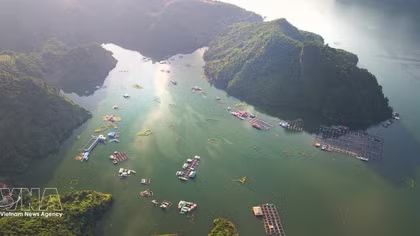
Mekong Delta looks to promote tourism

Localities in the western region of the Mekong Delta need to foster regional cooperation to create highly competitive tourism products, officials have said.

The western region of the Mekong Delta comprises Can Tho City and the six provinces of Bac Lieu, Ca Mau, Soc Trang, An Giang, Hau Giang and Kien Giang.

In the first six months of the year, the number of tourist arrivals to the region rose by 11% to reach 17.8 million, accounting for more than 76% of total tourist arrivals to the Mekong Delta region.

Tourism revenue was estimated at VND10.4 trillion (US$452.1 million), a year-on-year increase of more than 33%.

Tran Hieu Hung, Director of Ca Mau province’s Department of Culture, Sports and Tourism, said the tourism cooperation programme in the western cluster failed to bring expected outcomes due to an overlap in tourism products and uninteresting inter-regional tour packages.
Under the programme, the seven localities pledge to cooperate in marketing and promotion activities, new tourism products, unique inter-regional tour packages, human resource training, and international and national tourism events.

But the tourism potential in these localities has yet to be fully realised due to loose regional linkages in development of new tourism products and an overlap in tourism products, poor infrastructure and services, as well as ineffective and insufficient marketing.

Bui Quoc Thai, Deputy Director of Kien Giang province’s Department of Tourism, said localities in the Mekong Delta region were seeking unique tourism products.

The Mekong Delta region is well known for its waterway landscape, rice paddy fields, and verdant orchards, but localities do not invest in innovative and attractive models, resulting in similar tourism products, Thai said.

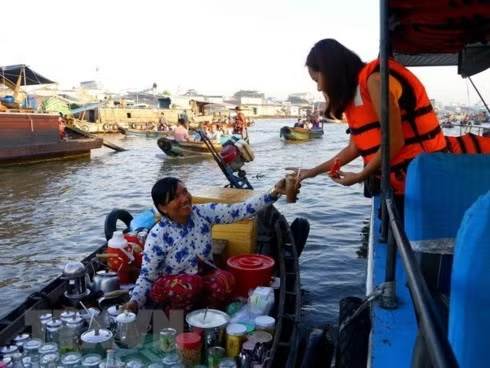
Floating markets, Don ca tai tu (southern amateur music) and food, for example, are designed for all kinds of tours. As a result, travellers just visit one place in the region.

Pham The Trieu, Deputy Director of An Giang province’s Department of Culture, Sports and Tourism, said tourism human resources lacked skills in communication, foreign languages, and professional and management skills.

Although tourism infrastructure and lodging facilities in the region have developed rapidly to meet the rising demand, most are small scale, Trieu said.

There is also a lack of high-end facilities and services operated by famous brands, he said.

Tourism experts said the linkages in tourism products aim to give diverse experiences and attractive itineraries to tourists.

Du To Tuan, Director of Vietravel’s Bac Lieu province branch, said that localities should take into consideration the demand of different age groups and incomes as well as specific market segments such as local and inbound tourists to develop tourism products and marketing strategies.

Tourism products for inbound visitors should focus on ecotourism tours, cultural and craft villages, local lifestyles and festivals.

Spiritual tourism is mostly favoured by local tourists, he said.

Cao Tan Dung, Deputy Director of Fiditour’s Can Tho city branch, said a tourism product should be well organised to satisfy demands during the entire trip, from restaurants, accommodations to destinations.

Can Tho city and Phu Quoc island in Kien Giang province, as the region’s tourism hubs, should play a driving force for the tourism industry of the entire region, Dung said.

Under the master plan for tourism development in the Mekong River Delta region, the western cluster in the Mekong Delta will focus on unique tourism products such as the Ca Mau Cape, sea and island leisure tourism, eco-tourism, and cultural tourism.

The plan targets developing three destinations in the cluster, including Phu Quoc island in Kien Giang province, Ca Mau Cape tourism area in the country’s southernmost province of Ca Mau, and Sam Mountain in An Giang province.

It also focuses on the development of four national tourist sites, including Ong Ho islet in An Giang province, Don ca tai tu and musician Cao Van Lau memorial house in Bac Lieu province, Ninh Kieu wharf in Can Tho city and Ha Tien town in Kien Giang province.

VNA

Other News

Vietnam secure berth at FIFA U17 World Cup 2026 for first time

Vietnam secure berth at FIFA U17 World Cup 2026 for first time

Vietnam national U17 football team secured a place at the FIFA U17 World Cup 2026 for the first time after defeating United Arab Emirates national U17 football team 3-2 on in the final Group C match of the AFC U17 Asian Cup 2026 in Saudi Arabia on early May 14 (Vietnam time).

Vietnam’s most beautiful railway station twins with French counterpart

Vietnam’s most beautiful railway station twins with French counterpart

A twinning agreement between Da Lat Railway Station in Vietnam and Trouville-Deauville Railway Station in France was signed at the French Embassy in Vietnam on May 7, creating new opportunities for cooperation in station management and operations, as well as cultural and tourism promotion between the two sides.

Hanoi gains two more craft villages in World Crafts Cities network

Hanoi gains two more craft villages in World Crafts Cities network

The recognition of Chuyen My and Son Dong craft villages as members of the World Crafts Cities network represents international acknowledgement of the cultural value, artisanal techniques, creativity and sustainable vitality of Vietnam’s traditional craft villages, he said.

Thang Long - Hanoi Festival 2026 to return in September

Thang Long - Hanoi Festival 2026 to return in September

Co-hosted by the municipal People’s Committee, the Department of Culture and Sports, and domestic and foreign agencies, the whole spectacle is meant to honour the city’s millennia-old heritage while reafffirming its strategy of establishing culture as a development engine.

Spreading Vietnamese cultural identity in digital space

Spreading Vietnamese cultural identity in digital space

In the context of deep international integration, cultural identity serves as both a “shield” against assimilation and a defining marker of a nation’s image. Protecting and promoting uniquely Vietnamese cultural values has therefore become a pressing task, particularly in an increasingly complex digital environment.

ITE HCMC 2026 to promote Vietnam’s tourism on global map

ITE HCMC 2026 to promote Vietnam’s tourism on global map

With its large scale, the ITE HCMC 2026 aims to promote tourism cooperation between Vietnam and priority markets such as Northeast Asia, Western Europe, North America, Southeast Asia, and Oceania while also boosting visitor arrivals from the Indian market

Vietnamese puppetry seeks renewal amid preservation challenges

Vietnamese puppetry seeks renewal amid preservation challenges

Although widely regarded as a cultural “speciality” attracting tourists, Vietnamese puppetry is facing multiple challenges in preservation and development, requiring renewed efforts to both safeguard its identity and adapt to contemporary cultural currents.

Project on digital transformation in cultural sector approved

Project on digital transformation in cultural sector approved

By 2030, the project targets the establishment of shared digital platforms across 100% of cultural sectors. All digitised cultural heritage will be standardised under the national data framework and shared in accordance with regulations, while 80% of public digital heritage assets are expected to receive digital identifiers to clarify ownership and management, encouraging organisations and individuals to do the same and support market development.

Vietnam eyes becoming region’s leading tourism destination

Vietnam eyes becoming region’s leading tourism destination

Vietnam has in recent years undergone a notable transformation in its tourism development strategy, placing a strong emphasis on nature-based and eco-tourism. This shift is not merely aligned with global trends, but represents a necessary step towards safeguarding valuable natural resources, while appealing to a growing segment of environmentally conscious travellers.