Non Nuoc Pagoda – an architectural masterpiece in a Hanoi suburb

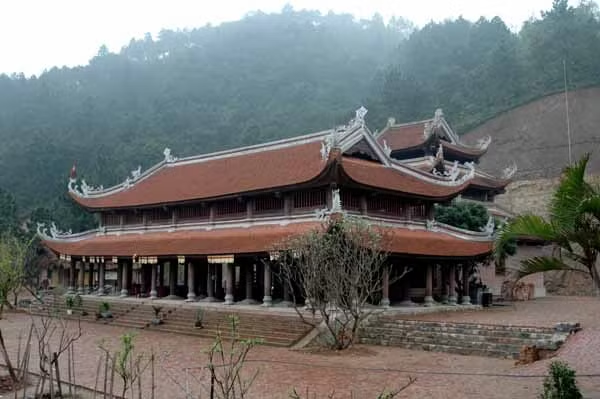
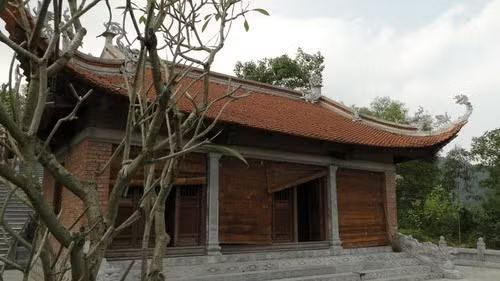
Located in Ve Tinh commune, Soc Son district, Hanoi, as part of the Soc temple complex, Non Nuoc pagoda and Vietnam Buddhist Academy are part of a monumental architectural work that has been in use for seven years. It is also a spiritual tourism address, increasingly attracting pilgrims.

According to legend, after defeating the An enemy on the road coming back to Soc mountain, Giong Saint stopped here and bathed in West lake. 

When on the road, the Giong Saint forgot the iron rod broken in battle, whereupon residents built a temple to worship him.
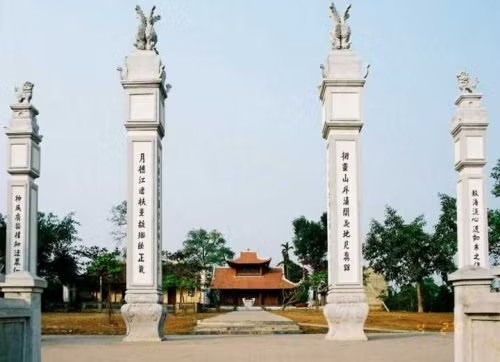
The ancient documentation of the temple said that the master monk was Ngo Chan Luu (933 – 1011) fourth generation of Vo Ngon Thong Zen. In 971, Khuong Viet was Grand Master granted by the king Dinh Tien Hoang. 

By the end of the Ly dynasty, the temple had two monks: Abbot Nguyen Truong (1110 – 1165) and Abbot Nguyen Hoc- 10th generation of Vo Ngon Thong sect.

The Non Nuoc pagoda is located in Soc temple complex 110 meters high. 

The pagoda is placed in the middle of a "mountain" like a person sitting on a throne, looking down towards the blue lake and thriving villages of Ve Linh commune, Soc Son district, Hanoi.

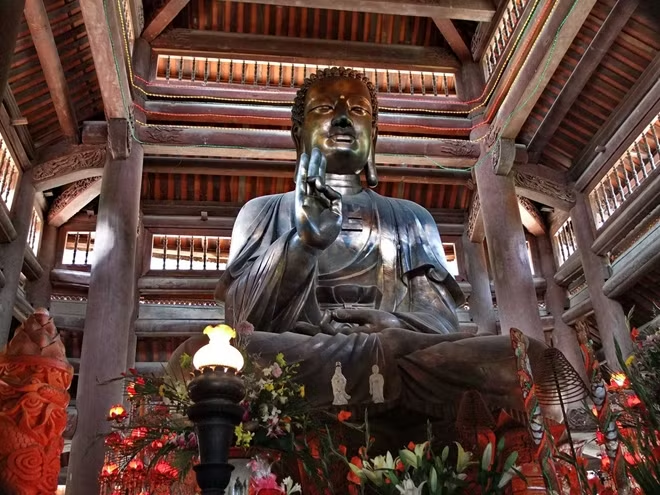
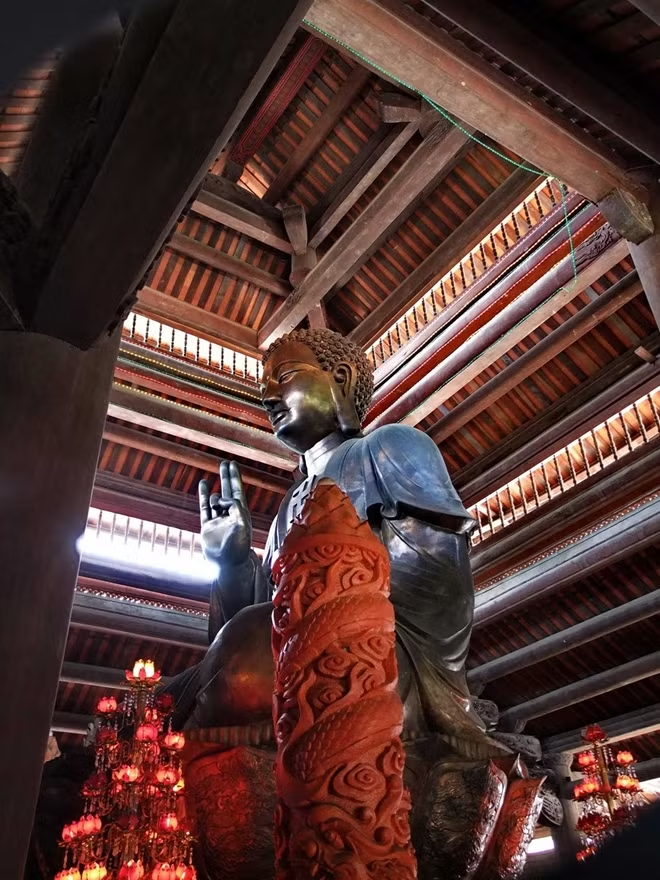
In 2000, Monk Thich Thanh Quyet decided to rebuild the pagoda and cast a bronze statue of Buddha Shakyamuni that was the largest one in the country at that time. 
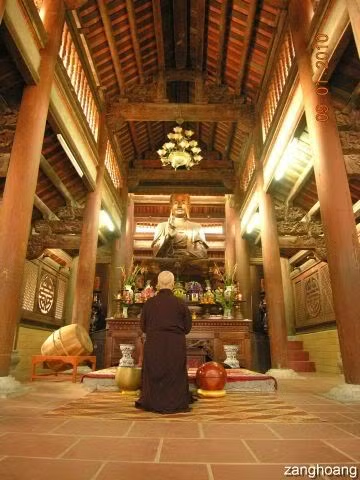
The statue was cast by craftsman Vu Duy Thuan in Lam town, Y Yen district, Nam Dinh.

 The statue was made during 18 months; with weight 20 tons of bronze, the lotus platform of 10 tons in weight, 1.35 in high; the stone pedestal 1.71 in high. If taking the stone monument into account, the statue has the height of 8.4 meters.

It was rebuilt on the slope of the mountain, the south of Nha Bia Mountain. The main hall has area of 260 square meters, 14 meters in high. Master monk Thich Thanh Quyet said that 30 tons of bronze were purchased from Singapore, 600m3 ironwood from Laos, and 30m3 of green stone from Thanh Hoa.

Over hundreds of years, with the ups and downs of history and nature, the pagoda’s foundation was accidentally discovered few years ago and the city People’s Committee decided to build on the former ground with the donation of Buddhist monks and nuns. 
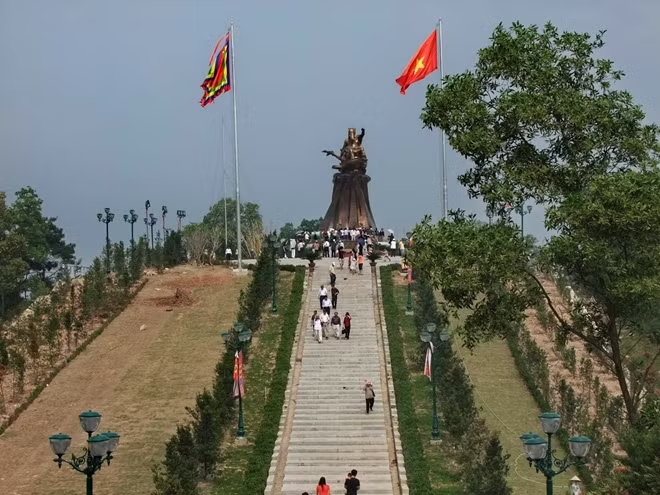
The temple is located on the back of the mountain, with a quiet campus amid a romantic landscape.

In 2004, the Buddhist Shangha of Vietnam held a groundbreaking ceremony to construct the Vietnam Buddhist Academy- a monk training center for the country.

Vietnamnet

Other News

Vietnam secure berth at FIFA U17 World Cup 2026 for first time

Vietnam secure berth at FIFA U17 World Cup 2026 for first time

Vietnam national U17 football team secured a place at the FIFA U17 World Cup 2026 for the first time after defeating United Arab Emirates national U17 football team 3-2 on in the final Group C match of the AFC U17 Asian Cup 2026 in Saudi Arabia on early May 14 (Vietnam time).

Vietnam’s most beautiful railway station twins with French counterpart

Vietnam’s most beautiful railway station twins with French counterpart

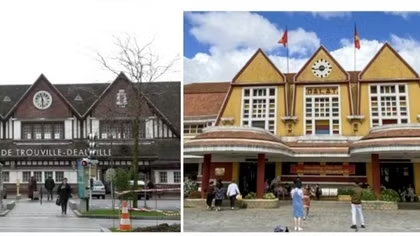
A twinning agreement between Da Lat Railway Station in Vietnam and Trouville-Deauville Railway Station in France was signed at the French Embassy in Vietnam on May 7, creating new opportunities for cooperation in station management and operations, as well as cultural and tourism promotion between the two sides.

Hanoi gains two more craft villages in World Crafts Cities network

Hanoi gains two more craft villages in World Crafts Cities network

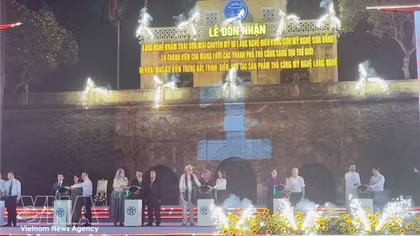
The recognition of Chuyen My and Son Dong craft villages as members of the World Crafts Cities network represents international acknowledgement of the cultural value, artisanal techniques, creativity and sustainable vitality of Vietnam’s traditional craft villages, he said.

Thang Long - Hanoi Festival 2026 to return in September

Thang Long - Hanoi Festival 2026 to return in September

Co-hosted by the municipal People’s Committee, the Department of Culture and Sports, and domestic and foreign agencies, the whole spectacle is meant to honour the city’s millennia-old heritage while reafffirming its strategy of establishing culture as a development engine.

Spreading Vietnamese cultural identity in digital space

Spreading Vietnamese cultural identity in digital space

In the context of deep international integration, cultural identity serves as both a “shield” against assimilation and a defining marker of a nation’s image. Protecting and promoting uniquely Vietnamese cultural values has therefore become a pressing task, particularly in an increasingly complex digital environment.

ITE HCMC 2026 to promote Vietnam’s tourism on global map

ITE HCMC 2026 to promote Vietnam’s tourism on global map

With its large scale, the ITE HCMC 2026 aims to promote tourism cooperation between Vietnam and priority markets such as Northeast Asia, Western Europe, North America, Southeast Asia, and Oceania while also boosting visitor arrivals from the Indian market

Vietnamese puppetry seeks renewal amid preservation challenges

Vietnamese puppetry seeks renewal amid preservation challenges

Although widely regarded as a cultural “speciality” attracting tourists, Vietnamese puppetry is facing multiple challenges in preservation and development, requiring renewed efforts to both safeguard its identity and adapt to contemporary cultural currents.

Project on digital transformation in cultural sector approved

Project on digital transformation in cultural sector approved

By 2030, the project targets the establishment of shared digital platforms across 100% of cultural sectors. All digitised cultural heritage will be standardised under the national data framework and shared in accordance with regulations, while 80% of public digital heritage assets are expected to receive digital identifiers to clarify ownership and management, encouraging organisations and individuals to do the same and support market development.

Vietnam eyes becoming region’s leading tourism destination

Vietnam eyes becoming region’s leading tourism destination

Vietnam has in recent years undergone a notable transformation in its tourism development strategy, placing a strong emphasis on nature-based and eco-tourism. This shift is not merely aligned with global trends, but represents a necessary step towards safeguarding valuable natural resources, while appealing to a growing segment of environmentally conscious travellers.