Hanoi (VNA) - Throughout more than 70 years of the development of Vietnam’s revolutionary cinema, war and national history-related topics have always held a particularly important position. Cinema not only reflects the nation’s arduous years of struggle, but also serves as a means of preserving historical memory, conveying revolutionary ideals, inspiring patriotism, and strengthening public confidence.
However, amid the rapid development of digital media platforms, hostile forces have exploited literary and artistic works in general, and films in particular, to distort history and spread misleading views aimed at undermining the great national unity bloc. This has made the task facing filmmakers today increasingly urgent. They must preserve the authenticity of the history while enhancing the artistic quality and appeal of their works in order to counter harmful products.
Preserving history authenticity in cinema
Since President Ho Chi Minh signed the decree establishing the Vietnam Movie and Photography Enterprise on March 15, 1953, Vietnam’s revolutionary cinema has gone through more than seven decades of formation and development. Thousands of films on revolutionary war themes, including documentaries, feature films, and animated films, have been produced and distributed, profoundly reflecting the resistance wars, national construction efforts, contemporary life, as well as Vietnamese cultural values and people.
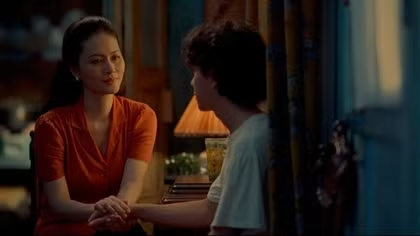
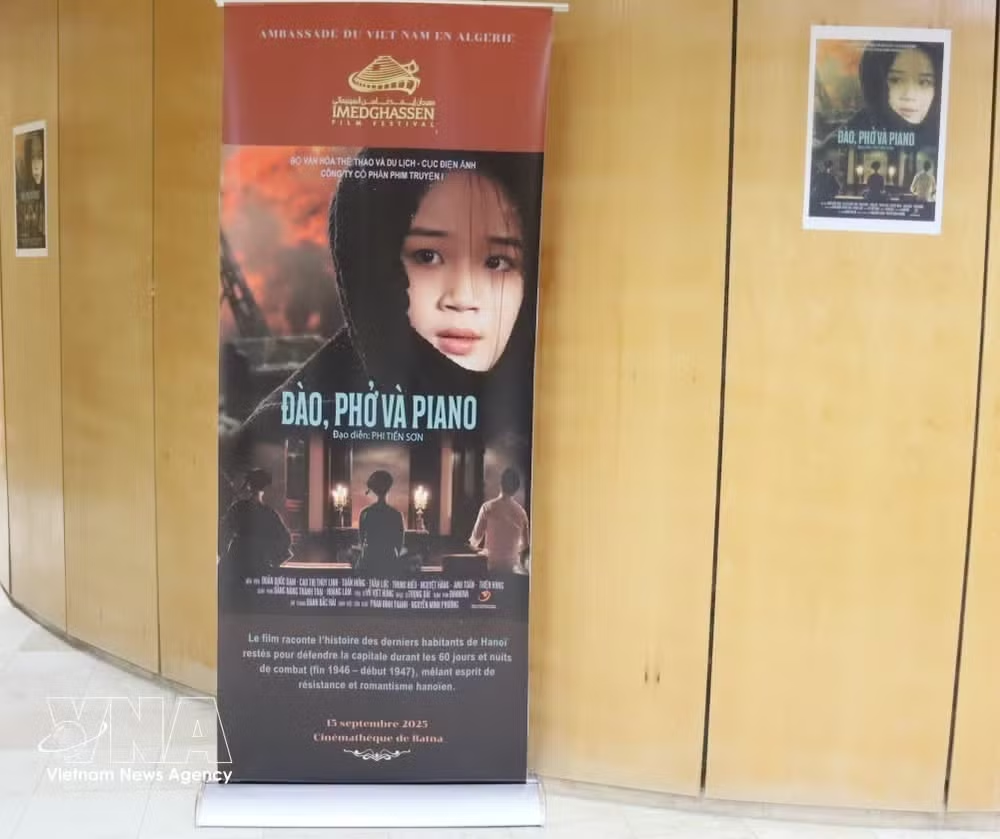
From early films such as “The Passerine Bird,” “The Abandoned Field: Free Fire Zone,” “The Little Girl of Hanoi,” “When the Tenth Month Comes,” “Sister Tu Hau,” and “The 17th Parallel, Nights and Days,” to more recent works such as “The Scent of Burning Grass,” “Peach Blossom, Pho and Piano,” “Tunnel: Sun in the Dark,” and “Red Rain,” revolutionary war cinema has not only portrayed the realities of combat, but also depicted the depth of the Vietnamese soul, expressing patriotism, compassion, the aspiration for peace, and the strength of the national spirit.
Many directors and experts believe that authenticity is always a core requirement of art in general and cinema in particular, especially for works exploring historical and revolutionary war themes. For events and figures already recorded in history, truthful representation is an important principle in the creative process.
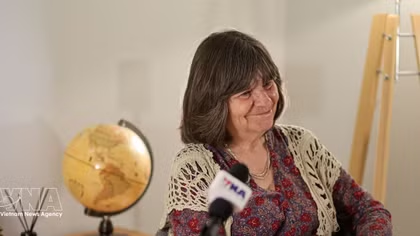
Director of “Peach Blossom, Pho and Piano” Meritorious Artist Phi Tien Son said that when discussing war themes in literature and the arts in general, and cinema in particular, it is necessary to recognise this as an especially complex field because artistic works are inherently fictional and are influenced by the perspectives and viewpoints of their creators. The key issue is how far fiction can go, and how it should be used, while still ensuring historical authenticity.
According to Son, historical truthfulness in reality depends greatly on perspective. Every individual approaching war does so from a different position, experience, and fragment of history. Even those who directly fought in battles only witnessed part of the war, within the specific space and time in which they were present. Such personal experiences do not necessarily reflect the full picture of the war; therefore, individual experiences cannot be imposed as the entirety of war history.
Sharing the same view, a representative of the Vietnam Cinema Association stated that for literary and artistic works exploring revolutionary war themes and national history, the foremost requirement is to ensure historical authenticity. History is not only material for artistic creation, but also the memory, spiritual foundation, and identity of an entire nation.
Cinema is an art form, but it cannot be separated from social responsibility. Filmmakers have the right to be creative and to use fictionalised or adapted elements to create vivid and emotionally rich artistic characters with inner lives, destinies, thoughts, and the spirit of their era. However, such creativity must be grounded in respect for historical truth; it must not distort the nature of events, misrepresent historical figures, or overturn established historical values.
For feature films, artistic works may incorporate fictional and adapted elements to enhance expressive power. However, for documentaries - a genre that “speaks nothing but the truth” - respect for history and factual accuracy must take top priority. Most importantly, through the distinctive language of documentaries, audiences should be encouraged to reflect, draw meaningful lessons, and absorb positive values that serve contemporary life, thereby contributing to the building of a better new generation and a better new society.
Building culture “immunity” for the public
The representative of the Vietnam Cinema Association stated that in the context of today’s fourth Industrial Revolution, the requirement to respect and ensure historical authenticity through cinema has become more important than ever, as digital platforms and cyberspace have enabled the widespread dissemination of cross-border media products. Taking advantage of this, hostile elements have used literature and the arts, including films produced with dishonest intentions, deliberately exploiting history in a one-sided and extremist manner to create distorted views of Vietnam’s revolutionary wars, falsify history, distort the image of the Vietnamese revolution, incite extremist sentiments, and undermine the ideological foundation of the Party and the State.
This issue needs to be approached with clear awareness, because such products are often produced abroad, outside Vietnam’s legal jurisdiction, by organisations or individuals not subject to Vietnamese law. Therefore, preventing them at the source is not simple. What must be done is to ensure that such products do not have the opportunity to spread within Vietnam.
Under Vietnamese law and the current Cinema Law, all films distributed in Vietnam, including those released online, are subject to pre-screening and post-screening mechanisms in accordance with regulations of the relevant authorities, with the Cinema Department directly responsible for appraisal and licensing for distribution. Products containing historical distortions, anti-State content, or material inciting ethnic division cannot be legally distributed. Organisations and individuals disseminating products with historically inaccurate content, defaming the regime, or opposing the State will be held accountable before the law.
Alongside management efforts, the representative of the Vietnam Cinema Association believed that the fundamental solution is to build culture “immunity” within society through history education, raising public awareness, and developing genuine cinematic works with ideological depth and artistic value.
Over the past more than 70 years, Vietnam’s revolutionary cinema has established a distinctly oriented film tradition that truthfully reflects the resistance wars, the nation-building process, as well as the core values of Vietnamese culture and people. These works have not only served political missions, but have also contributed to nurturing ideals, patriotism, strengthening the great national unity bloc, and spreading aspirations for national development. It is precisely revolutionary and historical films that are professionally invested in, possess artistic quality, truthfully portray the life of the nation, and aim toward humanistic values that constitute the leading force in combating harmful media products.
In this context, Vietnam’s revolutionary cinema needs more than ever to promote its role in guiding public thought, protecting historical truth, and strengthening social confidence through highly artistic and persuasive works. To effectively counter false and distorted viewpoints, mainstream cinema must first be capable of attracting audiences and touching viewers’ hearts.
For such works to truly achieve their effectiveness, improving artistic quality is an extremely urgent issue.
Therefore, the responsibility of today’s creative community lies not only in accurately reflecting history, but also in retelling history through modern, engaging, and deeply humanistic cinematic language, so that genuine values can compete with misleading information circulating in cyberspace. Only when audiences truly empathise with the characters, their destinies, and the stories on screen can the messages conveyed by filmmakers reach real life and generate enough momentum to counter harmful works.
Alongside improving the quality of films, efforts in promotion, distribution, film criticism, and audience guidance also need to be strengthened. The public must be equipped with the ability to distinguish between genuine artistic works and products that exploit cinema to distort history and undermine ideology. When individuals possess a solid foundation of awareness, a proper understanding of national history, and strong cultural resilience, harmful products will find it difficult to create negative influence.
In the context of fierce competition in digital media, the struggle to protect the ideological foundation of the Party and the State is present in every literary and artistic work and is the responsibility of artists and writers - those who directly create artistic images and narratives. With its unique power, cinema must continue to affirm its role as an important force on the ideological and cultural front, contributing to safeguarding the spiritual foundation of society and preserving the nation’s historical memory for present and future generations./.