Overseas remittances to HCM City enjoys Q1 surge

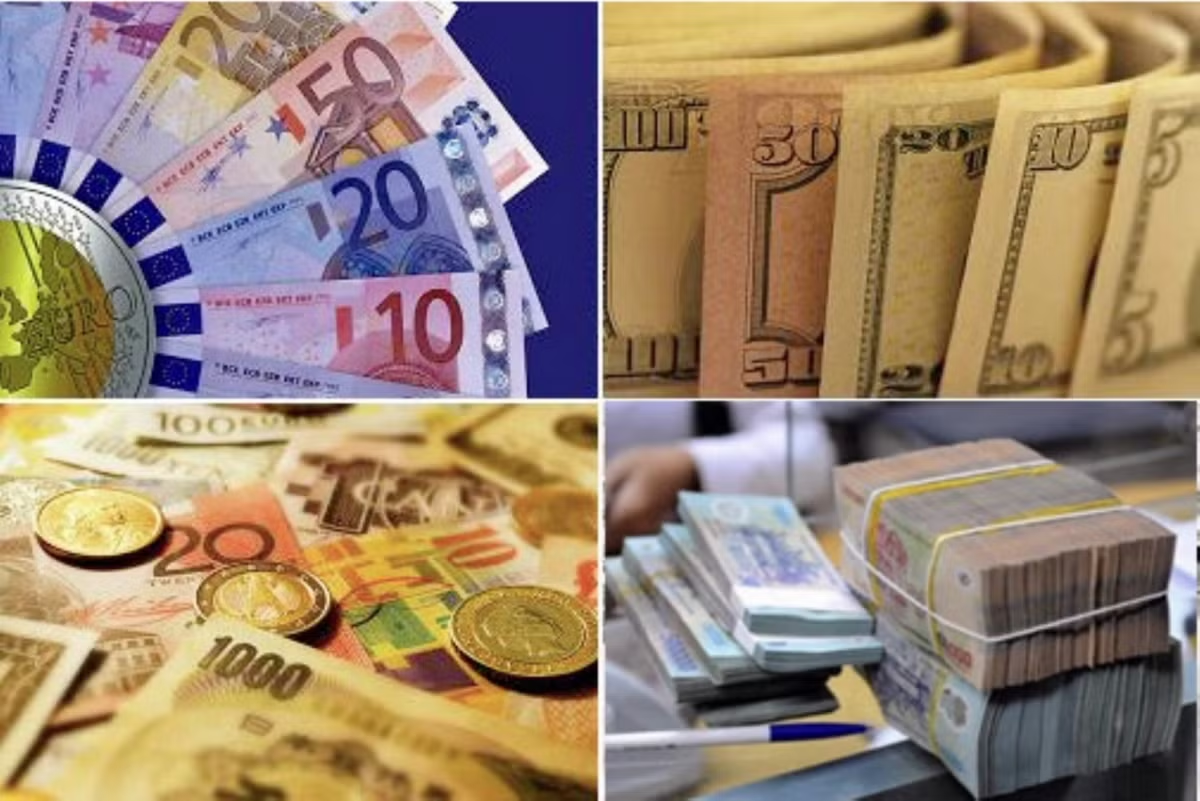
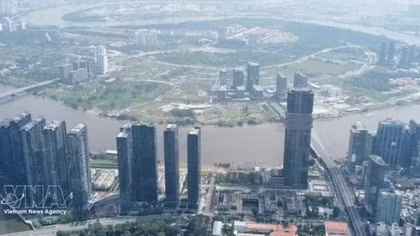
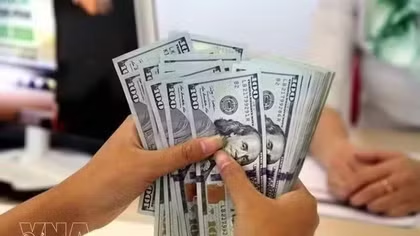
The first quarter of the year witnessed overseas remittances to Ho Chi Minh City increase by 10% year on year to U$S1.45 billion, according to figures released by the municipal Committee for Overseas Vietnamese Affairs.

Overseas remittances to HCM City enjoys Q1 surge ảnh 1

The southern metropolis received a total of US$6.1 billion in remittances last year, a rise of 15% compared to 2019. This sum not only provided funding for local production and business, but also served to boost the city’s foreign reserves.

Whilst the exchange rate between VND and US$ has been stable in recent times, recipients have been able to sell them to credit institutions.

Furthermore, several banks use remittance payment technology whilst offering services in order to change foreign currencies into VND for the purpose of enjoying savings at a high interest rate.

Recent years has seen remittances come not only in the form of savings, but also in terms of securities, real estate, share purchases, and the establishment of businesses.

Banks have also strived to enhance the use of technology whilst offering promotions in a bid to attract more customers. For example, Sacombank has co-operated alongside partners in the United States, Australia, Europe, Japan, and Taiwan (China).

In addition, they have adopted API technology which allows quick payments around the clock, thereby making it easier for recipients to get their remittances as swiftly as possible.
VOV

Other News

Tax policy stability now key to keeping foreign investors: Officials

Tax policy stability now key to keeping foreign investors: Officials

Companies must ensure records and data truthfully reflect the substance of transactions and engage in dialogue early when complex issues arise. Tax authorities, in turn, need to publish policies, give clear guidance, enforce rules consistently and deliver information in a timely manner.

Vietnam – a potential regional supply hub for Jatropha seed oil

Vietnam – a potential regional supply hub for Jatropha seed oil

Japan’s research on non-edible oil feedstocks showed that Jatropha is highly drought-tolerant and could grow well on wasteland, eroded sandy land and infertile soil. Given this, areas in central Vietnam, including Ninh Thuan, Binh Thuan and the Central Highlands, have climatic, sunlight and soil conditions suitable for achieving high seed yields and oil content.

Vietnam enters investment grade credit rating category for first time

Vietnam enters investment grade credit rating category for first time

Vietnam has maintained robust growth, outperforming other Southeast Asian economies. Its ongoing government reforms aimed at streamlining the state apparatus, promoting the private sector, improving the institutional framework and developing capital markets will strengthen the country’s growth potential and economic resilience.

Vietnam, Laos seek to expand room for trade, investment cooperation

Vietnam, Laos seek to expand room for trade, investment cooperation

Vietnam and Laos aim to boost bilateral trade in 2026 towards the milestone of 10 billion USD by 2030, a target said to be challenging but feasible as both Governments work to remove trade barriers, improve border-trade mechanisms, and strengthen transport and logistics connectivity.

Vietnam's national brand value jumps 45% to over 462 bln USD

Vietnam's national brand value jumps 45% to over 462 bln USD

Deputy Minister of Industry and Trade Luong Hoang Thai outlined Vietnam's National Brand Programme 's achievements, the role of business community and plans for brand development in a press interview ahead of the 10th Vietnam National Brand Product recognition ceremony on October 16.

Vietnam revises scheme to improve sovereign credit rating by 2030

Vietnam revises scheme to improve sovereign credit rating by 2030

Under the decision, Vietnam aims to become a developing country with modern industry and upper-middle income by 2030, while building a competitive and effective governance system and a dynamic economy driven by science, technology, innovation and digital transformation.

Vietnam posts GDP growth of 9.95% in Q3

Vietnam posts GDP growth of 9.95% in Q3

In the first nine months, Vietnam's GDP was estimated to increase 9.01% from the same period last year. Agriculture, forestry and fisheries grew 4.02%, contributing 5.35% to overall gross value added growth; industry and construction rose 11.21%, contributing 49.62%; and services expanded 8.69%, contributing 45.03%.

Vietnam sees 149,700 new businesses in nine months

Vietnam sees 149,700 new businesses in nine months

Vietnam recorded nearly 149,700 newly established enterprises in the first nine months of 2026, up 3.2% year-on-year, with total registered capital rising 32.7% to over 1.88 quadrillion VND (71.6 billion USD).

Vietnam accelerates innovation to boost growth, competitiveness

Vietnam accelerates innovation to boost growth, competitiveness

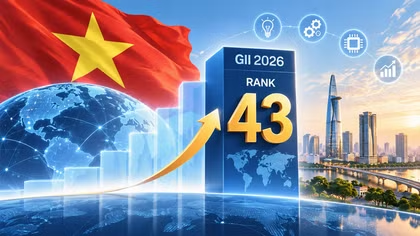
By 2030, Vietnam aims to rank among the world’s top 40 in the GII; raise total social investment in R&D to at least 2% of GDP, with non-State funding accounting for over 60%; increase international scientific publications by an average of 10% annually; and raise the number of patent applications and granted patents by an average of 16-18% annually.

Vietnam sees high growth prospects

Vietnam sees high growth prospects

Experts from the Institute of Vietnam and World Economy under the Vietnam Academy of Social Sciences noted the quality of recent growth as the high growth rate has been recorded against an increasingly higher comparative base.

Vietnam seeks bigger share of global Halal market

Vietnam seeks bigger share of global Halal market

Vietnam's Halal exports remain modest at around 900 million USD a year, accounting for less than 1% of the global market. Most exports are still raw agricultural and seafood products. Only around 1,000–1,300 Vietnamese businesses obtained or maintained Halal certification during 2024–2026.

Hanoi sets up inter-agency mechanism to operate carbon market

Hanoi sets up inter-agency mechanism to operate carbon market

Under a decision of the municipal People’s Committee on establishing an inter-agency working group, departments and agencies are responsible for identifying facilities subject to greenhouse gas inventories, developing emissions-reduction plans and studying projects capable of generating carbon credits.