PM chairs Coordinating Council for Red River Delta Region’s meeting

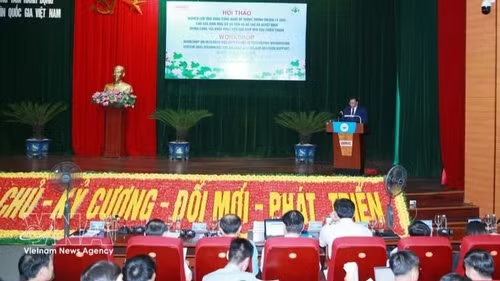
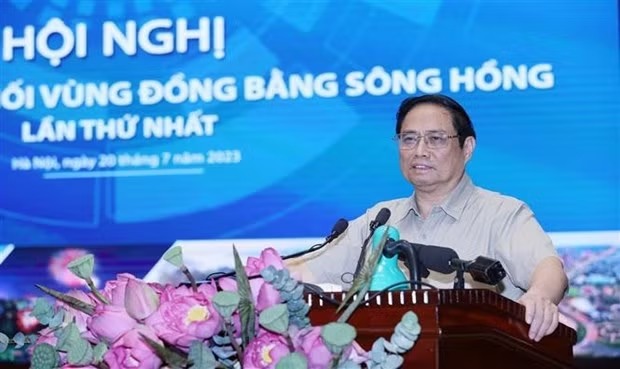
Prime Minister Pham Minh Chinh, Chairman of the Coordinating Council for Red River Delta Region, chaired its first meeting in Hanoi on July 20.

PM chairs Coordinating Council for Red River Delta Region’s meeting -0
Prime Minister Pham Minh Chinh speaks at the meeting of Coordinating Council for Red River Delta Region in Hanoi on July 20 (Photo: VNA) 

Prime Minister Pham Minh Chinh, Chairman of the Coordinating Council for Red River Delta Region, chaired its first meeting in Hanoi on July 20.

The meeting was held right after the PM decided to establish the coordinating councils for the northern and coastal central region, the southeastern region, the Red River Delta region, and the Central Highlands region.

According to the plan of the Red River Delta region in the 2021- 2030 period, with a vision to 2050, it is oriented to become a fast and sustainable developing region with a well-structured economy imbued with national cultural identity.

The council is an inter-sectoral bodies helping the PM with considering, directing, coordinating, and handling important and inter-sectoral issues on regional connectivity and sustainable development.

PM Chinh stressed that the Party and the State, and key leaders always pay special attention to the implementation of the 13th Party Congress's Resolution on six socio-economic regions in the country, including the Red River Delta.

He underlined the region’s development potential, saying that it is an important strategic area, the northern gateway of the country and ASEAN in economic and trade connection with China, and a vital bridge connecting international economic and cultural exchange.

However, the region’s development has not been commensurate with its potential, advantage and location, he noted.  

The establishment of the Coordinating Council for Red River Delta Region aims to overcome existing limitations and promote rapid and sustainable economic development in accordance with the 13th Party Congress’s Resolution and Resolutions of the Politburo, the National Assembly and the Government, he said.

According to the PM, regional connectivity should focus on realising the goals of stabilising the macro economy, controlling inflation, promoting growth, and ensuring major balances of its economy.

He emphasised the need to focus on promoting strategic infrastructure connectivity, training high-quality human resources, accelerating administrative reform and improving investment and business environment, and perfecting institutions.

The leader requested provinces and cities in the region to urgently implement tasks set by the Council and affiliated organisations and urgently complete provincial and regional planning, especially Hanoi, underlining the necessity to develop projects to protect the environment and combat climate change in association with promoting green growth in Hanoi and the whole region.

The PM suggested forming cooperation mechanisms in sharing experience in Party and political system building and anti-corruption work, and a regional infrastructure development fund, as well as organising scientific seminars on digital transformation, green transformation, circular economy, sharing economy, and disaster and climate change response.

At the session, representatives from ministries, sectors, localities, experts and scientists discussed and proposed coordination programmes and solutions for developing the Red River Delta region, easing environmental pollution, and promoting green and sustainable development.

They also proposed measures to develop the region into a centre of science, technology and innovation and to develop urban, service and tourism centres, modern and high-tech industries, marine economic centres and seaport systems in the region in association with building a modern warehouse and logistics system linking with industrial parks and coastal economic zones.

Delegates proposed specific mechanisms for the region to effectively mobilise resources from all economic sectors to invest in developing regional infrastructure, especially in the field of transport.

VNA

Other News

Vietnam steps up implementation of ethnic affairs strategy through 2030

Vietnam steps up implementation of ethnic affairs strategy through 2030

To accelerate the implementation of the the Ethnic Affairs Strategy by 2030, with a vision toward 2045, the Prime Minister requested ministries, agencies and local authorities to continue thoroughly carrying out the Party and State’s policies on ethnic affairs, enhancing the effectiveness of State management and strengthening oversight of policy implementation.

Security preparations reviewed for APEC 2027 in Phu Quoc

Security preparations reviewed for APEC 2027 in Phu Quoc

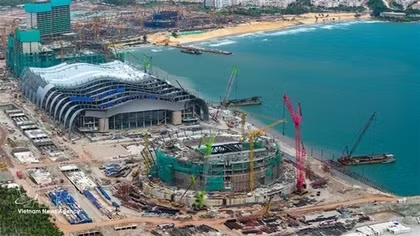
The team examined the APEC 2027 Convention Centre, where main conference activities are scheduled; Sun Serenia Hospital, designated to provide healthcare and emergency medical services for delegates; provincial road DT.975, which connects Phu Quoc International Airport to the convention centre; and the area surrounding Phu Quoc International Airport.

Hanoi accelerates seven Red River bridge projects, many exceed 70% completion

Hanoi accelerates seven Red River bridge projects, many exceed 70% completion

According to the municipal Transport Construction Investment Project Management Board, the city is simultaneously implementing seven projects, namely Tu Lien, Ngoc Hoi, Tran Hung Dao, Thuong Cat, Van Phuc, Hong Ha and Me So bridges. Construction is being carried out on multiple fronts, focusing on bored piles, pile caps, piers and superstructure works.

Dien Bien battlefield legacy powers tourism revival

Dien Bien battlefield legacy powers tourism revival

Seventy-two years after the Dien Bien Phu Victory, its legacy still reverberates. The unity, self-reliance, and resilience forged in that historic triumph remain a powerful internal engine, now propelling Dien Bien toward fast and sustainable development.

Hanoi accelerates shift to green buses, targets 100% by 2030

Hanoi accelerates shift to green buses, targets 100% by 2030

In the 2027–2030 period, the city will accelerate the transition towards the complete phase-out of fossil fuel-powered buses. The share of electric and green energy-fueled buses is projected to reach 79–89% by 2029 and 100% by 2030.

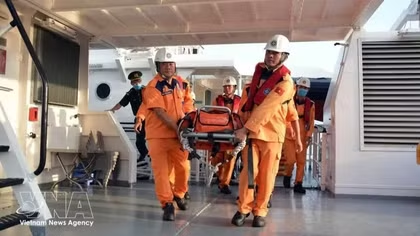
36 fishermen safely rescued after boat breaks down near Truong Sa

36 fishermen safely rescued after boat breaks down near Truong Sa

At 8:00 the same day, KN475 began towing the disabled fishing boat toward Da Tay A island. The towing operation was carried out safely, and by 18:30 both the vessel and its crew had arrived at the island without incident, where repairs and additional support procedures were arranged.

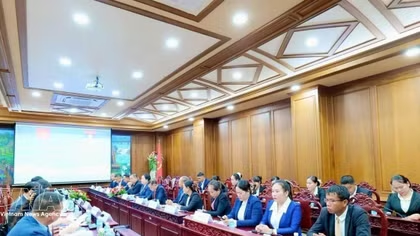
Vietnamese language contest in Laos strengthens youth ties, bilateral friendship

Vietnamese language contest in Laos strengthens youth ties, bilateral friendship

Held in response to the launch of the Vietnamese Language Day among overseas Vietnamese communities, the event aimed to enhance the quality of Vietnamese language teaching and learning in Laos while contributing to the great friendship, special solidarity, comprehensive cooperation and strategic cohesion between the two countries.

Vietnamese language contest in Laos strengthens youth ties, bilateral friendship

Vietnamese language contest in Laos strengthens youth ties, bilateral friendship

Held in response to the launch of the Vietnamese Language Day among overseas Vietnamese communities, the event aimed to enhance the quality of Vietnamese language teaching and learning in Laos while contributing to the great friendship, special solidarity, comprehensive cooperation and strategic cohesion between the two countries.

Hanoi launches 10 electric bus routes from April 1

Hanoi launches 10 electric bus routes from April 1

By the end of April, the number of buses using electricity and other green energy sources in the city is expected to reach 822, including 683 electric buses and 139 compressed natural gas (CNG) buses, representing 42.1% of the total number of vehicles.