PM issues national plan to eradicate hunger

Prime Minister Nguyen Xuan Phuc has issued a National Action Programme on Zero Hunger, aiming to ensure enough food and nutrition for all citizens.
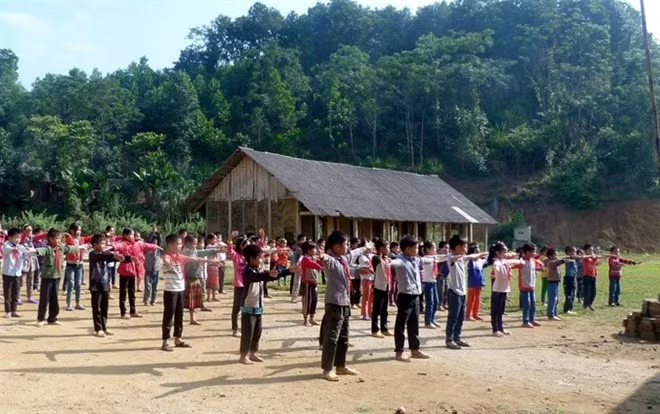
Students at Dao Vien Primary School in Yen Son District of the northern mountainous province of Tuyen Quang take part in a morning exercise session. (Photo:VNA)

Students at Dao Vien Primary School in Yen Son District of the northern mountainous province of Tuyen Quang take part in a morning exercise session. (Photo:VNA)

The programme is part of the United Nations Sustainable Development Goal No 2 which focuses on sustainable solutions to eradicate hunger in all its forms by 2030 and to achieve food security.

The programme prioritises the reduction of malnutrition among children under two by 2025.

More specifically, a target has been set to reduce the ratio of children under two who are a low height for their age (stunted) to less than 20 percent across most of the country, and 25 percent for children in mountainous areas in the northern and Central Highland regions.

The target for children under two who are a low weight for their height or a low weight for their age has been set at below 5 percent.

Social policies to support pregnant women and provide children with adequate nutrition are also included in the programme.

Under the National Action Programme on Zero Hunger, to develop a sustainable food system, farmers should become members of co-operatives and production chains to allow small-scale farming households to enjoy increased productivity and incomes and avoid waste through the use of new technologies.  

Improving natural disaster forecasting and warnings is also one of the targets.

Funding will be sourced from the national programme on poverty reduction, and is expected to cost over 545 billion VND (23.7 million USD), including nearly 34 billion VND (1.5 million USD) for the first phase from 2018-20, and over 511 billion VND (22.2 million USD) for the second phase from 2021-25.

According to the Ministry of Agriculture and Rural Development, Vietnam’s poverty rate fell from 46.9 percent in 1990-92 to 9 percent in 2010-12.

The number of poor households nationwide had fallen to 7 percent at the end of 2017, according to the Ministry of Labour, Invalids and Social Affairs. 

According to the Food and Agriculture Organisation, Vietnam had achieved the first phase of Sustainable Development Goal No 2 by cutting its poverty rate by half in 2015, and looking to address poverty as a whole by 2020.

However, malnutrition remains a big problem, especially in rural and mountainous areas.

The Zero Hunger Challenge was launched by United Nations Secretary-General Ban Ki-moon in 2012. The Zero Hunger vision reflects five elements from within the sustainable development goals, which taken together, can end hunger, eliminate all forms of malnutrition, and build inclusive and sustainable food systems. 

VNA

Other News

Hanoi ready to implement Capital Law 2026, unlocking new development momentum

Hanoi ready to implement Capital Law 2026, unlocking new development momentum

The effectiveness of the Capital Law 2026 will be measured not by the number of legal documents issued but by tangible improvements in governance and public administration, better services for people and businesses, faster administrative procedures, stronger investment attraction and higher economic growth.

Vietnamese students earn honours at ROBOG Asia Cup 2026

Vietnamese students earn honours at ROBOG Asia Cup 2026

Three teams from Chu Van An Secondary School in Vietnam’s Thai Nguyen province have earned First Prize honours and advanced to the quarterfinals at the ROBOG Asia Cup 2026, a regional robotics and artificial intelligence (AI) competition for students held in Hong Kong, China.

Hanoi sets out new investment blueprint with century-long development vision

Hanoi sets out new investment blueprint with century-long development vision

As of early June, Hanoi had attracted 74.6 billion USD in foreign direct investment (FDI) through more than 9,250 valid projects. FDI inflows in the first six months were projected at 3.2 billion USD, surpassing the annual target by 116%, while nearly 16,000 new businesses were established in the first five months, up 34.4% year-on-year.

Vietnam promotes legal cooperation and rule of law at global forum

Vietnam promotes legal cooperation and rule of law at global forum

Vietnam’s development and international integration have gone hand in hand with the improvement of its legal system, the incorporation of international commitments into domestic legislation, and legal reforms aimed at fostering development, openness and global integration. The country regards international law as an essential instrument for building fair, mutually beneficial relations among nations.

Hanoi to hold investment promotion event on June 29

Hanoi to hold investment promotion event on June 29

At the event, Hanoi authorities plan to grant investment policy decisions and investment registration certificates to 20 exemplary projects in the fields of transportation infrastructure, industrial parks, urban development, social housing, environment, science and technology, and foreign investment attraction.

Hanoi's Red River urban area development draws widespread attention

Hanoi's Red River urban area development draws widespread attention

Located south of the Red River and extending from the historic inner city to newly developing areas in the south and the west, the central urban area along Red River’s right bank covers approximately 45,317 hectares and is projected to accommodate around 6.365 million residents by 2045 and 6.455 million by 2065.

Hanoi's Red River urban area development draws widespread attention

Hanoi's Red River urban area development draws widespread attention

Located south of the Red River and extending from the historic inner city to newly developing areas in the south and the west, the central urban area along Red River’s right bank covers approximately 45,317 hectares and is projected to accommodate around 6.365 million residents by 2045 and 6.455 million by 2065.

Regional cooperation strengthened to combat cross-border drug crime

Regional cooperation strengthened to combat cross-border drug crime

Vietnam, China, Laos and Myanmar face common challenges as drug syndicates increasingly exploit the Mekong River, cross-border transport networks, e-commerce platforms, international logistics services, cyberspace and cryptocurrencies to organise drug transactions and smuggling operations.