PM sets no-fly and restricted zones for drones, ultra-light aircraft

Prime Minister Nguyen Xuan Phuc has issued a decision stipulating the no-fly and restricted zones to unmanned aerial vehicles (UAVs) and ultra-light aircraft.
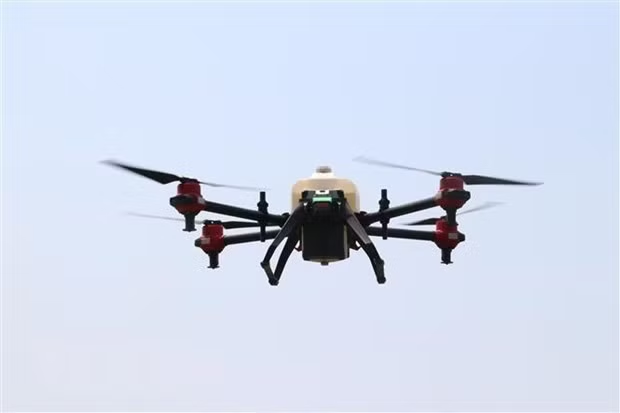
A drone used for spraying pesticide. (Photo: VNA)

A drone used for spraying pesticide. (Photo: VNA)

Prime Minister Nguyen Xuan Phuc has issued a decision stipulating the no-fly and restricted zones to unmanned aerial vehicles (UAVs) and ultra-light aircraft.

Under Decision 18/2020/QD-TTg, the no-fly zones are national defence and security areas under the management and protection of the Ministry of Defence and Ministry of Public Security.

These include military stations, areas for deploying forces, combat equipment and training, warehouses, factories, logistic bases, prisons and detention camps of the Ministry of Defence and Ministry of Public Security, and other areas related to the national security, the decision said.

The distance from the UAVs and ultra-light aircraft to the no-fly zones horizontally must not be less than 500m at any height.

The vehicles are banned from flying over working areas of offices of Party, State, National Assembly, Government, ministries and central-level agencies, the Vietnam Fatherland Front, provincial and city-level Party committees, people’s committees and councils, diplomatic and consular missions, and international organisations.

The limit distance horizontally to the areas is no less than 200m at any height.

The areas of military and civil airports were noted as the no-fly zones. The no-fly zones extend by 15,000m and 5,000m from two sides of rectangular shapes of the runways at any height.

Airports which have less than six civil flights per day can flexibly adjust the no-fly zones at their discretion.

However, drones and ultra-light aircraft will not be allowed to fly within the boundaries of airports and in the time before and after one hour of the airplanes landing and taking off.

The vehicles can only fly with the permissions of military flight control and management agencies at the airports.

The no-fly zones are also the areas within the limits of air routes, flight trails and corridors that were licensed in the airspace of Vietnam, the limited scope of air routes stated in the Aeronautical Information Publication (AIP) Vietnam published by the Civil Aviation Administration of Vietnam.

The PM’s decision states that in special cases of national defence and security or at the requests of ministries, branches and localities to ensure flight safety and social order, the Ministry of Defence shall decide to temporarily prohibit from flying to unmanned aircraft in one or some areas. The decision will take effect immediately.

The PM’s decision also regulates restricted flying zones to drones and ultra-light flying vehicles including airspace over 120m above the terrain (excluding airspace of the above-mentioned no-fly zones), crowded areas and the border areas.

The limited distance in the land border with China is 25,000m from border line to the land of Vietnam at all heights while the limited distance in land border between Vietnam and Laos and Cambodia is 10,000m.

The limited distances are 3,000m in width and 5,000m in length from the no-fly zones at airports having military and civil flights. And the heights are less than 1,200m above the terrain.

The organisation of flights of drones and ultra-light aircraft in restricted flying areas must meet requirements of flight licensing authorities, the decision said.

VNA

Other News

Hanoi ready to implement Capital Law 2026, unlocking new development momentum

Hanoi ready to implement Capital Law 2026, unlocking new development momentum

The effectiveness of the Capital Law 2026 will be measured not by the number of legal documents issued but by tangible improvements in governance and public administration, better services for people and businesses, faster administrative procedures, stronger investment attraction and higher economic growth.

Vietnamese students earn honours at ROBOG Asia Cup 2026

Vietnamese students earn honours at ROBOG Asia Cup 2026

Three teams from Chu Van An Secondary School in Vietnam’s Thai Nguyen province have earned First Prize honours and advanced to the quarterfinals at the ROBOG Asia Cup 2026, a regional robotics and artificial intelligence (AI) competition for students held in Hong Kong, China.

Hanoi sets out new investment blueprint with century-long development vision

Hanoi sets out new investment blueprint with century-long development vision

As of early June, Hanoi had attracted 74.6 billion USD in foreign direct investment (FDI) through more than 9,250 valid projects. FDI inflows in the first six months were projected at 3.2 billion USD, surpassing the annual target by 116%, while nearly 16,000 new businesses were established in the first five months, up 34.4% year-on-year.

Vietnam promotes legal cooperation and rule of law at global forum

Vietnam promotes legal cooperation and rule of law at global forum

Vietnam’s development and international integration have gone hand in hand with the improvement of its legal system, the incorporation of international commitments into domestic legislation, and legal reforms aimed at fostering development, openness and global integration. The country regards international law as an essential instrument for building fair, mutually beneficial relations among nations.

Hanoi to hold investment promotion event on June 29

Hanoi to hold investment promotion event on June 29

At the event, Hanoi authorities plan to grant investment policy decisions and investment registration certificates to 20 exemplary projects in the fields of transportation infrastructure, industrial parks, urban development, social housing, environment, science and technology, and foreign investment attraction.

Hanoi's Red River urban area development draws widespread attention

Hanoi's Red River urban area development draws widespread attention

Located south of the Red River and extending from the historic inner city to newly developing areas in the south and the west, the central urban area along Red River’s right bank covers approximately 45,317 hectares and is projected to accommodate around 6.365 million residents by 2045 and 6.455 million by 2065.

Hanoi's Red River urban area development draws widespread attention

Hanoi's Red River urban area development draws widespread attention

Located south of the Red River and extending from the historic inner city to newly developing areas in the south and the west, the central urban area along Red River’s right bank covers approximately 45,317 hectares and is projected to accommodate around 6.365 million residents by 2045 and 6.455 million by 2065.

Regional cooperation strengthened to combat cross-border drug crime

Regional cooperation strengthened to combat cross-border drug crime

Vietnam, China, Laos and Myanmar face common challenges as drug syndicates increasingly exploit the Mekong River, cross-border transport networks, e-commerce platforms, international logistics services, cyberspace and cryptocurrencies to organise drug transactions and smuggling operations.