Efforts to enable poverty reduction in the southern region are to be pushed ahead in the coming time to help better the lives of ethnic minority groups in the area.
Eliminating poverty in a sustainable fashion for ethnic minority areas is a major policy of the Party and State and also garners the attention and support from the general public.
According to the Government’s Committee for Ethnic Minority Affairs, the poverty reduction rate in ethnic minority areas of the south is estimated at almost 1.9% on average during 2021-2023. Some localities have surpassed their targets such as Binh Phuoc, Tay Ninh, Vinh Long, Hau Giang, and Ca Mau. However, some are lagging behind, including Dong Nai, Ba Ria - Vung Tau, Tra Vinh, An Giang, Kien Giang, Can Tho, and Soc Trang.
Though the south has fared better than other regions nationwide, including the northern mountainous, central and Central Highlands regions, in disbursing capital under the national target programme on sustainable poverty reduction, the poverty alleviation rate in ethnic minority areas here is still low.
Hau A Lenh, Minister and Chairman of the Committee for Ethnic Minority Affairs, pointed out the fact that most ethnic minority people living under the poverty line in the south, especially the southwest, are irregular migrants or those from particularly disadvantaged areas lacking residential land, farmland, means of production, or clean water.
Policies supporting the settlement of these issues are included in the national target programme on socio-economic development in ethnic minority and mountainous areas, but bottlenecks linked with regulations and mechanisms remain. Therefore, many localities face difficulties in bringing the ethnic minority poverty rate down, he explained.
The official said to help with poverty reduction in the communities, he has demanded southern provinces and cities step up assistance for poor and near-poor families as well as those recently escaping from poverty to develop livelihoods through approved projects. Funding for these projects come from the State budget, loans from the Vietnam Bank for Social Policies (VBSP) or the credit institutions assigned by the State, and the capital for relevant policies, programmes, and projects.
A VBSP leader noted that to ensure sufficient concessional loans for ethnic minority households, the Party, National Assembly, Government, ministries and central agencies, along with administrations of localities, have paid attention to mobilising financial resources to meet the target group’s borrowing demand.
Huynh Thi Diem Ngoc, Vice Chairwoman of the Soc Trang provincial People’s Committee, said more than 7,100 households of the Khmer ethnic group and 345 others of the Hoa minority group are living under the poverty line in the province. Soc Trang aims to cut the household poverty rate among ethnic minorities by 3-4% annually.
For 2021-2023, it has been allocated with over 126 billion VND (5.2 million USD) to carry out the national target programme on sustainable poverty reduction. Soc Trang has arranged more than 12 billion VND in reciprocal capital and raised other resources from the public for programme implementation, she went on.
Meanwhile, the neighbouring province of Tra Vinh looks to reduce the poverty rate, as measured according to multidimensional poverty criteria, among ethnic minority households by 1% and lift two hamlets out of the particularly disadvantaged status this year.
To that end, it is disbursing over 80 billion VND for its localities, maximising resources from the public, and combining poverty reduction with many other programmes, projects, and policies to help the poor improve their livelihoods and living conditions.
Actions taken so far include disbursing concessional loans for low-income earners and disadvantaged students, funding the construction of water supply and hygienic facilities, providing capital for job creation for the poor, and using the Social Security Fund to finance house building for poor and near-poor families, local authorities said.
At a teleconference held by the Central Steering Committee for the national target programmes in the southern province of Bac Lieu in early August, Deputy Prime Minister Tran Luu Quang asked localities in the Mekong Delta (southwestern) region to speed up capital disbursement for the programmes, increase information sharing and experience with one another, and send inspection teams to examine and remove obstacles in a timely manner.
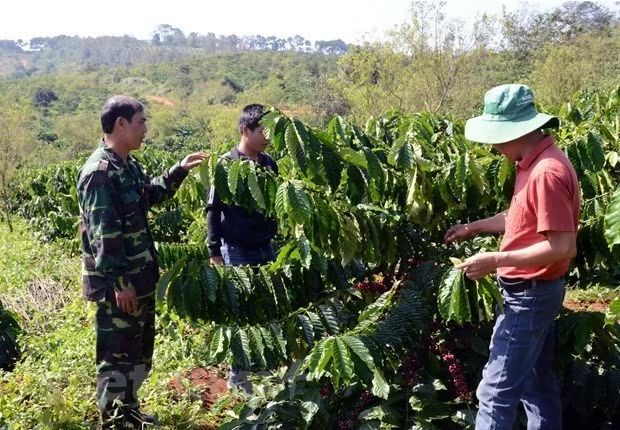
He also told relevant agencies and units to allocate more capital under the national target programmes to help locals develop livelihoods. He also required due attention to the transfer of scientific and technical advances to assist farmers in improving production efficiency.
Meanwhile, the Committee for Ethnic Minority Affairs was asked to introduce and expand the application of fruitful production models to help with poverty alleviation in ethnic minority areas.