 |
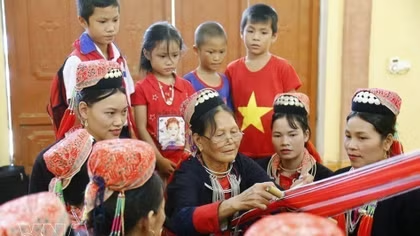
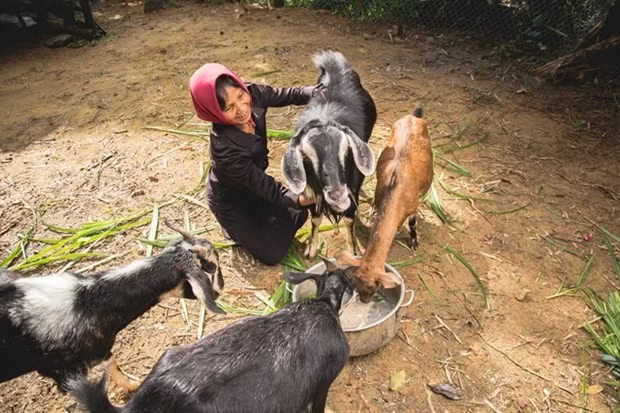
| Dinh Thi Krot in Quang Ngai province is happy raising goats with her children (Photos courtesy of World Bank) |
Pham Van Mang, Chairman of Ba Trang commune People’s Committee in the central province of Quang Ngai, remembers the radiant faces and smiles of local people when a new bridge spanning the Tha Stream was opened thanks to the Central Highlands Poverty Reduction Project.
The bridge benefits more than 500 households of the commune, contributing to the development of the local economy and infrastructure. More importantly, it saves many lives when the flood season comes.
“Before, students walked through the stream to get to school, and it was difficult for people to transport goods. It was very dangerous when the flood season arrived,” said Mang.
“Now safety is guaranteed and people are so happy and thankful because they are connected with other communes and transport is more convenient.”
It’s a result of the Central Highlands Poverty Reduction (CHPR) Project launched by the Ministry of Planning and Investment (MPI) with support from the World Bank in 2013.
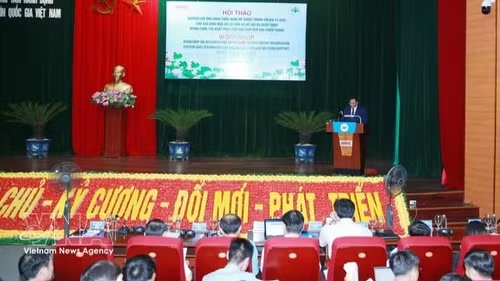
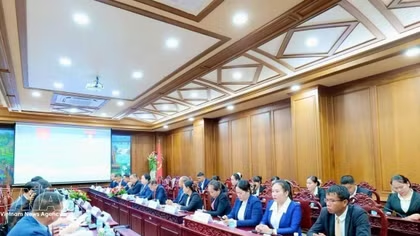
A conference to review the project from 2013-2019 has been held in Hanoi. It’s estimated that investment of 135 million USD from the World Bank's official development assistance (ODA) fund and the State budget has been spent on the project.
Tran Duy Dong, Director of the Local and Territorial Economy Department (MPI), said the project had totally changed the lives of many people in the Central Highlands.
“The project aims to enhance opportunities and livelihoods of residents in poor households and communities in the Central Highlands by improving access to basic services related to farm production and strengthening food security and nutrition,” he said.
“It also helps them to upgrade infrastructure and train local staff.
“We have built 439km of roads in rural areas, 73 new bridges and 141 clean water stations. About 142,000 households have benefited from the project thanks to training on breeding/farming and funding for them to buy their own livestocks and farms.”
Bling Thi Cot from the central province of Quang Nam shared her happiness about a new road built in her hometown in Ba Trang commune.
“I used to walk 2km to reach our field. The road was full of obstacles and impassable by vehicle,” she said.
“Last year, a new road was built, much to the delight of all the villagers. We can ride motorbikes to go to work, and come back for a rest at midday.”
A Hieu agreed: “Thanks to the road, the children don’t fall over anymore.
“Some years ago, I harvested one tonne of coffee per hectare. After the road was built, the work became easier, and last year I harvested four tonnes per hectare.”
Ho Thi Hen didn’t know that her children had a poor diet, like many other mothers in Nam Tra My district, that was until she attended a training course to raise people’s awareness of childcare and health.
“Children in my village used to eat vegetables like sweet potatoes and cassava. Life was hard and we didn’t have many options. We didn’t think much about nutrition,” Hen said.
The project arrived in her village and Hen was one of the women to receive funds and livestock.
Now she raises 20 ducks and chickens to improve her income, and her children can have eggs with their meals.
The project has spread to 26 districts in the provinces of Dak Lak, Dak Nong, Gia Lai, Kon Tum, Quang Nam and Quang Ngai.
“This project is among a number of World Bank funded operations targeting the poorest areas in the country and demonstrates the consistency between the goals of the Government and those of the bank in addressing absolute poverty,” said Keiko Inoue, World Bank Vietnam Programme Leader for Human Development.
“Over the past five years, the project has delivered technical support and financing for essential infrastructure and livelihood activities across 130 ethnic communes.”
“We are pleased to learn that according to the recently completed impact evaluation that travel time to schools and administrative centres has been reduced, drop-out rates for primary and secondary students have fallen, agriculture activities have become more diverse and animal husbandry has increased, and per capita expenditures have increased for female-headed households and for migrant ethnic minority groups,” she said.
Inoue said it would become more and more challenging to reach groups that remained behind, particularly in lagging regions, and to bridge gaps in basic services, access to economic opportunities, and poverty.
The World Bank has committed to move forward with Vietnam to bring the project to more poor areas in the northern mountainous region for a better life in the country.