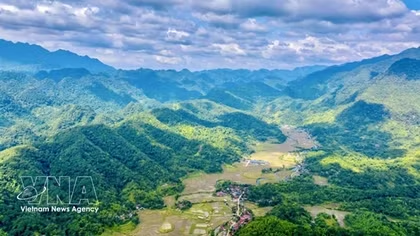
Quan Ba, a heaven of clouds and mountains

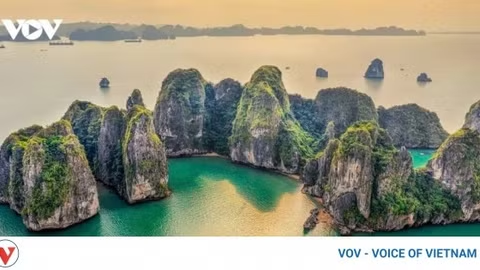
Quan Ba, a scenic district in northern Ha Giang province is a gateway to the Dong Van Karst Plateau Geopark. High rocks, small, deep valleys, winding roads, and unique local culture make Quan Ba a tourist attraction.
quan ba, a heaven of clouds and mountains hinh 0

Located between 1,000 and 1,600 meters above sea level, Quan Ba district comprises a township and 12 communes inhabited by 16 ethnic groups, 60% of them Mong, 14% Dao, and 11% Tay. Quan Ba is the only place in Vietnam that is home to the Pu Y ethnic group of 880 people.

The Tay live in stilt houses with palm thatch. The Dao build their mud house and grow wet rice at the foot of the mountains. The Mong live in the high mountains and mainly cultivate maize. The local traditional crafts are weaving, carpentry, and pottery. The Tay, Mong, and Dao in Quan Ba embrace a rich treasury of folk cultures with numerous legends, fairy tales, poems, and folk tunes.

Quan Ba is full of exceptional sites such as the Dong Van Heaven Gate, the Can Ty walls, Kho My Tung Vai cave, and Thach Son Than mountain. On the Dong Van karst plateau are two limestone peaks that evoke the shape of two female breasts that are associated with a Mong legend about a fairy named Hoa Dao (peach blossom) who fell in love with a Mong man. They got married and had a little boy. Furious, the Jade Emperor forced Hoa Dao to return to heaven. Upon leaving the earth, she left her breasts to feed her baby. Later, her two breasts turned into two mountains that the locals dubbed "Fairy Mountain". 

Nguyen Tuan Khoa, a photographer from Hanoi said "Tourists, passing through Quan Ba, stop to contemplate the beautiful landscapes and these two breast-like mountains. I have been here several times and each time have been strongly impressed."

In Quan Ba, tourists can explore ethnic villages and hamlets like Hop Tien village’s brocade weaving craft, or the Tày Cultural Village in Tam Son township. They can also listen to Then singing and Tinh zither music and attend the rite of passage to adulthood of the Dao, hear the prayers for a good harvest of the Nung and Tay, join the Gau Tao feast of the Mong, and observe the worship of the forest genie by the Pu Y.

The Quan Ba, Quyet Tien, Tung Vai, and Trang Kim markets sell local products and specialties. It would be a shame to stay in the area without sampling ethnic culinary specialties like corn alcohol, smoked pork, farm pork, corn flour, and black-legged chicken. Quan Ba has landscapes of striking beauty and meeting its ethnic minorities is an unforgettable experience.
VOV5

Other News

Vietnam secure berth at FIFA U17 World Cup 2026 for first time

Vietnam secure berth at FIFA U17 World Cup 2026 for first time

Vietnam national U17 football team secured a place at the FIFA U17 World Cup 2026 for the first time after defeating United Arab Emirates national U17 football team 3-2 on in the final Group C match of the AFC U17 Asian Cup 2026 in Saudi Arabia on early May 14 (Vietnam time).

Vietnam’s most beautiful railway station twins with French counterpart

Vietnam’s most beautiful railway station twins with French counterpart

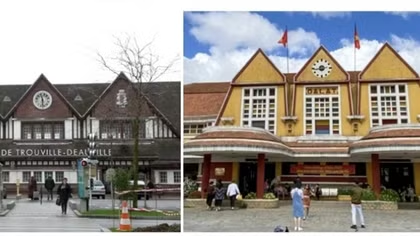
A twinning agreement between Da Lat Railway Station in Vietnam and Trouville-Deauville Railway Station in France was signed at the French Embassy in Vietnam on May 7, creating new opportunities for cooperation in station management and operations, as well as cultural and tourism promotion between the two sides.

Hanoi gains two more craft villages in World Crafts Cities network

Hanoi gains two more craft villages in World Crafts Cities network

The recognition of Chuyen My and Son Dong craft villages as members of the World Crafts Cities network represents international acknowledgement of the cultural value, artisanal techniques, creativity and sustainable vitality of Vietnam’s traditional craft villages, he said.

Thang Long - Hanoi Festival 2026 to return in September

Thang Long - Hanoi Festival 2026 to return in September

Co-hosted by the municipal People’s Committee, the Department of Culture and Sports, and domestic and foreign agencies, the whole spectacle is meant to honour the city’s millennia-old heritage while reafffirming its strategy of establishing culture as a development engine.

Spreading Vietnamese cultural identity in digital space

Spreading Vietnamese cultural identity in digital space

In the context of deep international integration, cultural identity serves as both a “shield” against assimilation and a defining marker of a nation’s image. Protecting and promoting uniquely Vietnamese cultural values has therefore become a pressing task, particularly in an increasingly complex digital environment.

ITE HCMC 2026 to promote Vietnam’s tourism on global map

ITE HCMC 2026 to promote Vietnam’s tourism on global map

With its large scale, the ITE HCMC 2026 aims to promote tourism cooperation between Vietnam and priority markets such as Northeast Asia, Western Europe, North America, Southeast Asia, and Oceania while also boosting visitor arrivals from the Indian market

Vietnamese puppetry seeks renewal amid preservation challenges

Vietnamese puppetry seeks renewal amid preservation challenges

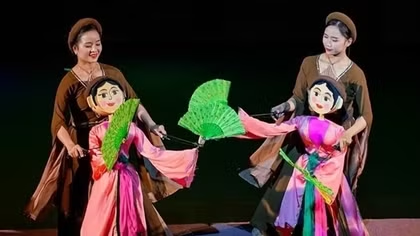
Although widely regarded as a cultural “speciality” attracting tourists, Vietnamese puppetry is facing multiple challenges in preservation and development, requiring renewed efforts to both safeguard its identity and adapt to contemporary cultural currents.

Project on digital transformation in cultural sector approved

Project on digital transformation in cultural sector approved

By 2030, the project targets the establishment of shared digital platforms across 100% of cultural sectors. All digitised cultural heritage will be standardised under the national data framework and shared in accordance with regulations, while 80% of public digital heritage assets are expected to receive digital identifiers to clarify ownership and management, encouraging organisations and individuals to do the same and support market development.

Vietnam eyes becoming region’s leading tourism destination

Vietnam eyes becoming region’s leading tourism destination

Vietnam has in recent years undergone a notable transformation in its tourism development strategy, placing a strong emphasis on nature-based and eco-tourism. This shift is not merely aligned with global trends, but represents a necessary step towards safeguarding valuable natural resources, while appealing to a growing segment of environmentally conscious travellers.