 |
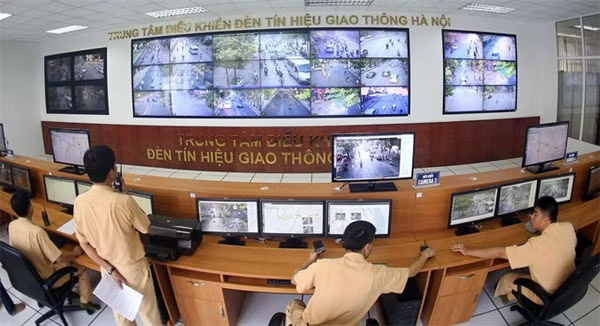
| Police officers in the traffic signal control centre of Hanoi. In the ’smart city’ future, a system of sensors and actuators would automatically handle the management of traffic signals based on current demands, without the need for human intervention. — VNA/VNS Photo Huy Hung |
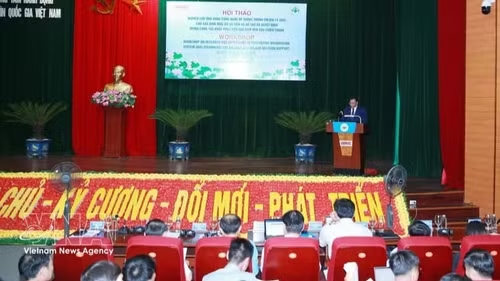
The vision of modern, urban Vietnam is usually associated with foreign giants such as Microsoft or IBM, which have partnered with Da Nang and Hanoi to realise their smart city dreams. However, as it stands, several made-in-Vietnam solutions for smart homes, meters and transportation fleet management, are ranked highly even in the global market, Tuấn said during a smart city talk held on Thursday in Hanoi by the Ministry of Planning and Investment and the Thailand-based Amata group.
Tuan stressed that with the advent of the fourth industrial revolution, with IoT at its heart, smart solutions will be necessary in the future where automation and Artificial Intelligent reign, freeing humans from repetitive labour and allowing them to focus on more innovation and creative works.
“Most importantly, the ultimate purpose of any smart initiative, including a smart city, is to improve quality of life,” he added.
The notion of the smart city has been an increasingly hot topic in Vietnam, especially as the major economic hubs of Hai Phong and HCM City have announced ambitious multi-billion projects to transform themselves in line with the demands of the digital age.
Still, ‘smart city’ remains a fairly vague concept with no rigid definition. However, most would agree that a smart city would be an urban area that intensively utilises technologies to optimise its operations – everything from simplifying administrative procedures and ensuring effective functions of water and power supply to collecting trash and managing lighting on streets at night.
A 10-component smart city was proposed which would include smart energy, smart mobility, smart community, smart environment, smart education, smart manufacturing, smart aerospace city, smart innovation, smart economy and smart governance where every component would be interlinked in a harmonious manner.
Somhatai Panichewa, CEO of Amata Viet Nam PLC, said that the company would start in Ha Long City in the coastal province of Quang Ninh as the destination for a 714ha smart city project, underlining its confidence in the future development of Vietnam’s north-eastern region.
Prime Minister Nguyen Xuan Phuc, during a meeting with several Thailand businesses within his State-level visit to Thailand last year, has asked Quang Ninh authorities to “create favourable conditions” for the company to conduct smart city projects in the province. He also told the company to pay attention to land clearance and environment protection, given the world heritage status of Ha Long City.
As the investor of two smart cities in the Eastern Economic Corridor (EEC) of Thailand, Amata Viet Nam’s leader has shared some of the ‘smart’ policies from Thailand. Despite being a country with plenty of land, Thailand’s government confined its new $45 billion investment zone to an area spanning three provinces Chonburi, Rayong, and Chachoengsao in its eastern seaboard, as these three already contributed some 20 per cent of the country’s GDP, the infrastructure can be readily upgraded and its name is already established in the global market.
Thailand’s government has delineated a clear strategy of developing smart cities within the EEC, with several investment incentives such as a flat personal income tax rate (17 per cent), reduced corporation income taxes, and extending land use certificates from the previous 30 years to up to 99 years.
“These are some of the key policies that Thailand has implemented,” Somhatai said, adding that these could be good suggestions for the Vietnamese Government to consider in crafting policies should it want to push for smart cities.
Vu Tu Thanh, deputy regional managing director and Vietnam’s representative for the US-ASEAN Business Council, said that originally, US providers of smart city solutions intended to approach the public sector as potential customers. However, as the implementation of a smart city requires inter-sectoral co-operation between several State agencies, for example, deployment of a smart transportation system in Hanoi would not need just the municipal transport department, but also construction, science and technology departments, as well as the media.
As State agencies are not easily willing to part way with the budget and resources allocated to their unit to contribute to a mutual effort, making it hard to translate ambition to reality, and as a result, American firms’ involvement in government-led smart city efforts was sputtering, Thanh said.
However, he affirmed that the reception in the private sector has been positive, with many corporations and businesses who have a long-term development strategy already investing their resources in finding ways to optimise their operations.