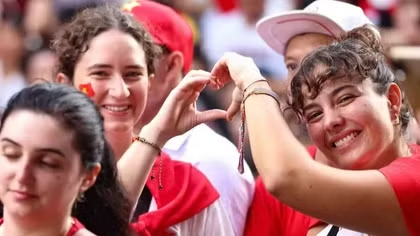
Spring festivals of ethnic minority groups

Spring is considered the season of festivals for ethnic minority people, and each ethnic group has their own festivals reflecting their customs, beliefs and farming practice. However, all of them share the wish for prosperity and happiness in the new year. 
New rice festival of Central Highlands people

Spring festivals of ethnic minority groups ảnh 1

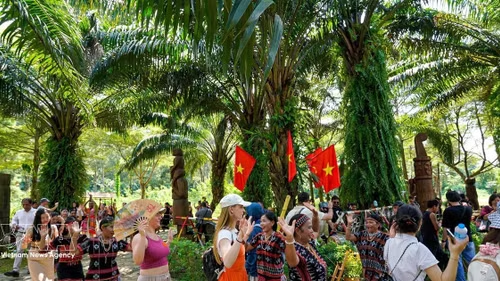
The spring or new rice festival is held by E De, Gia Rai, Ba Na, Xo Dang and M’Nong ethnic groups in the Central Highlands after harvest time to welcome a new year. Dedicated to the god of rice, the festival is usually observed in early lunar New Year to wish for favourable weather for crops. It also seeks blessings from gods for good health and prosperity for all villagers. Ritual offerings include newly harvested fragrant rice, ruou can (rice wine drunk from a jar through stalks), a cockerel, a hog and meat of wild animals.  During the festival, a rite dedicated to the god of water is conducted to ask for clean and clear water, implying good health for villagers. On festive days, villagers drink ruou can and dance to the sounds of gongs.

H’Mong outdoor playing festivity 

Spring festivals of ethnic minority groups ảnh 2

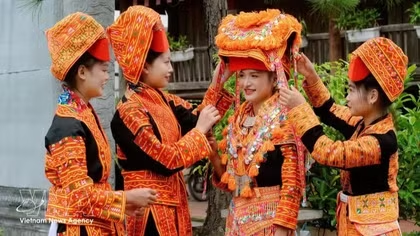
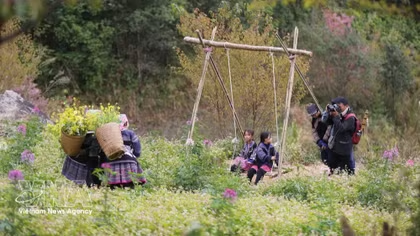
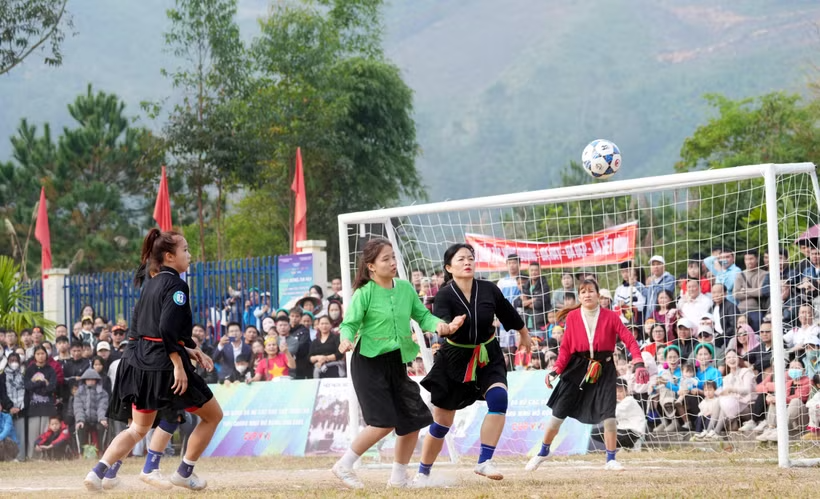
Gau tao, which means outdoor play in H’Mong language, is the traditional New Year festival of the H’Mong. Annually, a H’Mong village will meet and select a family to host the festival, which is usually held after the second day of the first lunar month and lasts between one and three days. 

On the opening day, the host prepares offerings for a ceremony to show gratitude to the heaven and earth for giving villagers health and children and pray for peace and prosperity for the village. The formality to open the festival is a pan-pipe dance followed by a singing performance led by some old men and the festival owner who is usually a prestigious villager. After that, different activities take place on a big hill, including crossbow shooting, top playing, danh yen (a game similar to badminton with the shuttlecock made of bamboo stuck with some feathers), nem pao (transferring a colorful cloth ball between teams) and gau plenh (love song) singing.

Fire jumping by the Pa Then

Spring festivals of ethnic minority groups ảnh 3

Nhay lua (fire jumping), a harvesting festival, is an original cultural activity of the Pa Then. Held right after Tet (lunar new year festival), the festivity, which reflects the Pa Then’s strength and wish to conquer nature, aims to win support from the god of fire for favourable weather, bumper crops and happiness. The god of fire is also believed by the Pa Then to expel evil spirits and save people from misery, bringing them peace and prosperity. The festival starts with lighting a fire for a deity worshiping rite conducted by a sorcerer who, surrounded by young men, sits on a bench, beating two iron objects to create repeated sounds. The young men then sit on the bench in turn, starting to get into a trance. Bending down and shaking their bodies, they start jumping and within moments, turning strong and jumping into the fire without feeling hot. Some even lay down in the fire before jumping out. Pa Then people believe the duration a man can jump in a fire depends on his strength bestowed by deities, which keeps him from being burned. 

H’Tend, New Year celebration of the H’re

Spring festivals of ethnic minority groups ảnh 4

H’Tend, the festival of the H’re, who lives mostly in central Vietnam, takes place in the second or third lunar month. Before H’Tend, people prepare food, clean their homes and villages, set up cay neu (new year tree) and prepare musical instruments and clothing. On the first day of H’Tend, H’re people conduct a rite to clean their homes, expel evil spirits and receive fortune and happiness. This rite is followed by an offering ceremony to deities and ancestors who are believed to join family members celebrating the new year and protect them. After these two rites, villagers make sticky rice cakes and kill pigs and chickens as offerings for a buffalo worshiping ceremony held the next day. This ceremony is held at dawn right at the buffalo stall to pray for good health for the cattle. After that, people have a party together, drinking ruou can, chatting, playing gongs, dancing and playing traditional games. On the last day of H’Tend festival, people clean homes to welcome guests. During H’Tend, people wish one another good health, success and prosperity.

Muong Bi people start a year with khai ha festival 

Spring festivals of ethnic minority groups ảnh 5

Khai ha (going down the field) is a big festival of Muong Bi group in Hoa Binh northern mountainous province. Held annually right after Tet to review the old year and mark a new year, the festivity is a chance for Muong Bi people to show their respect for gods and pray for a year of peace and prosperity. According to Muong Bi custom, only after khai ha can people go down the field to prepare a new crop and go to the forest for hunting and picking up forest products. People attending this festival all bring along a rice ball. The festival consists of two main parts: the offering ceremony conducted at the village temple and festive activities. An original trait of khai ha is the formality to repair Lo canal, the one irrigating the whole region. Each family sends a member to dredge and clean up the canal. After that, people have a meal together, eating food offerings shared to them and drinking ruou can. Festive activities open with the gong performance by Muong girls, followed by folk games such as crossbow shooting, tug of war, top playing, sac bua (gong playing) competition and responsive singing.

Xen Ban, Xen Muong, Thai ceremony dedicated to village founders

Spring festivals of ethnic minority groups ảnh 6

In the second lunar month, Thai people hold Xen Ban, Xen Muong, one of the group’s biggest festivals in memory of founders of Muong, the land of the Thai. Starting the ceremony is a procession of the offering tray from the village head’s home to the communal house. Leading the procession are the village head and other dignities, followed by young people carrying four gongs and a drum together with pan-pipes and flutes. Then come old villagers in colourful costumes, bringing bows and arrows and taking two buffaloes as the sacrifice. Finally are the village’s guards also in colourful costumes and red hats, carrying matchlocks, swords and spears on their shoulders. The procession is followed by the sacrifice ceremony conducted by a sorcerer. After that young people join dancing and singing contests, archery competition and play nem con. After the festival, Thai people refrain from receiving strangers, farming and going to forest for several days. Every house is closed with green tree branches hung outside.

Roong Pooc, biggest festival of the Giay

Spring festivals of ethnic minority groups ảnh 7

Annually on the day of the dragon of the first lunar month, the Giay in Sa Pa, Lao Cai northern province, opens Roong Pooc(going down the field), the festival dedicated to the Jade Emperor, fairies and deities, praying for their blessing for prosperity, peace and fine weather throughout the year. Giay people believe if they fail to celebrate Roong Pooc in a year, they will encounter numerous difficulties in that year, suffering misfortunes such as illness and natural disasters.
Roong Pooc starts with a sorcerer’s ritual offering. The offerings, which symbolize prosperity, include cloth, eggs, bamboo shoots, silver coins and 6 qua con (cloth ball) made by unmarried girls. Closing the ritual, the sorcerer gives the cloth balls for prestigious old villagers to throw them through the ring put on a high bamboo pole. Symbolizing the sun and moon, this ring has one side stuck with red paper and the other with yellow paper. When the ball is thrown through the ring, each family in the village burns incense on the altar set up for the offering rite to pray for good luck for their family and village. Villagers then play nem con, tug of war and hold a ploughing competition for young men.
VNA

Other News

UAE grants visa-on-arrival for eligible Vietnamese citizens

UAE grants visa-on-arrival for eligible Vietnamese citizens

PSNews - The UAE Embassy in Vietnam also confirmed that Vietnamese citizens holding ordinary passports, and their eligible accompanying family members, are able to get a visa on arrival from June 25, 2026 as long as they meet the above requirements.

Hanoi festival celebrates cultural heritage of lotus

Hanoi festival celebrates cultural heritage of lotus

The festival is part of Hanoi's strategy to boost its cultural industries by transforming cultural heritage into a driver of socio-economic development while preserving and promoting the city's traditional cultural values.

Vietnam's Hidden Spa-Water Hope wins top jury prize at Architizer A+Awards 2026

Vietnam's Hidden Spa-Water Hope wins top jury prize at Architizer A+Awards 2026

Nestled among coastal sand dunes in Cam Ranh, the project was conceived with a strong commitment to respecting the natural landscape and harnessing water as its central element. Rather than creating a visually dominant structure, the design blends into the terrain, making use of sand layers, native vegetation and open spaces to strengthen the connection between people and nature.

Heritage resources fuel Hue's new growth ambitions

Heritage resources fuel Hue's new growth ambitions

Hue is simultaneously stepping up efforts to attract investment into tourism, services and cultural industries. In the first five months of 2026, the city secured more than 19 trillion VND in newly registered investment capital, with projects planned in coastal tourism, lagoon-based ecotourism, cultural spaces along the Perfume River, convention and exhibition centres, night-time economy projects and cultural innovation hubs.

Phu Tho moves to unlock tourism potential after administrative mergence

Phu Tho moves to unlock tourism potential after administrative mergence

With coordinated efforts in planning, infrastructure development, product diversification, human resources training, digital transformation and destination branding, Phu Tho is well-positioned to transform tourism into a spearhead economic sector and a new engine of sustainable growth in the years ahead.

AI ushers in a new era for digital art

AI ushers in a new era for digital art

As cultural industries and the creative economy gain momentum, AI is proving valuable in improving efficiency, streamlining operations and enabling creators to focus more on artistic content.

Green tourism charts a new course for Vietnam

Green tourism charts a new course for Vietnam

With its rich agricultural ecosystem, where each region boasts unique produce, culinary traditions, and farming practices, Vietnam is well positioned to develop and expand the farm-to-table model. Cities and provinces, such as Hanoi, Thai Nguyen, Da Nang, Hue, Can Tho, Lam Dong, and Vinh Long, are already embracing the model as part of their green tourism strategies.

Wildlife protection drive delivers encouraging conservation gains

Wildlife protection drive delivers encouraging conservation gains

Implemented under Plan 628, a joint initiative between the Ministry of Public Security and the Ministry of Agriculture and Environment, the campaign marks a shift towards a more coordinated and long-term approach to protecting wildlife and natural resources.

Vietnam seeks strong global presence for its children's books

Vietnam seeks strong global presence for its children's books

According to experts, Vietnam needs a systematic and long-term strategy to bring its children’s literature to the world. This includes strong support for authors, illustrators, editors, translators, and copyright specialists, as well as greater participation in international book fairs as part of a cultural industry development strategy.

Lotus Festival lights up Hue's summer

Lotus Festival lights up Hue's summer

Scheduled for June 19-21 at Bong Lai Islet on Tinh Tam Lotus Lake in Phu Xuan ward, one of Hue’s most renowned scenic landmarks and a symbol of royal garden art, the festival draws inspiration from the lotus’s enduring beauty in court culture. The event aims to honour local heritage while offering visitors a distinctive summer tourism experience.

ASEAN city leaders explore Hanoi's heritage sites

ASEAN city leaders explore Hanoi's heritage sites

At the Imperial Citadel of Thang Long, delegates visited the Doan Mon Gate and learnt about the formation and development of the ancient capital through different historical periods at display spaces. They also explored the Kinh Thien Palace’s Dragon Steps (large stone steps with dragon carvings), regarded as the political and ceremonial centre of the imperial citadel during successive Vietnamese dynasties.

Heritage takes centre stage at Da Nang International Fireworks Festival 2026

Heritage takes centre stage at Da Nang International Fireworks Festival 2026

Vietnam's Z121 Vina Pyrotech impressed spectators at Da Nang International Fireworks Festival (DIFF) 2026 with a display deeply rooted in national identity. Using modern pyrotechnic technology, the team recreated the image of the palm tree, a symbol of the ancestral land of Phu Tho, before closing with a spectacular synchronised fireworks finale set to the iconic song Noi vong tay lon (Joining Hands Together), drawing enthusiastic applause from audiences.

Phong Nha – Ke Bang earns UNESCO World Biosphere Reserve status

Phong Nha – Ke Bang earns UNESCO World Biosphere Reserve status

The recognition marks the third UNESCO accolade for Phong Nha – Ke Bang, which was inscribed as a World Natural Heritage Site in 2003 and again in 2015. The latest designation highlights the park's global ecological significance while opening new prospects for conservation and sustainable development.

Night-time economy drives growth of Hanoi's cultural industries

Night-time economy drives growth of Hanoi's cultural industries

Under the Politburo’s Resolution No. 80-NQ/TW on the development of Vietnamese culture, Hanoi has been given fresh opportunities to leverage its cultural, historical, tourism and creative assets. The city’s recently approved project on developing the night-time economy for 2026–2030, with a vision to 2045, is expected to create momentum for cultural industry growth while enhancing Hanoi’s standing as a creative and modern city with a distinctive identity.

Efforts made to preserve, promote values of Non nuoc Cao Bang global geopark

Efforts made to preserve, promote values of Non nuoc Cao Bang global geopark

UNESCO presented certificates to 12 newly designated UNESCO Global Geoparks and 44 others that successfully passed revalidation in Paris on April 27, 2026. Among them, Vietnam’s Non Nuoc Cao Bang Global Geopark was once again honoured, reaffirming its outstanding heritage and sustained efforts in preservation and promotion.