Students in low-risk localities returning to schools after closure

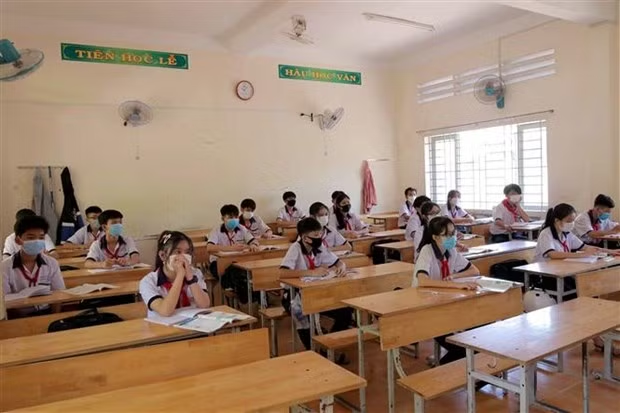
The northern province of Thai Binh and the Mekong Delta province of Ca Mau were the two first localities in Vietnam to let students return to schools on April 20 after an extended closure due to COVID-19.

The northern province of Thai Binh and the Mekong Delta province of Ca Mau were the two first localities in Vietnam to let students return to schools on April 20 after an extended closure due to COVID-19.

In the Mekong Delta province of Ca Mau, nearly 22,000 ninth and twelfth graders were back to school while other students still stay at home and wait for further notice.

Schools were requested to split classes into smaller groups and implement measures to maintain a safe distance of two metres between parents when waiting to pick up their children.

While in Thai Binh province, students from grade 9 to 12 only spend half a day at schools as opposed to the usual full-time schedule. The provincial Department of Education and Training also asked high schools to arrange for grade 11 and 12 to study in the morning and grade 10 in the afternoon.

The Thanh Hoa provincial People’s Committee on the day released an urgent notice to allow secondary and high school students to come back to school on April 21.

In southern Vinh Long province, ninth and twelfth graders will return to schools from April 27.

Other localities in the low-risk group of infections also have plans to re-open secondary and high schools in late April or early May. Primary schools and kindergartens are expected to receive students one or two weeks later.

Schools are asked to sterilize campuses, provide soap and antiseptic hand wash for students and ensure ventilation. All mass gatherings including field-trips or extra classes are currently prohibited until further notice.

Deputy Minister of Education and Training Nguyen Huu Do said 35 low-risk provinces and cities across the country should consider when to re-admit students as well as put the safety of students and teachers first.

Final year students including ninth and twelfth graders should be prioritized to return to school, he said, adding students did not need to be on campus the whole week. Timetables can be re-scheduled to make sure students spend at least three days at school.

The deputy minister said each class could be divided in half while online and on-campus teaching could be combined to ensure knowledge is delivered for students.

He also asked schools to strictly follow instructions of the Ministry of Education and Training and Ministry of Health on practicing good hygiene.


VNA

Other News

Hanoi ready to implement Capital Law 2026, unlocking new development momentum

Hanoi ready to implement Capital Law 2026, unlocking new development momentum

The effectiveness of the Capital Law 2026 will be measured not by the number of legal documents issued but by tangible improvements in governance and public administration, better services for people and businesses, faster administrative procedures, stronger investment attraction and higher economic growth.

Vietnamese students earn honours at ROBOG Asia Cup 2026

Vietnamese students earn honours at ROBOG Asia Cup 2026

Three teams from Chu Van An Secondary School in Vietnam’s Thai Nguyen province have earned First Prize honours and advanced to the quarterfinals at the ROBOG Asia Cup 2026, a regional robotics and artificial intelligence (AI) competition for students held in Hong Kong, China.

Hanoi sets out new investment blueprint with century-long development vision

Hanoi sets out new investment blueprint with century-long development vision

As of early June, Hanoi had attracted 74.6 billion USD in foreign direct investment (FDI) through more than 9,250 valid projects. FDI inflows in the first six months were projected at 3.2 billion USD, surpassing the annual target by 116%, while nearly 16,000 new businesses were established in the first five months, up 34.4% year-on-year.

Vietnam promotes legal cooperation and rule of law at global forum

Vietnam promotes legal cooperation and rule of law at global forum

Vietnam’s development and international integration have gone hand in hand with the improvement of its legal system, the incorporation of international commitments into domestic legislation, and legal reforms aimed at fostering development, openness and global integration. The country regards international law as an essential instrument for building fair, mutually beneficial relations among nations.

Hanoi to hold investment promotion event on June 29

Hanoi to hold investment promotion event on June 29

At the event, Hanoi authorities plan to grant investment policy decisions and investment registration certificates to 20 exemplary projects in the fields of transportation infrastructure, industrial parks, urban development, social housing, environment, science and technology, and foreign investment attraction.

Hanoi's Red River urban area development draws widespread attention

Hanoi's Red River urban area development draws widespread attention

Located south of the Red River and extending from the historic inner city to newly developing areas in the south and the west, the central urban area along Red River’s right bank covers approximately 45,317 hectares and is projected to accommodate around 6.365 million residents by 2045 and 6.455 million by 2065.

Hanoi's Red River urban area development draws widespread attention

Hanoi's Red River urban area development draws widespread attention

Located south of the Red River and extending from the historic inner city to newly developing areas in the south and the west, the central urban area along Red River’s right bank covers approximately 45,317 hectares and is projected to accommodate around 6.365 million residents by 2045 and 6.455 million by 2065.

Regional cooperation strengthened to combat cross-border drug crime

Regional cooperation strengthened to combat cross-border drug crime

Vietnam, China, Laos and Myanmar face common challenges as drug syndicates increasingly exploit the Mekong River, cross-border transport networks, e-commerce platforms, international logistics services, cyberspace and cryptocurrencies to organise drug transactions and smuggling operations.