Tet food reflects different lifestyles

The three main regions of Vietnam are characterised by different climate and soil conditions that result in different traditions and customs, and some of these have to do with which traditional dishes are favoured and how they are prepared when Tet, the Lunar New Year, is celebrated.

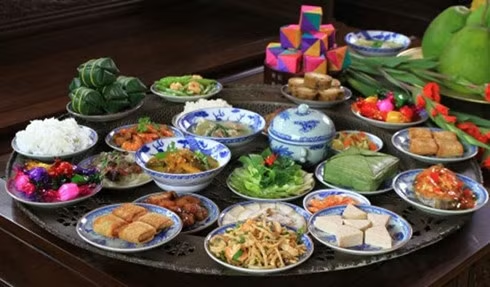
Taking as example the banh chung and banh tet, which are the most important Tet dishes. While people in the north prefer banh chung – square cake, residents in the former royal capital city of Hue in the central region prefer banh tet – the cylinder sticky rice cake that is said to symbolise a shoulder pole (the Centre) carrying two baskets (the North and the South) at either ends.

Another difference that can be seen is that the sizes of the cakes are smaller in the central region. Hue residents like to claim that this denotes an emphasis for sophistication rather than volume, as also greater skills required to shape and wrap the smaller cakes.

While banh chung and banh tet are the items that Hue inherited from ancestors who came in from the North, dua mon, which is sliced papaya, kohlrabi, carrot and onion preserved in salt, sugar and vinegar, is a ‘endemic’ Tet dish of locals. It is as an accompaniment to banh chung and banh tet in order to enjoy a combination of different tastes - sweet, salty, fatty and spicy.

Predicting the Tet weather in Hue is a difficult task. It might be hot at above 30 Celsius degrees or be cold under 15 Celsius degrees with continuous rains for a week. With such unpredictable weather conditions, banh tet and dua mon are the best choices for Tet food, since they can be preserved for up to 15 days, and people do not have to spend too much time in the kitchen.

Most Vietnamese men drink alcohol to celebrate Tet. And as a tradition, Hue women also prepare food for the drinkers, like slices of pig stomach and Roxburgh fig (Ficus auriculata) soaked in sweetened fish sauce. This fig preparation is a Hue specialty because the tree does not grow so well outside Thua Thien- Hue province.
Blessed with a lot of sunlight and rich soil to grow plants and vegetables all year round, the southern region enjoys an abundance of fruits, vegetables and seafood. So there is an air of unmistakable prosperity here, compared to other rural regions in the country.
Their Tet food, apart from the banh chung and banh tet, are easy to cook, with some of the more popular dishes including pork cooked in coconut milk and a soup cooked with bitter gourd stuffed with mushrooms and pork.
Coconut palms can be found everywhere in the South, and bitter gourds grow in just about every garden. The fruit is called kho qua in the south. Literally, kho  means hardships in life and qua means over. The kho qua soup conveys the wish to overcome hardships in the coming year.
These dishes are easy to cook, taking very little time compared to the week-long preparations that Hue dishes involve.
VNA

Other News

Vietnam secure berth at FIFA U17 World Cup 2026 for first time

Vietnam secure berth at FIFA U17 World Cup 2026 for first time

Vietnam national U17 football team secured a place at the FIFA U17 World Cup 2026 for the first time after defeating United Arab Emirates national U17 football team 3-2 on in the final Group C match of the AFC U17 Asian Cup 2026 in Saudi Arabia on early May 14 (Vietnam time).

Vietnam’s most beautiful railway station twins with French counterpart

Vietnam’s most beautiful railway station twins with French counterpart

A twinning agreement between Da Lat Railway Station in Vietnam and Trouville-Deauville Railway Station in France was signed at the French Embassy in Vietnam on May 7, creating new opportunities for cooperation in station management and operations, as well as cultural and tourism promotion between the two sides.

Hanoi gains two more craft villages in World Crafts Cities network

Hanoi gains two more craft villages in World Crafts Cities network

The recognition of Chuyen My and Son Dong craft villages as members of the World Crafts Cities network represents international acknowledgement of the cultural value, artisanal techniques, creativity and sustainable vitality of Vietnam’s traditional craft villages, he said.

Thang Long - Hanoi Festival 2026 to return in September

Thang Long - Hanoi Festival 2026 to return in September

Co-hosted by the municipal People’s Committee, the Department of Culture and Sports, and domestic and foreign agencies, the whole spectacle is meant to honour the city’s millennia-old heritage while reafffirming its strategy of establishing culture as a development engine.

Spreading Vietnamese cultural identity in digital space

Spreading Vietnamese cultural identity in digital space

In the context of deep international integration, cultural identity serves as both a “shield” against assimilation and a defining marker of a nation’s image. Protecting and promoting uniquely Vietnamese cultural values has therefore become a pressing task, particularly in an increasingly complex digital environment.

ITE HCMC 2026 to promote Vietnam’s tourism on global map

ITE HCMC 2026 to promote Vietnam’s tourism on global map

With its large scale, the ITE HCMC 2026 aims to promote tourism cooperation between Vietnam and priority markets such as Northeast Asia, Western Europe, North America, Southeast Asia, and Oceania while also boosting visitor arrivals from the Indian market

Vietnamese puppetry seeks renewal amid preservation challenges

Vietnamese puppetry seeks renewal amid preservation challenges

Although widely regarded as a cultural “speciality” attracting tourists, Vietnamese puppetry is facing multiple challenges in preservation and development, requiring renewed efforts to both safeguard its identity and adapt to contemporary cultural currents.

Project on digital transformation in cultural sector approved

Project on digital transformation in cultural sector approved

By 2030, the project targets the establishment of shared digital platforms across 100% of cultural sectors. All digitised cultural heritage will be standardised under the national data framework and shared in accordance with regulations, while 80% of public digital heritage assets are expected to receive digital identifiers to clarify ownership and management, encouraging organisations and individuals to do the same and support market development.

Vietnam eyes becoming region’s leading tourism destination

Vietnam eyes becoming region’s leading tourism destination

Vietnam has in recent years undergone a notable transformation in its tourism development strategy, placing a strong emphasis on nature-based and eco-tourism. This shift is not merely aligned with global trends, but represents a necessary step towards safeguarding valuable natural resources, while appealing to a growing segment of environmentally conscious travellers.