Tet fruit tray, indispensible part of Vietnamese culture

A “Mam Ngu Qua” or five-fruit tray is indispensable for each Vietnamese family among the numerous offerings that are required to decorate ancestral altars during the traditional Lunar New Year (Tet) festival.

The tray symbolizes the wholeheartedness and gratitude of the present generation towards their ancestors and the Genie of the Land during Tet.

Like other popular rituals, the preparation of a five fruit tray for Tet has become an established convention.

During the few days just before Tet, the Vietnamese begin to buy the necessary fruits for this purpose.
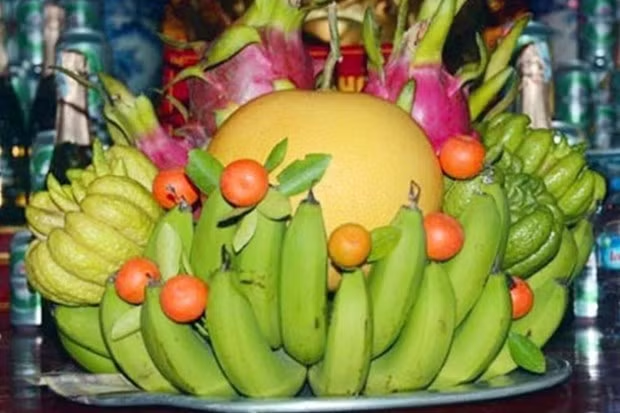
A five fruit tray is usually composed of a hand of green bananas, a ripe pomelo (or a Buddha's hand, a shaddock), oranges, persimmons, sapodilla plums, a bunch of kumquat (Photo: VNA)

A five fruit tray is usually composed of a hand of green bananas, a ripe pomelo (or a Buddha's hand, a shaddock), oranges, persimmons, sapodilla plums, a bunch of kumquat, and in recent years, one can add mangoes and grapes from southern Vietnam, or apples and pears from China. Although it is called a five fruit tray, it does not necessarily contain exactly five kinds of fruit.

Arranging fruits on the crimson, hourglass shaped wooden tray is really an art. One has to combine the colours and shapes of the different fruits in arranging them on the tray to make it look like a still life picture.

To ensure balance on the tray, the hand of bananas is usually put in the middle with the bananas pointing upright and the pomelo on the concave surface of the hand of bananas. Then the oranges, sapodilla plums, apples are added in the gaps between the bananas and the pomelo.

The last little gaps are filled in with little kumquats to create a full, compact tray of fruits.

In colours, the fruit tray presents a harmonious combination of the different colours of fruits: dark green of banana, light yellow of pomelo, deep red of persimmon, reddish yellow of orange and kumquat, light green of apple, and dark brown of sapodilla plum. To complete the picture, the fruit tray will be covered here and there with some small, fresh leaves of kumquat.

The five-fruit tray, together with horizontal lacquered boards engraved with Chinese characters, parallel sentences written on red paper, ornamental kumquat and peach trees, and popular Hang Trong and Dong Ho pictures, has transcended its material value to become a spiritual symbol, an original national product in the spiritual life of the Vietnamese.

At present, while many of the ancient spiritual values have sunk into oblivion, the custom of arranging the five fruit tray on the altar during the lunar New Year days is being jealously preserved as a fine legacy of Vietnam's traditional culture.

The “Mam Ngu Qua” in Tet Festival represent the quintessence that Heaven and Earth bless humans. This is one of the general perceptions of life of the Vietnamese, which is “An qua nho ke trong cay” (When taking fruit, you should think of the grower).

VNA

Other News

Vietnam secure berth at FIFA U17 World Cup 2026 for first time

Vietnam secure berth at FIFA U17 World Cup 2026 for first time

Vietnam national U17 football team secured a place at the FIFA U17 World Cup 2026 for the first time after defeating United Arab Emirates national U17 football team 3-2 on in the final Group C match of the AFC U17 Asian Cup 2026 in Saudi Arabia on early May 14 (Vietnam time).

Vietnam’s most beautiful railway station twins with French counterpart

Vietnam’s most beautiful railway station twins with French counterpart

A twinning agreement between Da Lat Railway Station in Vietnam and Trouville-Deauville Railway Station in France was signed at the French Embassy in Vietnam on May 7, creating new opportunities for cooperation in station management and operations, as well as cultural and tourism promotion between the two sides.

Hanoi gains two more craft villages in World Crafts Cities network

Hanoi gains two more craft villages in World Crafts Cities network

The recognition of Chuyen My and Son Dong craft villages as members of the World Crafts Cities network represents international acknowledgement of the cultural value, artisanal techniques, creativity and sustainable vitality of Vietnam’s traditional craft villages, he said.

Thang Long - Hanoi Festival 2026 to return in September

Thang Long - Hanoi Festival 2026 to return in September

Co-hosted by the municipal People’s Committee, the Department of Culture and Sports, and domestic and foreign agencies, the whole spectacle is meant to honour the city’s millennia-old heritage while reafffirming its strategy of establishing culture as a development engine.

Spreading Vietnamese cultural identity in digital space

Spreading Vietnamese cultural identity in digital space

In the context of deep international integration, cultural identity serves as both a “shield” against assimilation and a defining marker of a nation’s image. Protecting and promoting uniquely Vietnamese cultural values has therefore become a pressing task, particularly in an increasingly complex digital environment.

ITE HCMC 2026 to promote Vietnam’s tourism on global map

ITE HCMC 2026 to promote Vietnam’s tourism on global map

With its large scale, the ITE HCMC 2026 aims to promote tourism cooperation between Vietnam and priority markets such as Northeast Asia, Western Europe, North America, Southeast Asia, and Oceania while also boosting visitor arrivals from the Indian market

Vietnamese puppetry seeks renewal amid preservation challenges

Vietnamese puppetry seeks renewal amid preservation challenges

Although widely regarded as a cultural “speciality” attracting tourists, Vietnamese puppetry is facing multiple challenges in preservation and development, requiring renewed efforts to both safeguard its identity and adapt to contemporary cultural currents.

Project on digital transformation in cultural sector approved

Project on digital transformation in cultural sector approved

By 2030, the project targets the establishment of shared digital platforms across 100% of cultural sectors. All digitised cultural heritage will be standardised under the national data framework and shared in accordance with regulations, while 80% of public digital heritage assets are expected to receive digital identifiers to clarify ownership and management, encouraging organisations and individuals to do the same and support market development.

Vietnam eyes becoming region’s leading tourism destination

Vietnam eyes becoming region’s leading tourism destination

Vietnam has in recent years undergone a notable transformation in its tourism development strategy, placing a strong emphasis on nature-based and eco-tourism. This shift is not merely aligned with global trends, but represents a necessary step towards safeguarding valuable natural resources, while appealing to a growing segment of environmentally conscious travellers.