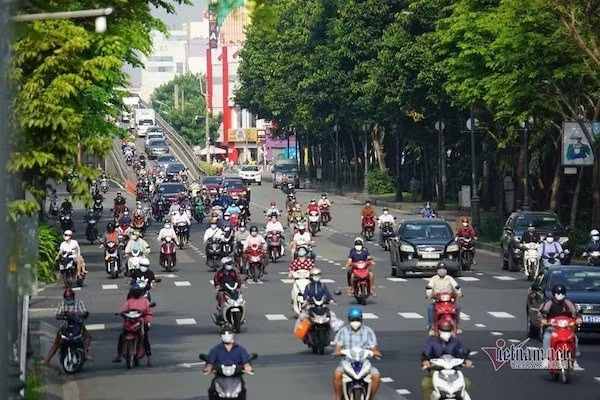
The local media no longer reports about long lines of trucks stuck at the gate of Hai Phong port or the gateway into Can Tho City, or about truck drivers jostling for COVID-19 testing to get in and out provinces.
The growth indicators and industrial production of cities and provinces that are considered the country’s economic locomotives have begun to rise again.
According to a report from Prime Minister Pham My Chinh, also Head of the National Steering Committee on Epidemic Prevention and Control, given to the National Assembly last weekend, in October and the first days of November state agencies at all levels and local governments changed their thinking, methods and ways of organizing epidemic prevention and control in accordance with the motto of “safe adaptation, flexibility, effective control of the COVID-19 epidemic”, while removing difficulties for production and business, implementing a roadmap to gradually open the economy. As a result, “the socio-economic situation in October turned positive compared to the previous month," he said.
That is a good sign for the new anti-epidemic strategy that the Prime Minister initiated after painful experiences from the outbreaks in Ho Chi Minh City and the southern provinces.
Two locomotives of economy speed up
Economic expert and National Assembly deputy Tran Hoang Ngan said that after over a month of reopening, Ho Chi Minh City has made "very positive changes".
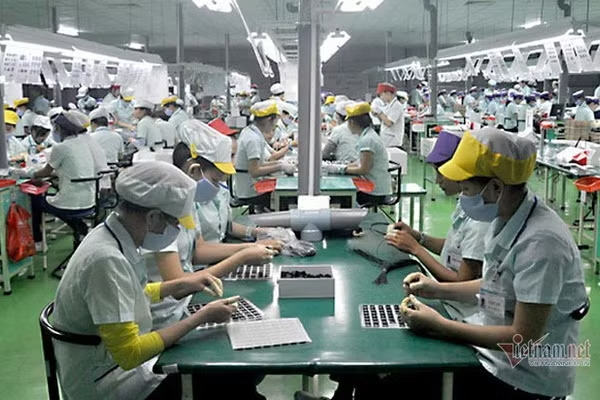
At its hi-tech park, 100% of enterprises have resumed operations with a total of 47,000 employees. In 17 industrial clusters, industrial parks, and export processing zones in the city, 1,355 enterprises have opened again, accounting for 96% of the total. The city's index of industrial production (IIP) in October increased by 23.6% compared to September.
Ngan said that HCM City will try to achieve budget revenue of VND364,893 billion this year, of which VND296,000 billion will be transferred to the state budget and the city will keep VND69,000 billion. "The city will make maximum efforts to join the entire country to restore economic development," he said.
Th largest city of Vietnam implemented a lockdown for five months under Directives 15 and 16, so the goal will not be easy.
In the northern economic center, Hanoi also recorded significant changes after reopening, with the IPP up by 10.2% over the previous month and up by 5.6% compared to the same period last year.
Hanoi did not apply three-on-the-spot model in industrial zones, so its industrial production was not interrupted.
The capital city’s budget revenue in January-October of 2021 reached VND215 trillion, or 91.5% of the assigned plan and 85.7% of the city's estimate, up 7.6% year on year.
“Hanoi has been trying its best, implementing measures to effectively control the epidemic as soon as possible; focusing on solving difficulties, supporting businesses to overcome challenges to maintain and restore production and business, and minimizing negative impacts caused by the COVID-19 pandemic,” Hanoi Party Secretary Dinh Tien Dung told the business community in a recent dialogue.
The costs
However, it has been a hard road for the reopening since October 1.
To combat the pandemic, businesses in many provinces across the country had to implement the "three on the spot" and "one road - two destinations" models in early 2021. At first, this model seemed to work in Bac Giang and Bac Ninh, where the pandemic broke out in early 2021, but later, when these models were deployed on a large scale, they disrupted the supply chain and circulation of goods.
Dr. Pham Hong Chuong, Rector of the National Economics University, and scientists said that these models were applied rigidly and caused great difficulties for businesses both in terms of cost and risk in disease control, health and living space, because the physical conditions to meet the requirements of both working and living at the same site were not designed appropriately from the start.
Many highly qualified workers in big cities such as Hanoi, Ho Chi Minh City, Hai Phong, Da Nang were unable to go to work, disrupting the labor source.
Traffic control measures and the concept of "essential goods" in localities differed, which hindered the transportation and circulation of goods. The supply chain of processed and manufactured goods such as electricity, electronics, machinery and equipment suffered a disruption in the supply of labor and raw materials. The supply chain of aquatic products and agricultural products was also disrupted in terms of labor, markets, transportation; and the supply chains of textiles and garments were broken due to the labor-related problems and the high cost of satisfying production conditions.
Lockdown measures under Directive 16 in 23 provinces brought about great consequences, causing the country’s Q3 growth rate to be its lowest in Vietnam’s statistical history.
That situation could not last any longer.
Turning point in thinking
August 29 was a special day in the fight against the epidemic in Vietnam. Presiding over the anti-epidemic meeting with leaders of 20 provinces, Prime Minister Pham Minh Chinh said: "We set the goal to contain and control the pandemic, but also determined that this war is still long, and we have to live with the pandemic for a long time, so we cannot completely control the disease, but have to adapt to it and have a suitable approach.
The message "live with the virus for the long run” that was introduced by the Prime Minister at that meeting marked a turning point in the fight against the epidemic, which had been previously based on the Zero COVID philosophy since the beginning of 2020. Although it may have been true for the old virus strains, it caused great damage to livelihoods and production because for every case, a whole factory, market, village or district was put under lockdown.
However, because the message was strong, breaking the stronghold of Directives 15, 16, 19, it did not appear in the concluding document issued the next day.
But, in the end, the new anti-epidemic thinking prevailed and came to life. The economy reopened on October 1 after the trauma in HCM City and economic losses.
Initiating and pursuing the vaccine diplomacy strategy after falling short of the pace compared to many other countries in accessing vaccines in 2020, the Prime Minister and diplomats created a miracle when bringing vaccines home for the people.
Vaccinations have been implemented very quickly. Vietnam has risen to the top countries in vaccination rates in ASEAN. The Prime Minister’s original epidemic prevention strategy — "5K + vaccine" has been extended to specific drugs + treatment measures + technology + raising people's awareness + other measures such as traditional medicine.
Those measures hope to contain the epidemic which is at risk of spreading in some provinces.
Answering questions raised by National Assembly deputies at the recent Q&A session, the Prime Minister said that after consulting the World Health Organization (WHO), Vietnam focused on a people-centered approach, with people as the center in epidemic prevention. "Since then, all policies have been geared towards the people, and vice versa, the people must also participate in epidemic prevention and control in a proactive manner."