The mystery of 500-year-old Quyet Thanh pottery products

PSNews - Quyet Thanh pottery village, which is located in Que town (Kim Bang district, Ha Nam province),was founded in 16th century or about 500 years ago. 

It used to be called Dinh Xa village, specializing in producing wine bottles, teapots, potsfor famous Vu Dai village to cook fish dishes. Recently, Quyet Thanh village's products have been exported to Japan, HongKong, US, to name but a few.

Pottery village - Ups and downs

Quyet Thanh or Dinh Xa village is 5 km away from Phu Ly city. Since 1959, local authorities have officially renamed the village Quyet Thanh, and the traditional pottery industry has been restored ever since marked by the birth of a pottery co-op.
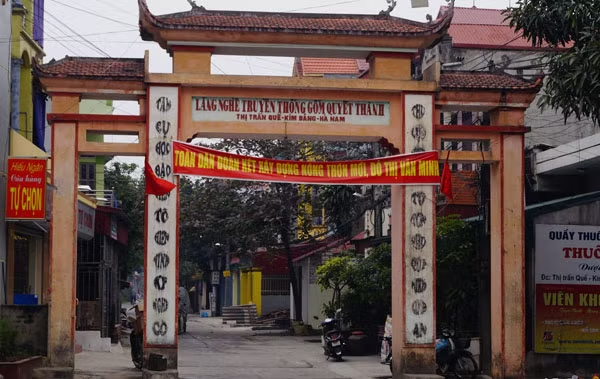
The entrance to Quyet Thanh village

At first, pottery was only produced in Ha village. When pottery products were well sold on the market, pottery production was expanded, attracting labors from neighboring villages. Later, pottery production spread over several villages, but Ha village-based co-op Quyet Thanh was still the hub of the area’s pottery production.

However, pottery products had then to make way for stainless steel cookware in the later 1990s and the early 2000s. Quyet Thanh Pottery Co-op was closed. Many kilns were abandoned and pottery production shrank. Pottery makers had also to peddle their products around.

Of the total 200 households, only 70 still produced pottery products at a low pace and on a small scale.
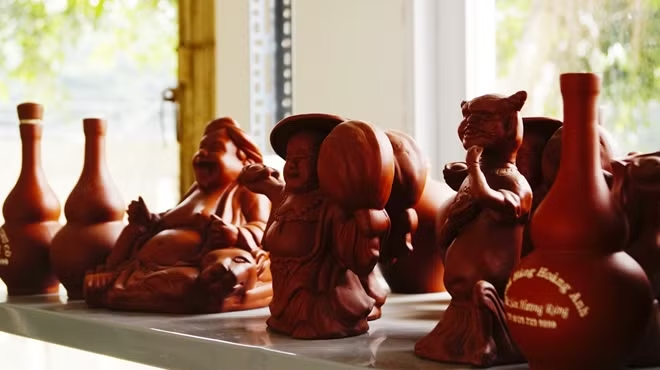
In 2004, Quyet Thanh village was recognized as a traditional craft village of Ha Nam province, and Quyet Thanh Pottery Co-op was reestablished. Since then, various products with golden color have been widely promoted at home and overseas. Skilled pottery workers have been recognized for their contributions to the development of pottery. Pottery production in Quyet Thanh village has gradually been restored, and Quyet Thanh pottery has become a renowned brand.

Thanks to the enthusiasm and creativity of pottery partisans and workers, Quyet Thanh village now produces 6 million products per year, mainly including wine bottles, teapots and cooking pots. They are distributed in many provinces, including Hanoi, Ha Giang, Thai Binh, Thanh Hoa and some Southern provinces. Although there are only 5 kilns, including just one invested in with high technology, the Quyet Thanh Pottery Co-op is still creating a large number of pottery products with various styles and shapes, preserving and fostering the traditional craft.

Nguyen Duc Phu, Chairman ofthe Quyet Thanh Pottery Co-op said: "Traditional pottery production has recovered but we still face a number of difficulties, including lacks of capital, modern technology and market.”

The mystery of pottery to detox alcohol

Quyet Thanh pottery wine bottles have been well-known for their mysterious use. Many people admit, if alcohol is contained in a bottle or jar for a while, the alcohol will be detoxified.

Thao, a wine dealer from Hai Phong just arriving in Quyet Thanh to buy pottery bottles said:"I've heard about the mysterious use recently. I am studying that mysterious use of the Quyet Thanh pottery products and planning to combine my traditional home-made wine and Quyet Thanh pottery to create detoxified new wine."
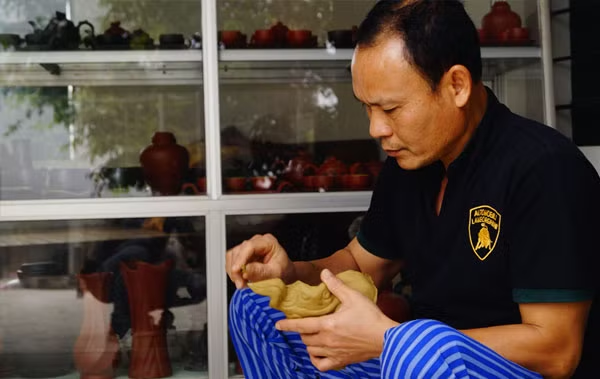
Nguyen Duc Phu, Chairman of the Quyet Thanh Pottery Co-oprevealed: "Thanks to the given natural climate, Quyet Thanh land is different from others. That is why our products could discharge aldehyde while still preserving the flavor of the wine and its concentration of alcohol. Quyet Thanh pottery teapots are also famous for making tea as tea made in the pottery teapot can smell and taste beeter and be preserved for a longer time."
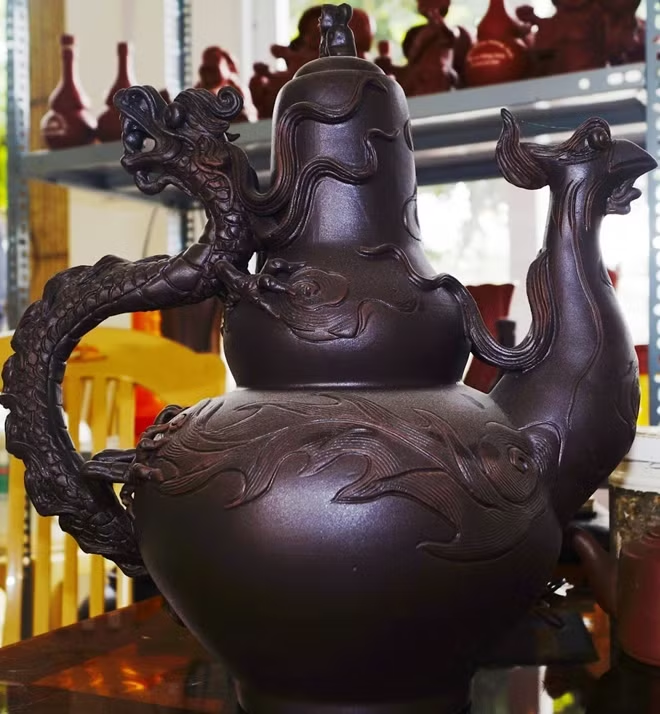
This phenomenon is still scientifically inexplicable, according to Mr. Phu, but there are many famous wine and tea brand sever coordinating with Quyet Thanh village.


Although many ups and downs, Quyet Thanh pottery village gradually develops its own brand and produces various products sold on both domestic and international markets. It has received for a Fine Ceramics Brand certificate in 2010 from the Ha Nam Science and Technology Department. 
By An Nhien

Other News

Vietnam secure berth at FIFA U17 World Cup 2026 for first time

Vietnam secure berth at FIFA U17 World Cup 2026 for first time

Vietnam national U17 football team secured a place at the FIFA U17 World Cup 2026 for the first time after defeating United Arab Emirates national U17 football team 3-2 on in the final Group C match of the AFC U17 Asian Cup 2026 in Saudi Arabia on early May 14 (Vietnam time).

Vietnam’s most beautiful railway station twins with French counterpart

Vietnam’s most beautiful railway station twins with French counterpart

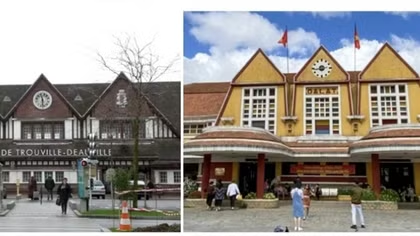
A twinning agreement between Da Lat Railway Station in Vietnam and Trouville-Deauville Railway Station in France was signed at the French Embassy in Vietnam on May 7, creating new opportunities for cooperation in station management and operations, as well as cultural and tourism promotion between the two sides.

Hanoi gains two more craft villages in World Crafts Cities network

Hanoi gains two more craft villages in World Crafts Cities network

The recognition of Chuyen My and Son Dong craft villages as members of the World Crafts Cities network represents international acknowledgement of the cultural value, artisanal techniques, creativity and sustainable vitality of Vietnam’s traditional craft villages, he said.

Thang Long - Hanoi Festival 2026 to return in September

Thang Long - Hanoi Festival 2026 to return in September

Co-hosted by the municipal People’s Committee, the Department of Culture and Sports, and domestic and foreign agencies, the whole spectacle is meant to honour the city’s millennia-old heritage while reafffirming its strategy of establishing culture as a development engine.

Spreading Vietnamese cultural identity in digital space

Spreading Vietnamese cultural identity in digital space

In the context of deep international integration, cultural identity serves as both a “shield” against assimilation and a defining marker of a nation’s image. Protecting and promoting uniquely Vietnamese cultural values has therefore become a pressing task, particularly in an increasingly complex digital environment.

ITE HCMC 2026 to promote Vietnam’s tourism on global map

ITE HCMC 2026 to promote Vietnam’s tourism on global map

With its large scale, the ITE HCMC 2026 aims to promote tourism cooperation between Vietnam and priority markets such as Northeast Asia, Western Europe, North America, Southeast Asia, and Oceania while also boosting visitor arrivals from the Indian market

Vietnamese puppetry seeks renewal amid preservation challenges

Vietnamese puppetry seeks renewal amid preservation challenges

Although widely regarded as a cultural “speciality” attracting tourists, Vietnamese puppetry is facing multiple challenges in preservation and development, requiring renewed efforts to both safeguard its identity and adapt to contemporary cultural currents.

Project on digital transformation in cultural sector approved

Project on digital transformation in cultural sector approved

By 2030, the project targets the establishment of shared digital platforms across 100% of cultural sectors. All digitised cultural heritage will be standardised under the national data framework and shared in accordance with regulations, while 80% of public digital heritage assets are expected to receive digital identifiers to clarify ownership and management, encouraging organisations and individuals to do the same and support market development.

Vietnam eyes becoming region’s leading tourism destination

Vietnam eyes becoming region’s leading tourism destination

Vietnam has in recent years undergone a notable transformation in its tourism development strategy, placing a strong emphasis on nature-based and eco-tourism. This shift is not merely aligned with global trends, but represents a necessary step towards safeguarding valuable natural resources, while appealing to a growing segment of environmentally conscious travellers.