This year’s new-style rural building targets completed ahead of schedule

The National Target Programme on New-style Rural Area Building for 2018 has achieved its set targets three months earlier than planned, said Nguyen Minh Tien, head of the programme’s Central Coordination Office.
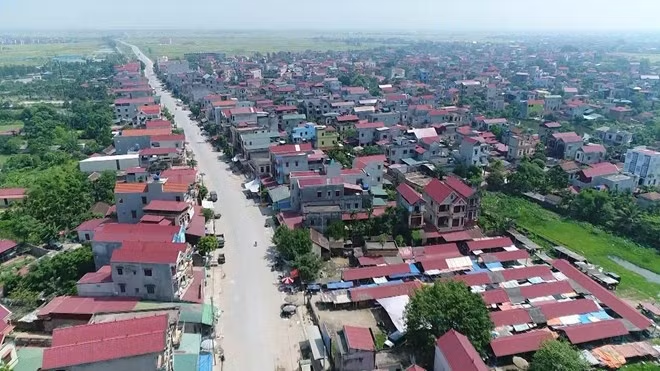
An aerial view of Bong Lai commune of Que Vo district, Bac Ninh province (Photo: VNA)

An aerial view of Bong Lai commune of Que Vo district, Bac Ninh province (Photo: VNA)

The programme, initiated by the government in 2010, laid out 19 criteria on socio-economic development, politics, and defence, aiming to enhance the development in rural regions of Vietnam. The list of criteria includes the development of infrastructure, the improvement of production capacity, environmental protection, and the promotion of cultural values.      

To date, the entire nation now has 3,542 communes that meet the standards of new-style rural areas (or 39.7 percent of all communes nationwide). Meanwhile, 55 districts in 28 provinces and cities have received the prime minister’s accreditation for fulfilling all criteria and completing their assigned mission in new-style rural building.

According to Tien, the goal set for this year was to have 3,500 communes (or 39 percent of all communes) recognised as new-style rural areas and at least 54 districts obtaining the PM’s accreditation. 

The official said the steering committee for the programme will focus on directing localities to continue their measures and efforts next year in a bid to realise the National Assembly’s goal for the 2016-2020 period.

Talking about this year’s outcomes, Tien said many localities have increased resources, innovations, and quality guarantees by developing value chains in line with food safety standards and production restructuring.

Many of them intensified their work to tackle environmental pollution and came up with effective solutions to their accrued liabilities that had arisen from the programme’s basic construction plans, he added.

Tien also pointed to a significant gap in building new-style rural areas among certain regions. While localities like Ho Chi Minh City, Da Nang, and Dong Nai have completed their set works and are now advancing into even further construction, others such as Dien Bien, Bac Kan, and Cao Bang have recorded very low numbers of communes that meet standards.

According to Tien, environmental pollution (especially water pollution) is getting worse in some areas, while food safety, despite the country’s progress in ensuring farm produce’s quality, remains a pressing issue.

The official said the steering committee for the programme will focus on directing localities to continue their measures and efforts next year in a bid to realise the National Assembly’s goal for the 2016-2020 period.

Talking about this year’s outcomes, Tien said many localities have increased resources, innovations, and quality guarantees by developing value chains in line with food safety standards and production restructuring.

Many of them intensified their work to tackle environmental pollution and came up with effective solutions to their accrued liabilities that had arisen from the programme’s basic construction plans, he added.

Tien also pointed to a significant gap in building new-style rural areas among certain regions. While localities like Ho Chi Minh City, Da Nang, and Dong Nai have completed their set works and are now advancing into even further construction, others such as Dien Bien, Bac Kan, and Cao Bang have recorded very low numbers of communes that meet standards.

According to Tien, environmental pollution (especially water pollution) is getting worse in some areas, while food safety, despite the country’s progress in ensuring farm produce’s quality, remains a pressing issue.


VNA

Other News

Hanoi ready to implement Capital Law 2026, unlocking new development momentum

Hanoi ready to implement Capital Law 2026, unlocking new development momentum

The effectiveness of the Capital Law 2026 will be measured not by the number of legal documents issued but by tangible improvements in governance and public administration, better services for people and businesses, faster administrative procedures, stronger investment attraction and higher economic growth.

Vietnamese students earn honours at ROBOG Asia Cup 2026

Vietnamese students earn honours at ROBOG Asia Cup 2026

Three teams from Chu Van An Secondary School in Vietnam’s Thai Nguyen province have earned First Prize honours and advanced to the quarterfinals at the ROBOG Asia Cup 2026, a regional robotics and artificial intelligence (AI) competition for students held in Hong Kong, China.

Hanoi sets out new investment blueprint with century-long development vision

Hanoi sets out new investment blueprint with century-long development vision

As of early June, Hanoi had attracted 74.6 billion USD in foreign direct investment (FDI) through more than 9,250 valid projects. FDI inflows in the first six months were projected at 3.2 billion USD, surpassing the annual target by 116%, while nearly 16,000 new businesses were established in the first five months, up 34.4% year-on-year.

Vietnam promotes legal cooperation and rule of law at global forum

Vietnam promotes legal cooperation and rule of law at global forum

Vietnam’s development and international integration have gone hand in hand with the improvement of its legal system, the incorporation of international commitments into domestic legislation, and legal reforms aimed at fostering development, openness and global integration. The country regards international law as an essential instrument for building fair, mutually beneficial relations among nations.

Hanoi to hold investment promotion event on June 29

Hanoi to hold investment promotion event on June 29

At the event, Hanoi authorities plan to grant investment policy decisions and investment registration certificates to 20 exemplary projects in the fields of transportation infrastructure, industrial parks, urban development, social housing, environment, science and technology, and foreign investment attraction.

Hanoi's Red River urban area development draws widespread attention

Hanoi's Red River urban area development draws widespread attention

Located south of the Red River and extending from the historic inner city to newly developing areas in the south and the west, the central urban area along Red River’s right bank covers approximately 45,317 hectares and is projected to accommodate around 6.365 million residents by 2045 and 6.455 million by 2065.

Hanoi's Red River urban area development draws widespread attention

Hanoi's Red River urban area development draws widespread attention

Located south of the Red River and extending from the historic inner city to newly developing areas in the south and the west, the central urban area along Red River’s right bank covers approximately 45,317 hectares and is projected to accommodate around 6.365 million residents by 2045 and 6.455 million by 2065.

Regional cooperation strengthened to combat cross-border drug crime

Regional cooperation strengthened to combat cross-border drug crime

Vietnam, China, Laos and Myanmar face common challenges as drug syndicates increasingly exploit the Mekong River, cross-border transport networks, e-commerce platforms, international logistics services, cyberspace and cryptocurrencies to organise drug transactions and smuggling operations.