Top leader urges shift from emergency relief to community resilience

Party General Secretary and State President To Lam, recently becoming Honorary President of the Vietnam Red Cross Society (VRCS) for the 2026-2031 tenure, has vowed to partner with the Party Central Committee’s Politburo and Secretariat, to improve the VRCS’s operating efficiency and fulfill its noble humanitarian mission with all possible support.

1-876.jpg
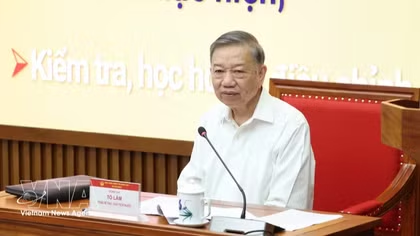
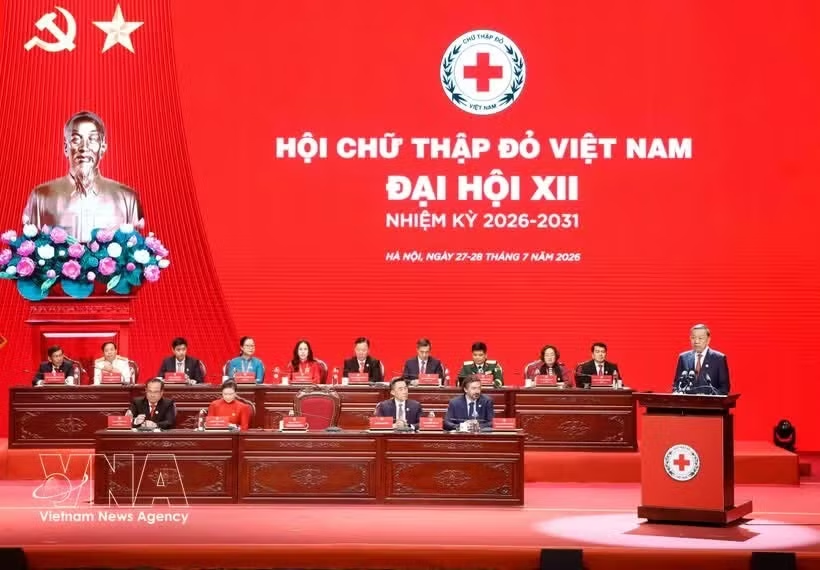
Party General Secretary and State President To Lam addresses the 12th National Congress of the Vietnam Red Cross Society for the 2026-2031 tenure on July 28. (Photo: VNA)

Hanoi (VNA) – Party General Secretary and State President To Lam, recently becoming Honorary President of the Vietnam Red Cross Society (VRCS) for the 2026-2031 tenure, has vowed to partner with the Party Central Committee’s Politburo and Secretariat, to improve the VRCS’s operating efficiency and fulfill its noble humanitarian mission with all possible support.

From relief to resilience

Addressing the VRCS’s 12th National Congress for the 2026-2031 tenure in Hanoi on July 28, which drew 500 delegates representing more than 5.6 million officials, members, volunteers, and youth nationwide, General Secretary and President Lam said the Vietnamese Party, State, and people look forward to continued cooperation from the International Red Cross and Red Crescent Movement, international organisations, and development partners to strengthen humanitarian capacity, friendship, solidarity, peace, and sustainable development.

Humanitarian work should not be confined to emergency relief when natural disasters, disease outbreaks, or other crises occur. Instead, it should become an integral part of the country's human development strategy, social welfare, risk governance, and community resilience, he said.

The leader called for a pivot from reactive response to proactive prevention, from post-disaster relief to early warning and action, from one-off aid to livelihood support and capacity building, and from isolated initiatives to an integrated humanitarian ecosystem linking the State, society, business, and citizens. The most effective assistance, he said, enables citizens to rebuild their lives and achieve lasting stability.

Endorsing the broad orientations, targets, and six action plans in the Congress’s political report, he said the newly elected 12th VRCS Central Committee and local chapters should refine the legal and institutional frameworks and tighten enforcement of legislation protecting vulnerable groups.

He also urged expanded education, vocational training, livelihood support, and sustainable job creation to integrate disadvantaged groups more firmly into the community.

The VRCS should take a more active role in community-based disaster risk management by building early warning systems, local emergency response forces, first-aid networks, and safe community models, he said. Each commune, ward, and special zone should gradually create trained volunteer teams with action plans and the capacity to deliver timely aid to vulnerable groups, particularly children, the elderly, the disabled, the seriously ill, and those in remote, border, and island areas.

It was urged to continue serving as the leading coordinator and bridge in humanitarian activities, with all efforts centred on the people, driven by actual needs and measured by tangible improvements in lives. Priority must go to the most in need, ensuring no one is left behind because of geographical distance, bureaucracy, or limited technology skills.

Transparency, tech, and resource mobilisation

He stressed that the VRCS must anchor operations in transparency, integrity, accountability, and openness. All donations must be managed and allocated as intended, with donors entitled to track use, beneficiaries, and outcomes, and recipients able to give feedback on relevance, fairness, and timeliness.

The organisation was directed to build a unified humanitarian database linked, where possible, with national databases and the social security system. He pushed for greater use of big data, artificial intelligence, geospatial mapping, and digital platforms to pinpoint needs, prevent duplication, coordinate resources, issue early warnings, manage volunteers, and assess impact.

He also underscored the need to build a strong, professional, modern VRCS by leveraging the contributions of its officials, members, and volunteers and expanding international cooperation.
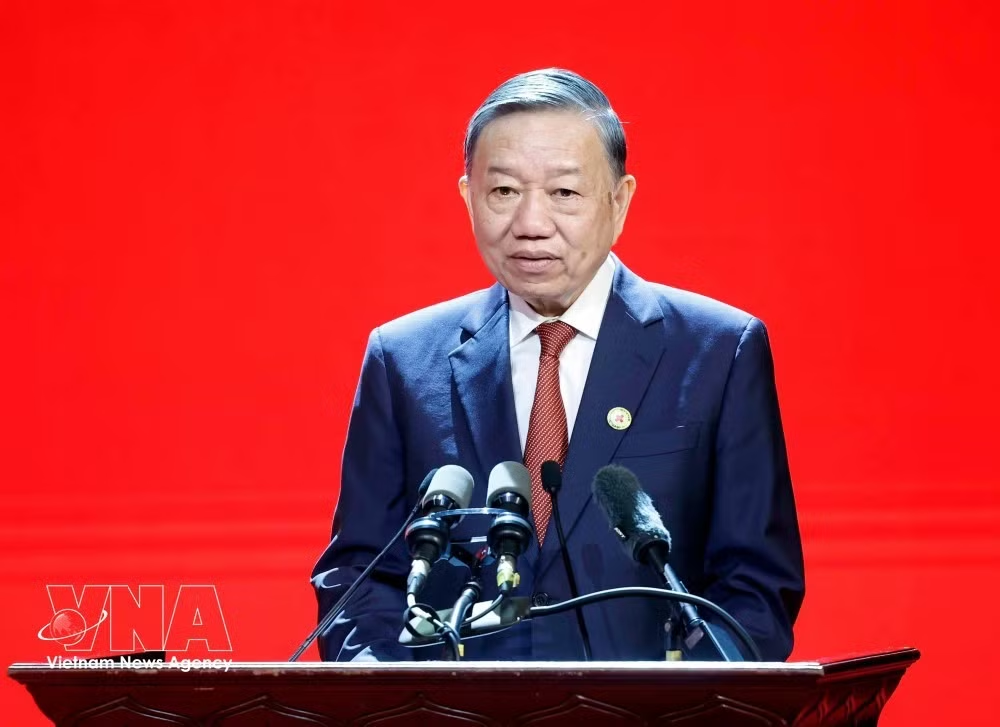
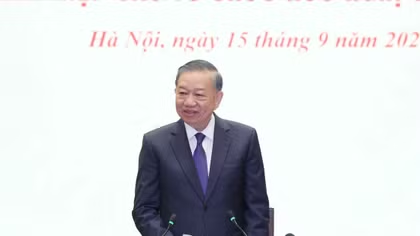
Party General Secretary and State President To Lam speaks at the congress. (Photo: VNA)

The Ministry of Health, healthcare facilities, and medical staff should continue working closely with the VRCS to spread the “Florence Nightingale Spirit” featuring compassion, dedication, courage, and tireless service, he said. He called for identifying, nurturing, and honouring outstanding contributors to patient care, disease control, disaster response, and community health.

The VRCS’s international humanitarian work should become a key channel of people-to-people diplomacy, projecting Vietnam as a peaceful, compassionate, and responsible nation, he said.

To deliver on these responsibilities, the entire political system, from central to local levels, must keep improving institutional mechanisms and policies, tighten coordination and information sharing, pool resources, and provide full support so the VRCS can play a bigger role in disaster prevention and response, community healthcare, first aid, blood donation, social assistance, and international humanitarian work.

He also pushed closer health sector coordination with the VRCS on blood and tissue donation campaigns, first-aid training, disease prevention and control, and aid for disadvantaged patients.

The education sector, the Ho Chi Minh Communist Youth Union, media, and social organisations should collaborate to cultivate compassion, volunteerism, life skills, and social responsibility among young people, he said.

He closed by calling on businesses, organisations, individuals, philanthropists, overseas Vietnamese, and international friends to keep backing the VRCS with resources, knowledge, technology, and shared responsibility./.
en.vietnamplus.vn

Other News

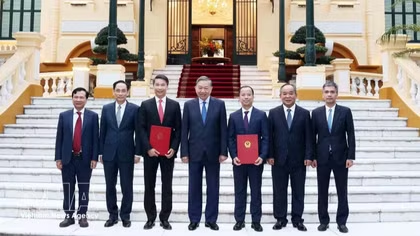
Top leader hands over appointment decisions to two Vietnamese ambassadors

Top leader hands over appointment decisions to two Vietnamese ambassadors

Amid a rapidly changing and complex world, the top leader asked the diplomatic sector, particularly ambassadors, to remain steadfast in principles while being flexible in tactics, maintain independence and self-reliance, proactively safeguard national interests, and seek new advantages and opportunities for the country while contributing to common peace and development.

National Defence Academy must become top military think-tank: PM

National Defence Academy must become top military think-tank: PM

The National Defence Academy must track global and regional developments closely, accurately size up partners and rivals, and stay ahead of changes in the international security environment. It should produce practical output, such as strategic forecasts, early warning and policy proposals, and absorb global military advances and technology without copying foreign models outright.

VUFO must focus on building networks for mobilising resources: Top leader

VUFO must focus on building networks for mobilising resources: Top leader

General Secretary and President To Lam expressed his confidence that VUFO will truly become a sharp and effective spearhead, proactively building trust, turning trust into resources and, through concrete actions, contributing to the country’s breakthrough development in the new era of national rise

Key leader highlights important tasks in Party building

Key leader highlights important tasks in Party building

The Party building covers four key areas: political, ideological and ethical work, and organisation and personnel. These areas are closely interconnected and together form a unified whole that determines the Party’s strength and its ability to lead the revolutionary cause.

Thai King, Queen arrive in Hanoi for State visit to Vietnam

Thai King, Queen arrive in Hanoi for State visit to Vietnam

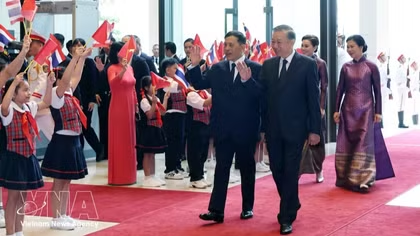
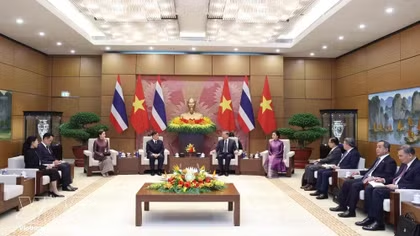
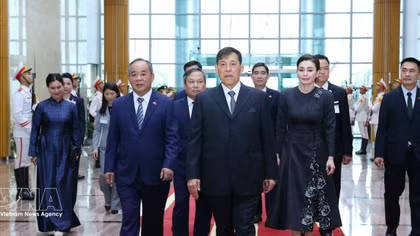
The State visit to Vietnam by King of Thailand Maha Vajiralongkorn Phra Vajiraklaochaoyuhua and Queen Suthida Bajrasudhabimalalakshana holds not only political significance but also serves as a continuation of the friendship and close ties between the Thai Royal Family, Government and people and the Vietnamese Government and people.

Vietnam attaches importance to promoting friendly relations, cooperation with Burundi: PM

Vietnam attaches importance to promoting friendly relations, cooperation with Burundi: PM

Thanking President Ndayishimiye and the Burundi Government for supporting the effective operation of Lumitel, the telecommunications joint venture of Vietnam’s Viettel Group in Burundi, Prime Minister Le Minh Hung proposed that Burundi continue facilitating Lumitel’s participation in e-government and digital transformation projects, while enabling it to expand investment and business activities, making it a symbol of bilateral cooperation.

PM Le Minh Hung wraps up working trip to India

PM Le Minh Hung wraps up working trip to India

​The working trip reaffirmed Vietnam's foreign policy of proactive and active integration into the world, and multilateralisation and diversification of external relations. It also helped to strengthen ties with partners, broaden avenues for cooperation, and enhance Vietnam's role and standing at regional and global multilateral mechanisms.

Vietnam seeks effective, substantive ties with Saudi Arabia

Vietnam seeks effective, substantive ties with Saudi Arabia

Affirming that Saudi Arabia is one of Vietnam’s most important partners in the Middle East, PM Hung expressed his pleasure at the positive development of bilateral relations in recent years, and voiced his wish to work with Saudi Arabia to further develop the bilateral relationship in a more effective and substantive manner, for the benefit of the two countries' people.

Vietnamese PM Le Minh Hung attends 18th BRICS Summit in New Delhi

Vietnamese PM Le Minh Hung attends 18th BRICS Summit in New Delhi

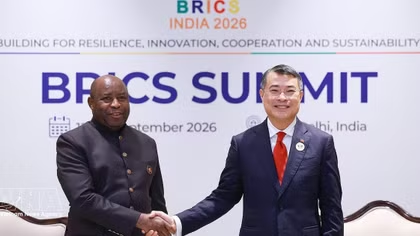
Vietnam's own development model centres on people, institutional reform, modern governance and science and technology, while ensuring harmony among economic growth, social equity and environmental protection, PM Hung said, affirming that Vietnam stands ready to work with BRICS in a spirit of responsibility, goodwill and substantive cooperation to create a peaceful, prosperous, sustainable and inclusive future for all countries and people.

Prime Minister meets with staff of Vietnamese representative agencies, community in India

Prime Minister meets with staff of Vietnamese representative agencies, community in India

At a meeting with staff of the Vietnamese Embassy and representative agencies in New Delhi on September 13, PM Hung said that officials and employees working overseas must firmly grasp the Party’s new mindset and policies on foreign affairs as well as overseas Vietnamese affairs, including the Politburo's Resolution No. 23-NQ/TW on overseas Vietnamese.

PM Le Minh Hung calls on WTO to continue support for Vietnam

PM Le Minh Hung calls on WTO to continue support for Vietnam

Vietnam actively and responsibly participates in the WTO’s agenda and supports its coordinating role in promoting inclusive and balanced global trade for peace, cooperation and development, while effectively responding to global challenges, said Prime Minister Le Minh Hung.

Prime Minister holds talks with Indian counterpart

Prime Minister holds talks with Indian counterpart

Vietnam and India are among the world's fastest-growing economies and have highly complementary strengths, with substantial untapped potential for cooperation. They expressed determination to step up measures to achieve the target of 25 billion USD in bilateral trade at an early date and facilitate market access for products from both countries, particularly pharmaceuticals, agricultural products, fisheries and livestock products.