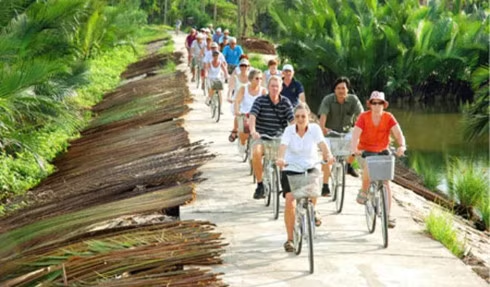
Tough sell – marketing Vietnam to international travellers

As a tourist destination, Vietnam is loaded with the attractions most international travellers dream of— lots of sun, gorgeous beaches, world-class scenery, friendly locals and fascinating history.

Yet for all its advantages, the Southeast Asian nation possessing more than 3,000 kilometres of coastline with 125 major beaches has a major problem attracting travellers to its shores.

Speaking at a recent travel forum in Ho Chi Minh City, an advisor to the City, Kieu Anh Vu, noted official statistics showed that the tourism segment contributed 4.6% (around US$7.9 billion) to the nation’s GDP in 2015.
Yet, last year, only a paltry 7.9 million international travellers came to Vietnam, a very small percentage of total arrivals in the booming Asia Pacific region and an even tinier fraction of the worldwide figures.

The problem – awareness, say officials

Vu mostly sees a relatively benign problem at the root of the nation’s sluggish tourism performance, one demanding a seemingly simple solution.

The biggest reason for the low numbers of tourist arrivals is not lack of infrastructure, crime, pollution, negative reports in the international media or even the cost of flying into and staying in the country.

The problem is the lack of awareness of Vietnam as a tourist destination.

To Vu, the failure of travellers to view Vietnam as a travel spot is the fundamental reason they have not visited the country and the solution rests in marketing to raise its tourism image.

Doan Manh Cuong from the Ministry of Culture, Sports and Tourism agreed. Awareness as a tourist destination is surprisingly low for Vietnam, Cuong noted, adding there are many reasons for this, but Vietnam largely remains a country to be discovered by most travellers.

In many markets, the failure to recognize Vietnam as a tourist destination is the biggest obstacle in attracting larger volumes of visitors to the country, echoed Noemie Robin from the French Consulate General in HCM City.

Just as importantly, noted Robin, Vietnam needs to develop and implement a comprehensive and strategic plan to reasonably develop tourism and simultaneously combat pollution.

If this isn’t done, the tourism industry will remain underdeveloped and less attractive, Robin emphasized, cautioning the country should not underestimate the interrelationship between pollution and tourism.

On the one hand, tourism gives rise to pollution – but on the other hand – too much pollution such as that found on far too many beaches in Vietnam will result in travellers never coming back for a return visit.

Most traveller from Western countries will not tolerate excessive amounts of pollution as that found throughout most of Vietnam and the international reputation of Vietnam consequently suffers tremendously.

Turning the stream into a river

So, is raising the country's international profile all it will take to make Vietnam more internationally renowned as a glamorous destination?

Those attending the tourism forum in HCM City thought so.

Vietnam beaches, mountains and jungles are spectacular. Vietnamese are warm, generous hosts. The food can, in many cases, be delicious. The country’s turbulent history and multi-layered culture are fascinating.

But none of these are new messages, and none of them have yet propelled Vietnam beyond second-tier status as an international tourist target.

A new direction, a new way of promoting Vietnam is required, they said with near unanimity.

It may be that the first step toward hitting the ambitious 10-million-visitors goal is for tourism officials to start facing up to the reality that in the travel game, reputation and perception are the backbone of marketing.

In addition, they need to acknowledge up front that Vietnam has a multitude of negative stereotypes – particularly as it relates to environmental pollution – that they need to change before it can successfully build upon its positive attributes.

The Vietnam Department of Tourism promotes the country’s attractions, and there are many to brag about. But simply glossing over serious deficiencies such as the horrific pollution on many of the country’s beaches with opulent adjectives and optimistic slogans isn’t a viable solution.
VOV

Other News

Vietnam steps up implementation of ethnic affairs strategy through 2030

Vietnam steps up implementation of ethnic affairs strategy through 2030

To accelerate the implementation of the the Ethnic Affairs Strategy by 2030, with a vision toward 2045, the Prime Minister requested ministries, agencies and local authorities to continue thoroughly carrying out the Party and State’s policies on ethnic affairs, enhancing the effectiveness of State management and strengthening oversight of policy implementation.

Security preparations reviewed for APEC 2027 in Phu Quoc

Security preparations reviewed for APEC 2027 in Phu Quoc

The team examined the APEC 2027 Convention Centre, where main conference activities are scheduled; Sun Serenia Hospital, designated to provide healthcare and emergency medical services for delegates; provincial road DT.975, which connects Phu Quoc International Airport to the convention centre; and the area surrounding Phu Quoc International Airport.

Hanoi accelerates seven Red River bridge projects, many exceed 70% completion

Hanoi accelerates seven Red River bridge projects, many exceed 70% completion

According to the municipal Transport Construction Investment Project Management Board, the city is simultaneously implementing seven projects, namely Tu Lien, Ngoc Hoi, Tran Hung Dao, Thuong Cat, Van Phuc, Hong Ha and Me So bridges. Construction is being carried out on multiple fronts, focusing on bored piles, pile caps, piers and superstructure works.

Dien Bien battlefield legacy powers tourism revival

Dien Bien battlefield legacy powers tourism revival

Seventy-two years after the Dien Bien Phu Victory, its legacy still reverberates. The unity, self-reliance, and resilience forged in that historic triumph remain a powerful internal engine, now propelling Dien Bien toward fast and sustainable development.

Hanoi accelerates shift to green buses, targets 100% by 2030

Hanoi accelerates shift to green buses, targets 100% by 2030

In the 2027–2030 period, the city will accelerate the transition towards the complete phase-out of fossil fuel-powered buses. The share of electric and green energy-fueled buses is projected to reach 79–89% by 2029 and 100% by 2030.

36 fishermen safely rescued after boat breaks down near Truong Sa

36 fishermen safely rescued after boat breaks down near Truong Sa

At 8:00 the same day, KN475 began towing the disabled fishing boat toward Da Tay A island. The towing operation was carried out safely, and by 18:30 both the vessel and its crew had arrived at the island without incident, where repairs and additional support procedures were arranged.

Vietnamese language contest in Laos strengthens youth ties, bilateral friendship

Vietnamese language contest in Laos strengthens youth ties, bilateral friendship

Held in response to the launch of the Vietnamese Language Day among overseas Vietnamese communities, the event aimed to enhance the quality of Vietnamese language teaching and learning in Laos while contributing to the great friendship, special solidarity, comprehensive cooperation and strategic cohesion between the two countries.

Vietnamese language contest in Laos strengthens youth ties, bilateral friendship

Vietnamese language contest in Laos strengthens youth ties, bilateral friendship

Held in response to the launch of the Vietnamese Language Day among overseas Vietnamese communities, the event aimed to enhance the quality of Vietnamese language teaching and learning in Laos while contributing to the great friendship, special solidarity, comprehensive cooperation and strategic cohesion between the two countries.

Hanoi launches 10 electric bus routes from April 1

Hanoi launches 10 electric bus routes from April 1

By the end of April, the number of buses using electricity and other green energy sources in the city is expected to reach 822, including 683 electric buses and 139 compressed natural gas (CNG) buses, representing 42.1% of the total number of vehicles.