Traditional Tet food offerings to ancestors

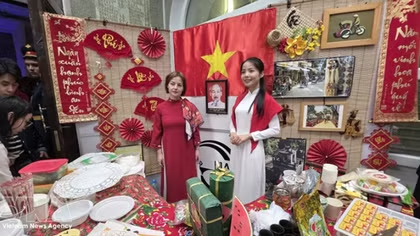
At Lunar New Year (Tet) festival, each ethnic group in Vietnam has its own culinary specialties that reflect the culture of their people and are used as offerings to worship their ancestors.

Most Kinh (Vietnamese ethnic majority) people start preparations a month before the festival.

Many people usually cook nine dishes: banh chung (square sticky rice cake), dua hanh (pickled onions), gio nac (boiled lean pork sausage) and gio thu (boiled pork head sausage), thit dong (frozen meat), nem ran (spring rolls), canh mang (bamboo shoot soup), canh bong tha (dried pig skin soup), boiled chicken, and che kho (sweet green bean paste).

These carefully cooked traditional dishes are put on the home altar to worship their ancestors during Tet festival.
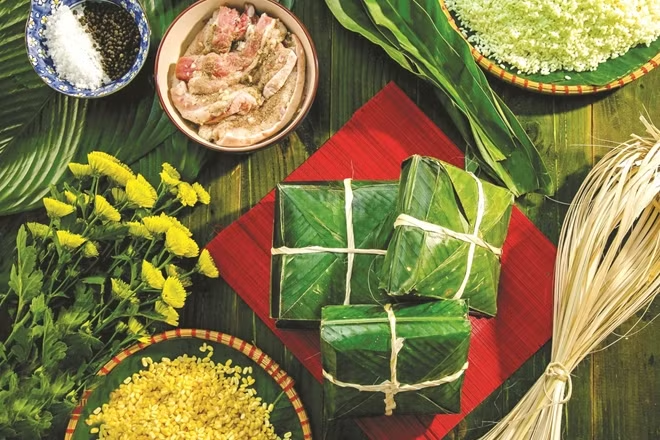
Photo: The Christina's Blog

Of all the dishes, banh chung is the soul of Tet, reflecting the quintessence of heaven and earth through the skilled hands of humans. To make the cake, the most fragrant and fibrous sticky rice are chosen and the cakes often have pork, green beans, dried onions and pepper in the centre.

The cakes are often eaten with pickled onion because its sour and light peppery flavour helps digestion. Meanwhile, gio nac and gio thu have remained on the offering food tray at Tet from the past to the present.

Nem (spring rolls) is a popular dish in the north that always has a place on a Tet food tray because it is so flavourful and healthy. It is made out of minced pork, carrots, wood ear fungus, green-bean sprouts, bean glass noodles and other ingredients. The fried rolls are then dipped into a bowl of sauce of mixed fish sauce, sugar, lemon or vinegar, chili and minced garlic.

The Tet food tray of northerners never lacks a big bowl of canh mang kho (dried bamboo shoot soup). 

Ethnic groups, such as the Mong, Thai, Muong, Tay, Nung, Dao, and Co Tu, have their own New Year dishes. 

For the Mong, their Tet tray should include dishes such as pork, wine, round cakes made from glutinous rice and maize cakes.

Fried fish is the specific dish of the Thai. They believe the stream deity will protect them from danger.

The Nung group often made banh khao from dried glutinous rice powder, minced pork fat and sugar to worship their ancestors. The elderly said the sweet fat in the cake would prevent unlucky happenings in the New Year.

Meanwhile, the Co Tu in Tay Nguyen (the Central Highlands) make their own wine known as ruou Ta Vat and ruou can to welcome Tet. All visitors at New Year are invited to enjoy these wines.

Each Dao household has its own thit lon chua (sour pork), locally known as o sui, in New Year holidays. Ingredients include pork, salt, and cool rice. The dish should be eaten with la lot (wild lolot leaves) and la prang lau (a kind of wild leaf), and dipped in a bowl of mixed lemon and chili. 

The Tay welcome Lunar New Year with a roast piglet. They often choose local piglets with small bones, firm and lean meat weighing from 20kg to 30kg. People often put mac mat (a kind of wild leaf and fruit) mixed with spices in the pig’s belly and cover the skin with honey. They then roast it on charcoal for three hours until well done. The food is dipped in a sweet and fragrant sauce gotten from the pig’s belly.
VNA

Other News

Vietnam secure berth at FIFA U17 World Cup 2026 for first time

Vietnam secure berth at FIFA U17 World Cup 2026 for first time

Vietnam national U17 football team secured a place at the FIFA U17 World Cup 2026 for the first time after defeating United Arab Emirates national U17 football team 3-2 on in the final Group C match of the AFC U17 Asian Cup 2026 in Saudi Arabia on early May 14 (Vietnam time).

Vietnam’s most beautiful railway station twins with French counterpart

Vietnam’s most beautiful railway station twins with French counterpart

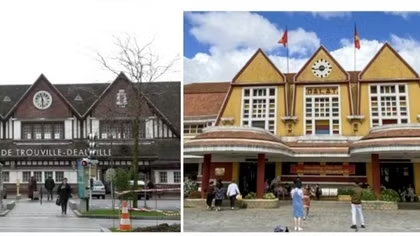
A twinning agreement between Da Lat Railway Station in Vietnam and Trouville-Deauville Railway Station in France was signed at the French Embassy in Vietnam on May 7, creating new opportunities for cooperation in station management and operations, as well as cultural and tourism promotion between the two sides.

Hanoi gains two more craft villages in World Crafts Cities network

Hanoi gains two more craft villages in World Crafts Cities network

The recognition of Chuyen My and Son Dong craft villages as members of the World Crafts Cities network represents international acknowledgement of the cultural value, artisanal techniques, creativity and sustainable vitality of Vietnam’s traditional craft villages, he said.

Thang Long - Hanoi Festival 2026 to return in September

Thang Long - Hanoi Festival 2026 to return in September

Co-hosted by the municipal People’s Committee, the Department of Culture and Sports, and domestic and foreign agencies, the whole spectacle is meant to honour the city’s millennia-old heritage while reafffirming its strategy of establishing culture as a development engine.

Spreading Vietnamese cultural identity in digital space

Spreading Vietnamese cultural identity in digital space

In the context of deep international integration, cultural identity serves as both a “shield” against assimilation and a defining marker of a nation’s image. Protecting and promoting uniquely Vietnamese cultural values has therefore become a pressing task, particularly in an increasingly complex digital environment.

ITE HCMC 2026 to promote Vietnam’s tourism on global map

ITE HCMC 2026 to promote Vietnam’s tourism on global map

With its large scale, the ITE HCMC 2026 aims to promote tourism cooperation between Vietnam and priority markets such as Northeast Asia, Western Europe, North America, Southeast Asia, and Oceania while also boosting visitor arrivals from the Indian market

Vietnamese puppetry seeks renewal amid preservation challenges

Vietnamese puppetry seeks renewal amid preservation challenges

Although widely regarded as a cultural “speciality” attracting tourists, Vietnamese puppetry is facing multiple challenges in preservation and development, requiring renewed efforts to both safeguard its identity and adapt to contemporary cultural currents.

Project on digital transformation in cultural sector approved

Project on digital transformation in cultural sector approved

By 2030, the project targets the establishment of shared digital platforms across 100% of cultural sectors. All digitised cultural heritage will be standardised under the national data framework and shared in accordance with regulations, while 80% of public digital heritage assets are expected to receive digital identifiers to clarify ownership and management, encouraging organisations and individuals to do the same and support market development.

Vietnam eyes becoming region’s leading tourism destination

Vietnam eyes becoming region’s leading tourism destination

Vietnam has in recent years undergone a notable transformation in its tourism development strategy, placing a strong emphasis on nature-based and eco-tourism. This shift is not merely aligned with global trends, but represents a necessary step towards safeguarding valuable natural resources, while appealing to a growing segment of environmentally conscious travellers.