 |
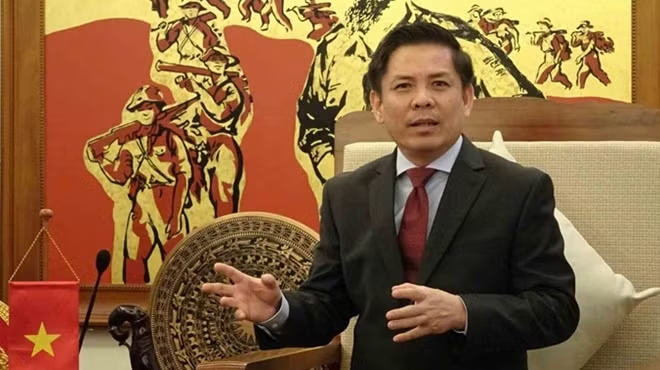
| Nguyen Van The, Minister of Transport |
What challenges does the Ministry of Transport face in the year 2018?
The biggest challenge the transport sector faces in 2018 is a serious shortage of funding. Coupled with that is the high funding demand for infrastructure development, particularly the connection between major economic centres and industrial parks nationwide. This is one of the reasons that in 2018, the State has to focus its financial resources on investing in infrastructure development.
In the past, we received quite a lot of ODA funding with low interest rates in infrastructure. But now Viet Nam has become a low middle income country, so we have to pay higher interest rates for ODA funds. As a result, the effectiveness in the usage of ODA funding has been limited. Adding to that is our country’s public debt, which has already reached a red line, and is nearing the ceiling level.
As a result, it is not easy for us to approach foreign capital. It is indisputable that if we continue to borrow foreign capital to invest in transport infrastructure, no doubt our foreign debt will hit the public debt ceiling. This is something that is prohibited by the National Assembly. This has further added challenges for Việt Nam in its cause of transport infrastructure development.
Regarding the socialization fund, we have been able to reach over VNĐ200 trillion (US$8.8 billion) for transport infrastructure development. However, by now I have to say that our mid-term loans from commercial banks have already reached their ceilings. In other words, we now can’t rely on credit from our commercial banks for infrastructure development.
How should we solve the funding shortage?
In such circumstances, we have tried to make the best use of the State budget allocated for transport infrastructure development. In the meantime, the MOT has continued to consider a few transport infrastructure projects which are promising to bring back high economic value to present to the Government for ODA investment.
In addition, we will launch a study on building more Build-Operate-Transfer expressways which are running parallel with our current national highways to offer more options for people to choose from. We understand that considering what has happened recently with BOT, our proposal to build more BOT expressways will not be welcomed by many people.
I can’t deny that the biggest problem of the transport sector at present is the shortage of funding. As a result, the MOT will focus efforts to advise the Government and the National Assembly to adopt special policies to encourage the general public and enterprises to participate in transport infrastructure projects to create more breakthroughs in the transport infrastructure sector.
Will you please elaborate on those policies?
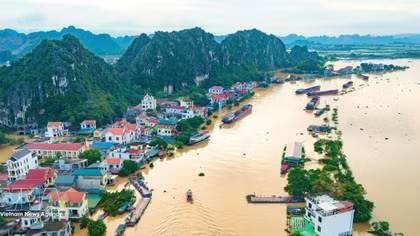
Our current domestic water routes have played an important role in national transport development. However, I cannot deny that in the past the water routes have failed to live up to their expectations. This is good food for thought in 2018.
In my opinion, a key reason behind the weakness was inadequate investment. To solve this problem, in 2018, the MOT plans to advise the Government to grant special mechanisms for waterways transport companies, particularly a special credit fund with a low interest rate for waterway transport companies to help them refurbish their ships and equipment. I’m confident that when transport companies have new and modern ships they will be able to share the transport burden with their on-land transport companies.
The second point I want to raise today is that with a long coast line and many rivers, we want to see more waterway transport companies established. Of course, they need the Government to grant them special mechanisms, particularly land to build their storage or factories.
On the side of the MOT, we promise to come up with some special policies to encourage the establishment of some shipping transport groups or corporations to make our oceangoing ship fleets on par with those of regional countries.
In addition, the MOT has encouraged all economic sectors to collaborate in investing in building new sea ports and wharfs. A recent survey conducted by the MOT has shown that the shortage of ports and wharfs is a hurdle for many localities on their path of development.
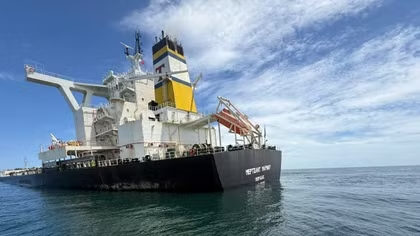
By now, Viet Nam has some 1,500 ships and boats operating along some 3,260 km of coast line. But in the long run, the MOT wants to increase the number of ships and boats to 5,000-6,000. Of course, the increase in maritime transport will ease the burden for mainland transportation. But to bring these plans to life, many entrepreneurs need to have access to banks’ soft loans or preferential loans to buy boats. In short they want the government to act as the midwives helping them to get the money they need to expand their production.