“Knowing the impact of school closures, it is clear that the decision for children to be in the classroom is in their best interests,” Flowers said in an interview granted to the Vietnam News Agency (VNA).
“The risks to children of being out of school are more significant than the risks of being in school.”
Prime Minister Pham Minh Chinh said at a Cabinet meeting on February 3 that schools at all levels nationwide should resume in-person classes any time between February 7 - 14.
Over 6,000 students from seventh to 12th grades in Hanoi’s COVID-19 low and medium risk areas (labelled green and yellow) returned to school on February 8. Meanwhile, more than 455,000 primary school students and 74,600 sixth graders in 18 outlying districts went back to school two days later.
The rest of students in Hanoi should come back to school starting February 21, and kindergarteners would also return based on the latest pandemic situation.
In Ho Chi Minh City, students from the 7th to 12th grades have been going to school since early January.
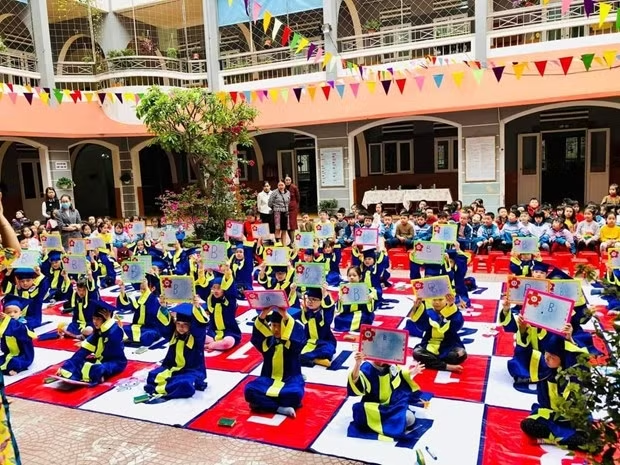
More than one million kindergarten, primary school and sixth-grade students in the southern economic hub returned to classrooms on February 14 morning after nine months of COVID-19-induced online learning.
“The reality is that when everything is open – all businesses, restaurants - there is no justification for schools to remain closed,” according to the UNICEF Representative.
Statistics announced by UNICEF on International Day of Education (January 24) reveal that more than 635 million students remain affected by full or partial school closures.
Globally, disruption to education has meant millions of children have significantly missed out on the academic learning they would have acquired if they had been in the classroom, with younger and more marginalised children facing the greatest loss.
“In March, we will mark two years of COVID-19-related disruptions to global education. Quite simply, we are looking at a nearly insurmountable scale of loss to children’s schooling,” said Robert Jenkins, UNICEF Chief of Education.
Follow-on consequences of school closures are on the rise. In addition to learning loss, school closures have impacted children’s mental health, reduced their access to a regular source of nutrition, and increased their risk of abuse.
A growing body of evidence shows that COVID-19 has caused high rates of anxiety and depression among children and young people, with some studies finding that girls, adolescents and those living in rural areas are most likely to experience these problems.
More than 370 million children globally missed out on school meals during school closures, losing what is for some children the only reliable source of food and daily nutrition, according to UNICEF.
Safe school reopening
Once deemed safe, reopening schools must be considered an upmost priority. The planning, implementation and monitoring of school reopening is no simple task.
“The best way to protect children for the return to school is in fact exactly what the Government of Vietnam is already doing: continuity of the 5K practice and ensure full vaccination plus booster of the adults in children's lives,” Flowers said.
She cited global experience showing that in-school mitigation measures work and it is possible to keep schools open for in-person learning.
UNICEF has contributed to the development of the Ministry of Education and Training (MoET)’s Framework for School Reopening to provide practical and flexible advice to help students return to in-person learning, she continued.
The UNICEF Representative mentioned specific measures to keep students and school staff safe such as ensuring adequate and appropriate ventilation; handwashing stations and hand sanitizer; cleaning of surfaces and shared objects; cohorting (keeping students and teachers in groups that do not mix, also referred to bubble, capsule, circle, safe squad); staggering start, break, bathroom, meals and end time; and establishing information sharing mechanisms with parents, students and teachers.
She pointed out the fact that some cases of COVID-19 would be found in schools, saying it is likely that where cases are identified, the children may be asked to return to online learning while the risk to infection is managed.
“Evidence confirms that children tend to be less affected by the virus – and as we learn to live with this virus – managing small outbreaks will be essential,” she added.
“It is very important that if you know your children have been exposed, even if they don’t yet have symptoms – that you keep them at home for several days to protect them and other children at school.”
Flowers went on to say that UNICEF and education partners are working together to support the Vietnamese Government to ensure that schools soon reopen in safe and conducive learning environments.
UNICEF encourages that as the schools reopen, rather than rushing into the business of catch-up learning, dedicate time – days, to welcome children back with confidence building activities, those that focus on social skills, on self-esteem and on reconnection, she said, adding skills that anyway are essential to employment in the future, but that today will ensure children embrace the learning quickly once back in school
As schools re-open, it is a must to ensure that all children and adolescents are back in school – particularly the most vulnerable – and receive the tailored support they need for their health, nutrition, psychosocial wellbeing and more, she stressed.
Flowers suggested the Government identify barriers that are now preventing many of the most vulnerable children from returning to the classroom, including socio-economic barriers, and find ways to overcome them.
“We can also engage adolescents and young people to raise awareness of the need to reopen schools and mobilise them to help support their most vulnerable peers left behind during COVID-19,” she said.
Vaccination not mandatory for school entry
Asked about Vietnam’s ongoing vaccination rollout for children, Flowers said UNICEF appreciates the Government’s efforts in this regard.
While COVID-19 is more rare and less severe in children, it can occasionally occur, she said, noting that being vaccinated will help to minimise disruption to their education, routines and other things that are important to their wellbeing.
“However, vaccination should not be a prerequisite for in-person learning," she said. “It is crucial that all schools provide in-person learning as soon as possible, without barriers to access, including not mandating vaccination prior to school entry.”
As Vietnam has high vaccination and growing booster levels, most of the teachers and the school workforce have received COVID-19 vaccine shots, which will enable them to be protected from community transmission and keep them healthy so they can continue the inspiring work they do in the classroom, she said.
By February 14, Vietnam had injected over 186.47 million doses of vaccines, with over 74.76 million people now fully inoculated with two doses, and more than 32.48 million booster shots and third shots administered. Vietnam has become one of the six countries with highest COVID-19 vaccination coverage in the world.
The country began to administer Pfizer COVID-19 vaccine to children aged from 12-17 in November 2021.
Up to 95.4% of the children aged 12 – 17 had received at least one dose of COVID-19 vaccines and 89.7% doubled vaccinated as of February 13, data from the Ministry of Health shows.
More than 16.4 million vaccine shots had been administered on this group across the country, the ministry said.
Forty-two out of the 63 cities and provinces, including Hanoi, reported over 90% of their children aged 12 – 17 provided with two coronavirus vaccine doses, while eight have the vaccine coverage on the group among the lowest in the country, below 80%.
The Vietnamese Government has approved the Ministry of Health’s proposal to purchase 21.9 million doses of the Pfizer COVID-19 vaccine for children from five to 11 years old.
The ministry said the vaccination for the 5-11 age group would be rolled out in the first and second quarter of this year when the vaccine arrives in Vietnam.
Vietnam’s child care, protection efforts hailed
Flowers said Vietnam stands out for the solidarity among the people to protect each other and for the Government’s decisive action to protect its people from the virus.
She pointed to the fact that orphans or children who have lost their loved ones due to the COVID-19 pandemic are among the most vulnerable.
UNICEF welcomes the Ministry of Labour, Invalids and Social Affairs (MoLISA)’s guidance dated September 23, 2021 that give priority to family-based alternative care within communities for children orphaned by COVID-19, she said.
This timely decision ensures that children deprived of parental care due to COVID-19 receive the support they need to overcome this incredibly challenging and difficult period, to have love and attention of extended family, and through this care to thrive and to develop to their full potential.
She also welcomed the recently-announced National School Healthcare Programme for 2021-2025, which is in line with the international standards.
“It is appreciated that the vision outlined in this programme goes beyond immediate recovery, but also addresses the need to make the education system more equitable, efficient, and resilient and provides concrete actions,” she said.
“For example, the pandemic has highlighted that innovation within education is both necessary and possible. The Government of Vietnam plans to take the opportunity not just to return to normal, but to build back stronger – investing in a revitalised digital infrastructure, digital skills, teacher training, skills for employability.”
As such, she said, UNICEF welcomes that the programme recommends to systematically invest in -among others- strengthening the enabling environment that advances digital learning for all students, especially the most marginalised.
“With a strong learning recovery programme — one that benefits from these innovations and takes equity seriously— Vietnam can truly begin to rebuild better,” she emphasised.
Given pandemic impacts on children, Flowers stressed the need to strengthen the protection system all the way down to the commune level, with training on child protection.
She also suggested investment in appropriate social welfare structures from national to the grassroots levels to ensure that protection services are delivered in a coordinated way, that children, women and families get appropriate and comprehensive support to address their needs, and that the services provided meet quality standards.
In addition, the system should be staffed by trained social workers, not volunteers, not overburdened welfare workers with many different tasks – but professional and dedicated staff on protection of children and women – who can identify, conduct proper risk assessment, timely intervene, respond and protect children, the UNICEF representative stressed.