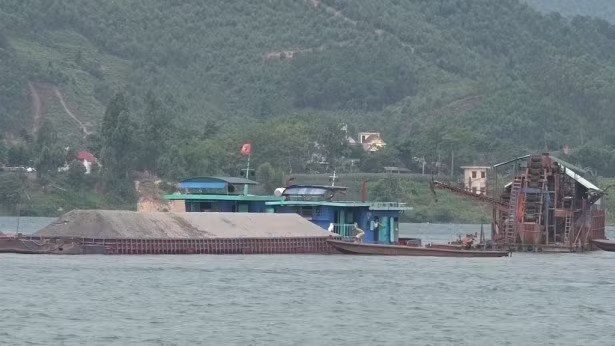
Urgent Gov’t meet on illegal sand mining

The Government held a meeting on Thursday to discuss urgent measures to limit illegal sand mining in the country, which has reached epidemic proportions in response to a boom in construction demand. 

The online meeting, chaired by Deputy Prime Minister Truong Hoa Binh, sought solutions to tighten State control over sand and gravel exploitation and trading. Participants said the demand for sand and gravel had dramatically increased and the trend would continue due to the burgeoning demand of infrastructure contruction.

Rampant illegal exploitation has been posing major challenges for law enforcement bodies. According to a report cited at the meeting, the country has 824 licensed sand and gravel mines and about 90 authorised projects of river-bed dredging.

However, Deputy Minister of Public Security, Senior Lieutenant General Le Quy Vuong, said the police had detected more than 4,300 violations in more than 8,000 inspections in the past year. The violations involved nearly 3,000 people and more than 1,000 facilities and equipment were seized. Criminal proceedings were only initiated in two cases.

Violations include excessive exploitation, exploitation at banned areas, or failing to follow proper procedures in trading exploited sand. They are particularly popular in the rivers of Hong, Da, Lo and Thai Binhin the north, Lai Vu, Lam, Tra Khuc, Huong in the centre, and Sai Gon, Dong Nai, Tien, Hau in the south, Vuong said.

Violence and corruption

Violators use different tactics to avoid detection, such as conducting their activities at night, on weekends or holidays. Some resorted to violence when facing authorities or engaged in turf fights with competitors.

More seriously, “there were cases where illegal activities were covered and protected by corrupt officials at commune and provincial levels and higher ones, too, and even by law protection bodies,” Vuong said.

“If the current situation continues, our country’s resources will soon be depleted, erosion will occur along river banks, natural water flows will be changed, adversely affecting buildings along river banks and harming the life and property of people in adjacent areas,” Deputy PM Binh said.

The Ministry of Public Security (MoPS) proposed that the Government ask the Ministry of Natural Resources and Environment (MoNRE) to ban exploitation in areas highly prone to erosion and subsidence, or those where physical features of water and hydraulic power are likely to change.

The ministry also proposed that authorities inform police before granting permission to companies/organisations to exploit minerals, particularly sand and gravel, so that the police can monitor their activities.

Deputy Minister of Construction Bui Pham Khanh said the high demand for sand was due to the great amount needed for levelling the ground at construction projects. For example, tens of million of cubic metres of sand were used to level the ground for construction of National Highway 5, he said.

“The Ministry of Construction proposes that sand not used to level the ground, but only for building,” he said.

The MoNRE asked the Government to encourage research on alternative materials to replace sand and gravel in construction and levelling. The ministry also proposed banning sand export, even saline sand.

Many Vietnamese businesses have taken advantage of a 2013 law allowing them to export saline sand dredged from river/sea projects to reap profits, resulting in serious environmental impact due to overexploitation.

Do Van Duong, deputy head of National Assembly’s Ombudsman Committee, suggested the MoPS increase criminal proceedings against illegal exploiters. Investors of exploitation projects which cause land erosion must compensate local residents for damage, he said. 

VNS

Other News

Hanoi ready to implement Capital Law 2026, unlocking new development momentum

Hanoi ready to implement Capital Law 2026, unlocking new development momentum

The effectiveness of the Capital Law 2026 will be measured not by the number of legal documents issued but by tangible improvements in governance and public administration, better services for people and businesses, faster administrative procedures, stronger investment attraction and higher economic growth.

Vietnamese students earn honours at ROBOG Asia Cup 2026

Vietnamese students earn honours at ROBOG Asia Cup 2026

Three teams from Chu Van An Secondary School in Vietnam’s Thai Nguyen province have earned First Prize honours and advanced to the quarterfinals at the ROBOG Asia Cup 2026, a regional robotics and artificial intelligence (AI) competition for students held in Hong Kong, China.

Hanoi sets out new investment blueprint with century-long development vision

Hanoi sets out new investment blueprint with century-long development vision

As of early June, Hanoi had attracted 74.6 billion USD in foreign direct investment (FDI) through more than 9,250 valid projects. FDI inflows in the first six months were projected at 3.2 billion USD, surpassing the annual target by 116%, while nearly 16,000 new businesses were established in the first five months, up 34.4% year-on-year.

Vietnam promotes legal cooperation and rule of law at global forum

Vietnam promotes legal cooperation and rule of law at global forum

Vietnam’s development and international integration have gone hand in hand with the improvement of its legal system, the incorporation of international commitments into domestic legislation, and legal reforms aimed at fostering development, openness and global integration. The country regards international law as an essential instrument for building fair, mutually beneficial relations among nations.

Hanoi to hold investment promotion event on June 29

Hanoi to hold investment promotion event on June 29

At the event, Hanoi authorities plan to grant investment policy decisions and investment registration certificates to 20 exemplary projects in the fields of transportation infrastructure, industrial parks, urban development, social housing, environment, science and technology, and foreign investment attraction.

Hanoi's Red River urban area development draws widespread attention

Hanoi's Red River urban area development draws widespread attention

Located south of the Red River and extending from the historic inner city to newly developing areas in the south and the west, the central urban area along Red River’s right bank covers approximately 45,317 hectares and is projected to accommodate around 6.365 million residents by 2045 and 6.455 million by 2065.

Hanoi's Red River urban area development draws widespread attention

Hanoi's Red River urban area development draws widespread attention

Located south of the Red River and extending from the historic inner city to newly developing areas in the south and the west, the central urban area along Red River’s right bank covers approximately 45,317 hectares and is projected to accommodate around 6.365 million residents by 2045 and 6.455 million by 2065.

Regional cooperation strengthened to combat cross-border drug crime

Regional cooperation strengthened to combat cross-border drug crime

Vietnam, China, Laos and Myanmar face common challenges as drug syndicates increasingly exploit the Mekong River, cross-border transport networks, e-commerce platforms, international logistics services, cyberspace and cryptocurrencies to organise drug transactions and smuggling operations.