- Vietnam eyes enhanced relations with US: ambassador
- U.S. Ambassador and the son of General Vo Nguyen Giap to pay a visit to Dien Bien Phu
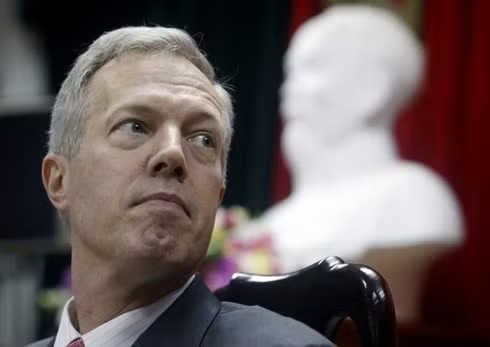
U.S. Ambassador to Vietnam Ted Osius will remain in office despite a recent order from President-elect Donald Trump's transition team asking for politically appointed ambassadors to quit their posts by Inauguration Day.
"The requirement from the incoming administration is specifically for ambassadors that are political appointees," Osius said in a statement late Friday. "As a career diplomat, I have not been asked to resign and expect to complete my full term as ambassador."
 |
The U.S. Senate confirmed Osius as its ambassador to Vietnam in November 2014 after President Barack Obama nominated him for the position in May that year. He is expected to conclude his term by the end of this year.
He has served in Indonesia, India, Thailand, the Philippines and Vietnam for most of his more than two decades in the Foreign Service.
According to the New York Times on Friday, Trump's transition team has issued a blanket mandate requiring politically appointed ambassadors installed by President Barack Obama to leave their posts by Inauguration Day on January 20.
The mandate was issued "without exceptions" through an order sent in a State Department cable on December 23, U.S. ambassador to New Zealand Mark Gilbert said in a Twitter message on January 6.
The Times quoted diplomatic sources as saying previous U.S. administrations, from both major political parties, have traditionally granted extensions to allow a few ambassadors, particularly those with school-age children, to remain in place for weeks or months.
The order threatens to leave the United States without Senate-confirmed envoys for months in critical nations like Germany, Canada and Britain, the Times reported.
A State Department official said: “Per standard practice, the White House requested and received the resignations from all politically-appointed Chiefs of Mission.”
A senior Trump transition official told the newspaper there was no ill will in the move, describing it as a simple matter of ensuring Obama's overseas envoys leave the government on schedule, just as thousands of political aides at the White House and in federal agencies must do.
Diplomats told the Times the order has thrown their personal lives into a tailspin, leaving them scrambling to secure living arrangements and acquire visas allowing them to stay in their countries so their children can remain in school.
'Overreacting'
But to some insiders, the move by Trump's transition team is by no means unusual.
"The new element here is that Trump is saying he wants every political appointee to leave office on January 20, with no temporary extensions granted as has been standard in the past," Peter Van Buren, a retired 24-year veteran of the U.S. Department of State, told VnExpress International.
"It can take a while for the new ambassadors to be confirmed by the Senate, and often in the past the old political appointee stayed around to fill the transition period, or until s/he found a convenient time to depart, say after locating a new job or at the end of the school year," he said.
"Personally, my opinion is that Trump's action is a bit harsh, needlessly speeding up a process that has worked well as it was since at least WWII. His plan accomplishes almost nothing of substance absent maybe looking 'tough' to some of his supporters."
But experts say at the end of the day, this move would have little to no effect on the operations of American diplomatic missions.
"Overall, this whole 'issue' is not a substantive one," Van Buren said. "It is at worst a kind of dumb but ultimately harmless decision by Trump that the media is overreacting to."