US welcomes 36th ASEAN Summit’s statement

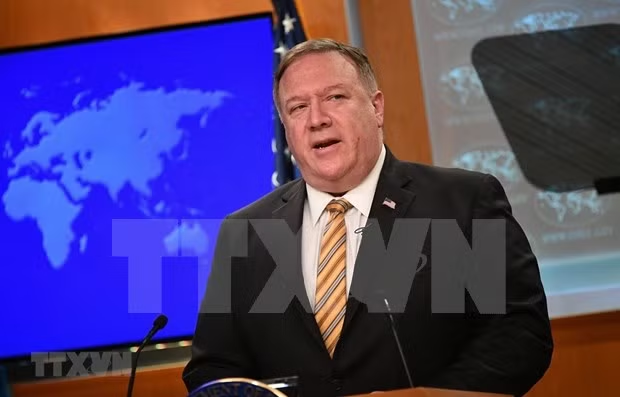
US Secretary of State Mike Pompeo affirmed on June 28 that the US welcomes the vision statement of ASEAN leaders, which was adopted at the recent 36th ASEAN Summit.

The diplomat tweeted “The United States welcomes ASEAN Leaders’ insistence that South China Sea disputes be resolved in line with international law, including UNCLOS. China cannot be allowed to treat the SCS as its maritime empire. We will have more to say on this topic soon.”

The South China Sea is known in Vietnam as the East Sea.

He also included a link to the ASEAN Leaders' Vision Statement on a Cohesive And Responsive ASEAN: Rising Above Challenges And Sustaining Growth.
The 36th ASEAN Summit was held via video conferencing on June 26 under the chair of Vietnamese Prime Minister Nguyen Xuan Phuc. Vietnam is the Chair of ASEAN in 2020.

ASEAN leaders affirmed the importance of maintaining and promoting peace, security, stability, safety and freedom of navigation and aviation in the East Sea.

They also emphasised the need to fully and effectively implement the Declaration on the Conduct of Parties in East Sea (DOC) and soon build a Code of Conduct in the East Sea (COC) in line with international law, including the 1982 United Nations Convention on the Law of the Sea (UNCLOS).

The bloc’s leaders expressed concerns over land reclamations, recent developments, activities and serious incidents, which have eroded trust and confidence, increased tensions and may undermine peace, security and stability in the region. 

They reaffirmed the need to enhance mutual trust and confidence, exercise self-restraint in the conduct of activities that would complicate or escalate disputes and affect peace and stability and avoid actions that may further complicate the situation, and pursue peaceful resolution of disputes in accordance with universally recognised principles of international law, including the 1982 UNCLOS. 

They also emphasised the importance of non-militarisation and self-restraint in the conduct of all activities by claimants and all other states that could further complicate the situation and escalate tensions in the East Sea.

Founded in 1967, the Association of Southeast Asian Nations (ASEAN) groups 10 member countries, namely Brunei, Cambodia, Indonesia, Laos, Malaysia, Myanmar, the Philippines, Singapore, Thailand and Vietnam
VNA

Other News

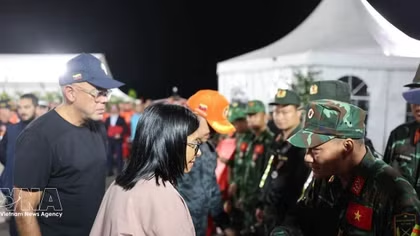
Vietnamese community in Venezuela backs rescue team on humanitarian mission

Vietnamese community in Venezuela backs rescue team on humanitarian mission

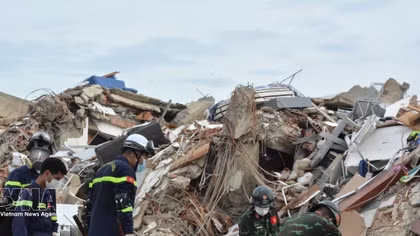
All members of the Vietnamese rescue team in Venezuela have maintained strict discipline, a strong sense of responsibility and unwavering focus when carrying out search, rescue and disaster recovery tasks, with the determination to successfully fulfil the international humanitarian mission entrusted by the Party, State and military.

Key issues ex high agenda at the ASEAN Future Forum 2026

Key issues ex high agenda at the ASEAN Future Forum 2026

PSNews - Nearly six decades after its founding, ASEAN is entering a new phase of transformation. Geopolitical turbulence, intensifying competition among major powers, non-traditional security challenges, and rapid technological change are raising fundamental questions about the region’s future trajectory. In this context, the ASEAN Future Forum (AFF) 2026 is more than a platform for regional countries to discuss current issues; it is designed to identify strategic pathways for ASEAN in the years ahead.

Malaysia bans social media accounts for children under 16

Malaysia bans social media accounts for children under 16

Under the new rules, social media platforms are required to implement age-verification systems and prevent users under 16 from creating accounts. The regulations apply to platforms with at least eight million users in Malaysia, including Facebook, Instagram, TikTok and YouTube.

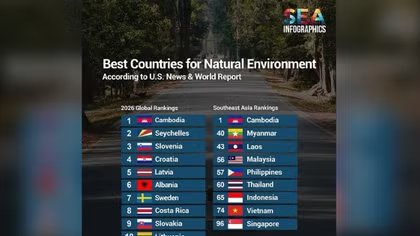
Cambodia ranked world's top country for natural environment in 2026

Cambodia ranked world's top country for natural environment in 2026

Cambodia currently manages 73 protected natural areas covering more than seven million hectares, equivalent to about 41% of the country’s total land area. These protected areas play a vital role in forest conservation, wildlife habitat protection and biodiversity preservation through stricter law enforcement and conservation measures.

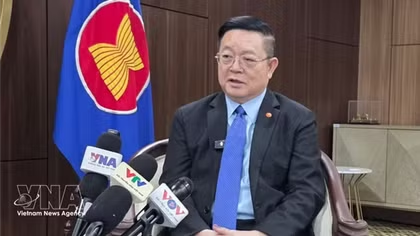
ASEAN chief spotlights Vietnam’s role in shaping bloc’s future

ASEAN chief spotlights Vietnam’s role in shaping bloc’s future

Vietnam is expected to maintain active contributions across ASEAN’s three pillars - the political-security community, the economic community, and the socio-cultural community; while further enhancing regional connectivity through infrastructure projects and stronger economic linkages.

Vietnam supports UNESCO's people-centred approach, multilateral cooperation: official

Vietnam supports UNESCO's people-centred approach, multilateral cooperation: official

Van affirmed Vietnam’s support for the UNESCO80 reform roadmap, focusing on the organisation’s core mandate, priority areas, interdisciplinary approach, and the special status of the Vietnam National Commission for UNESCO, and UNESCO representative offices, alongside efforts to diversify resources and strengthen global partnerships to enhance the organisation’s effectiveness.

Regional media highlight significant step in Vietnam’s leadership structure

Regional media highlight significant step in Vietnam’s leadership structure

Under General Secretary and President Lam’s leadership, Vietnam is expected to maintain a balanced foreign policy, strengthen its regional standing and accelerate economic development, thereby improving living standards and creating new opportunities for international investors, according to the India-based platform Devdiscourse.

Laos identifies 10 key tasks to build independent, self-reliant economy

Laos identifies 10 key tasks to build independent, self-reliant economy

Laos will step up agricultural production to ensure food security, meet domestic demand and expand exports; encourage the development of agro-processing industries, including those related to rubber, aquatic products, cassava and sugarcane, as well as fertiliser and animal feed production, in order to increase added value and create jobs in rural areas.