Vaccines, tests, treatment should be patent-free: Oxfam

Vaccinating the poorest half of humanity – 3.7 billion people - against coronavirus could cost less than the ten biggest pharmaceutical companies make in four months, Oxfam said o

The agency is urging governments and pharmaceutical companies to guarantee that vaccines, tests, and treatments will be patent-free and equitably distributed to all nations and people, ahead of the World Health Assembly next week. The virtual meeting on Monday 18 May will be attended by health ministers from 194 countries.

The Gates Foundation has estimated that the cost of procuring and delivering a safe and effective vaccine to the world’s poorest people is $25 billion. Last year the top ten pharmaceutical companies made $89 billion in profits – an average of just under $30 billion every four months.

Oxfam warned that rich countries and huge pharmaceutical companies – driven by national or private interests – could prevent or delay the vaccine from reaching vulnerable people, especially those living in developing countries.
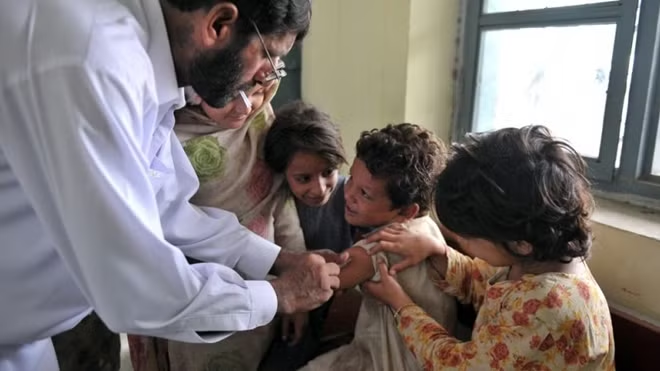
The EU has proposed the voluntary pooling of patents for coronavirus vaccines, treatments, and tests in their draft resolution for the World Health Assembly. Shutterstock

The EU has proposed the voluntary pooling of patents for coronavirus vaccines, treatments, and tests in their draft resolution for the World Health Assembly. If made mandatory and worldwide, this would ensure that all countries could produce, or import low cost versions, of any available vaccines, treatments, and tests. 

 However, leaked documents reveal that there is an attempt to delete references to pooled patents and insert strong language on respecting the patents of the pharmaceutical industry. This would give pharmaceutical companies exclusive rights to produce, and set prices for, any vaccines, treatments and tests they develop – even if taxpayer money has been used to fund their research and development. 

Jose Maria Vera, Oxfam International Interim Executive Director said: “Providing a vaccine to 3.7 billion people could cost less than what the ten biggest pharmaceutical companies make in four months. Anything less than guaranteeing that a vaccine is made available free of charge to all people would be obscene. 

“Vaccines, tests and treatments should be distributed according to need, not auctioned off to the highest bidder. We need safe, patent-free vaccines, treatments and tests that can be mass produced worldwide, and a clear and fair plan for how they will be distributed.”

Once vaccines or treatments are developed, there is also a high risk that rich and powerful governments will outbid poorer nations and force their way to the front of the queue, as they did in the scramble for other essential medical supplies such as personal protective equipment and oxygen. 

In March, drug manufacturer Gilead moved to extend the monopoly on a potential treatment for the virus, and only withdrew it after a public outcry. Gilead has now donated a significant portion of its current supply of remdesivir to the US government, but news reports suggest the company could make significant profits from subsequent production. Some Wall Street analysts expect Gilead to charge more than $4,000 per patient for the drug, even though the cost of remdesivir can be as low as $9 per patient.

Many poor countries are unable to access essential vaccines and medicines due to patent rules which give pharmaceutical companies monopoly rights and the power to set prices well above what they can afford. Pneumonia is the biggest killer of children under the age of five, with 2,000 children dying every day. For over a decade, millions of children have not had access to patented pneumonia vaccines manufactured by Pfizer and GlaxoSmithKline due to its high cost. After years of campaigning by Médecins San Frontieres, both companies reduced their prices in 2016, but only for the very poorest countries, leaving millions of children still without access to their vaccine.
PSN

Other News

Vietnam steps up implementation of ethnic affairs strategy through 2030

Vietnam steps up implementation of ethnic affairs strategy through 2030

To accelerate the implementation of the the Ethnic Affairs Strategy by 2030, with a vision toward 2045, the Prime Minister requested ministries, agencies and local authorities to continue thoroughly carrying out the Party and State’s policies on ethnic affairs, enhancing the effectiveness of State management and strengthening oversight of policy implementation.

Security preparations reviewed for APEC 2027 in Phu Quoc

Security preparations reviewed for APEC 2027 in Phu Quoc

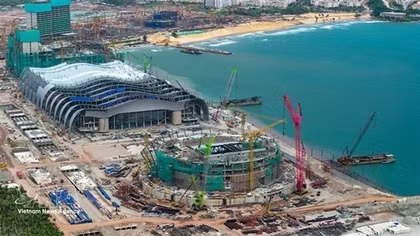
The team examined the APEC 2027 Convention Centre, where main conference activities are scheduled; Sun Serenia Hospital, designated to provide healthcare and emergency medical services for delegates; provincial road DT.975, which connects Phu Quoc International Airport to the convention centre; and the area surrounding Phu Quoc International Airport.

Hanoi accelerates seven Red River bridge projects, many exceed 70% completion

Hanoi accelerates seven Red River bridge projects, many exceed 70% completion

According to the municipal Transport Construction Investment Project Management Board, the city is simultaneously implementing seven projects, namely Tu Lien, Ngoc Hoi, Tran Hung Dao, Thuong Cat, Van Phuc, Hong Ha and Me So bridges. Construction is being carried out on multiple fronts, focusing on bored piles, pile caps, piers and superstructure works.

Dien Bien battlefield legacy powers tourism revival

Dien Bien battlefield legacy powers tourism revival

Seventy-two years after the Dien Bien Phu Victory, its legacy still reverberates. The unity, self-reliance, and resilience forged in that historic triumph remain a powerful internal engine, now propelling Dien Bien toward fast and sustainable development.

Hanoi accelerates shift to green buses, targets 100% by 2030

Hanoi accelerates shift to green buses, targets 100% by 2030

In the 2027–2030 period, the city will accelerate the transition towards the complete phase-out of fossil fuel-powered buses. The share of electric and green energy-fueled buses is projected to reach 79–89% by 2029 and 100% by 2030.

36 fishermen safely rescued after boat breaks down near Truong Sa

36 fishermen safely rescued after boat breaks down near Truong Sa

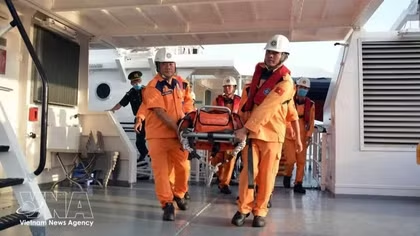
At 8:00 the same day, KN475 began towing the disabled fishing boat toward Da Tay A island. The towing operation was carried out safely, and by 18:30 both the vessel and its crew had arrived at the island without incident, where repairs and additional support procedures were arranged.

Vietnamese language contest in Laos strengthens youth ties, bilateral friendship

Vietnamese language contest in Laos strengthens youth ties, bilateral friendship

Held in response to the launch of the Vietnamese Language Day among overseas Vietnamese communities, the event aimed to enhance the quality of Vietnamese language teaching and learning in Laos while contributing to the great friendship, special solidarity, comprehensive cooperation and strategic cohesion between the two countries.

Vietnamese language contest in Laos strengthens youth ties, bilateral friendship

Vietnamese language contest in Laos strengthens youth ties, bilateral friendship

Held in response to the launch of the Vietnamese Language Day among overseas Vietnamese communities, the event aimed to enhance the quality of Vietnamese language teaching and learning in Laos while contributing to the great friendship, special solidarity, comprehensive cooperation and strategic cohesion between the two countries.

Hanoi launches 10 electric bus routes from April 1

Hanoi launches 10 electric bus routes from April 1

By the end of April, the number of buses using electricity and other green energy sources in the city is expected to reach 822, including 683 electric buses and 139 compressed natural gas (CNG) buses, representing 42.1% of the total number of vehicles.