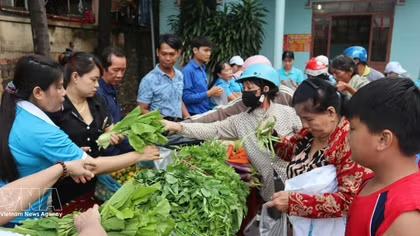
Since the Prime Minister approved a project in 2013 to organise annual activities marking the International Day of Happiness, Vietnam has implemented synchronised social security policies that have steadily improved living standards. Development strategies have increasingly placed people at the centre, focusing on well-being and satisfaction rather than purely economic indicators.
During the 2020–2025 period, with the guiding principle of “leaving no one behind,” the Party issued Resolution No. 42-NQ/TW on reforming and enhancing the effectiveness of social policies, Resolution No. 71-NQ/TW on breakthroughs in education and training, and Resolution No. 72-NQ/TW on strengthening public health protection and care. These efforts have helped Vietnam achieve notable progress in global rankings

Vietnam climbed to the 46th place in the World Happiness Report 2025, its highest position since the ranking was introduced in 2012. The country rose eight places from 2024, 19 from 2023, and 50 compared to its 96th position in 2016. The improvement reflects not only higher living standards but also growing social trust, stability, and more positive public perceptions.
However, behind these gains, happiness remains a deeply personal and varied experience.
For many workers, it is rooted in stability and security. Nguyen Thi Hanh, a garment worker in central Da Nang city, said happiness means having a stable job, a reliable childcare facility, and time to rest. A ride-hailing driver, Tran Van Dung, described it as being able to work smoothly and safely without heavy congestion. For Le Thi Lan, a patient undergoing treatment for a chronic illness, happiness lies in accessible healthcare, shorter waiting time, and affordable medical costs.
These perspectives highlight that happiness is not abstract but closely tied to everyday needs such as employment, healthcare, mobility, and safe living conditions. Beyond material factors, mental well-being is also gaining attention, as work pressure, fast-paced urban life, and social isolation increase the need for balance and human connection.
Improving happiness indicators therefore requires not only sustained economic growth but also higher-quality development. Economically, efforts should focus on creating sustainable jobs and raising real incomes, particularly for low-income groups. Social housing programmes must be integrated with essential services such as schools, healthcare, and cultural facilities.

Culturally, promoting healthy lifestyles and community engagement, alongside stronger mental health support, is essential. In the social sphere, enhancing public service quality remains critical, including reducing hospital overcrowding, improving education quality, and expanding public transport systems to ease congestion.
Such goals demand coordinated actions from authorities at all levels and must translate into measurable outcomes. More efficient transport networks, better-designed worker housing, less congested hospitals, and streamlined administrative procedures are the key to improving daily life and strengthening people’s sense of security.
Looking ahead, the 14th National Party Congress has set a target for Vietnam to rank among the world’s top 40 countries in the happiness rankings by 2030.
This ambition is underpinned by national strategies that prioritise quality of life, including adjustments to the national master plan for 2021–2030 with a vision to 2050. Key directions include strengthening social security, expanding healthcare and education, and raising the Human Development Index (HDI) to around 0.8 alongside higher per capita income.
Environmental protection has been identified as an urgent priority, with plans aimed at maintaining a green, clean, and culturally rich living environment, improving disaster forecasting and climate monitoring, and enhancing risk management to safeguard people’s lives.
The Resolution of the 14th National Party Congress outlined the development orientation of the country for the 2026-2030 period, underlining the need to continue renewing mindset and action, promoting development to ensure stability, and using stability as a foundation for further development and improving people’s living standards and happiness.