 |
Vietnam plans to reduce the rate of underweight and malnourished children under five to less than 15 percent by 2030.
The target is set in a program on the protection and development of ethnic minorities for 2021-2030 which has been approved by Prime Minister Nguyen Xuan Phuc.
The plan prioritises ethnic minority people residing in 12 provinces, namely Cao Bang, Ha Giang, Lao Cai, Yen Bai, Tuyen Quang, Lai Chau, Dien Bien, Son La, Nghe An, Ha Tinh, Quang Binh and Kon Tum.
It aims to drastically reduce maternal and child mortality rates as well as malnutrition among children under five, contributing to improving the quality of the population and ensuring equal development among ethnic groups.
Vietnam is home to 52 minority groups who make up 14 percent of its population of 96 million.
Child malnutrition remains a major problem in the country, especially among ethnic minority communities in remote areas.
According to the National Assembly’s Council for Ethnic Affairs, the prevalence of under-nutrition among ethnic minorities mainly exists in the Central Highlands, North Central region and northern mountainous region. Ethnic minority groups that have the highest rates are Chut, Bo Y, Ro Mam and Si La with 40, 35, 30 and 21.7 percent, respectively.
A World Bank report released in December last year found that nearly 1 in 3 ethnic minority children are affected by stunting, more than twice as much as the Kinh majority; and 21 percent of ethnic minority children are underweight, a ratio 2.5 times higher than that of their Kinh peers.
Stunting is linked to lower economic productivity, including a 10-percent reduction in lifetime earnings. When multiplied across an entire nation, poor nutrition can cost a nation up to three percent of its GDP annually, it said.
According to the program, by 2025, the rate of underweight and malnourished children under five will be reduced to less than 20 percent.
The number of child marriages and consanguineous marriage will be cut by 2-3 percent per year and more than 35 percent of youths would receive pre-marital advice and health examinations for early detection of infectious diseases and HIV.
The rate of maternal mortality will decrease by 25 percent and mortality rate among children under one will fall by 2-5 percent.
At least 50 percent of pregnant mothers and newborns will be screened for the four most common congenital diseases.
By 2030, the number of child marriages and consanguineous marriage is expected to be reduced by 3-5 percent per year, while more than 50 percent of youths will receive pre-marital advice and health examination for early detection of infectious diseases and HIV.
At least 70 percent of pregnant mothers and newborns will be screened for the five most common congenital diseases.
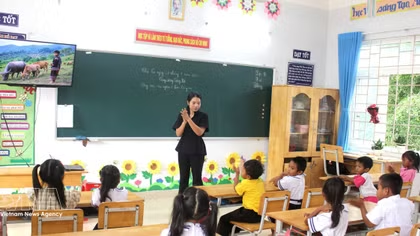
Nearly all ethnic minority people aged between 15 and 60 can read and write. Up to 70 percent of workers will receive appropriate training required for local development.
In November last year, the National Assembly passed a resolution on the master plan on socio-economic development in ethnic minority-inhabited, mountainous and extremely disadvantaged areas in the 2021-2030 period.
Under the master plan, by 2025, the income of the ethnic minority population would double that of 2020’s figure while the ratio of poor households would fall by 3 percent a year.
Infrastructure-wise, all schools, classrooms and medical stations are expected to be built or upgraded with duration in mind, 100 percent of communes are expected to have cement roads leading to their centers, 99 percent of households have access to the national power grid or other suitable power sources, 90 percent of the residents have access to clean water and 100 percent of the population have access to television and radio.
By 2030, average income per capita of ethnic minority people would account for half of the national one. The poverty rate will be cut to under 10 percent.
The plan also sets the targets of having 40 percent of the ethnic minority population being capable or trained in industrial jobs, tourism and service sectors, while 80 percent of rural households are to be engaged in commercial agricultural production.