 |
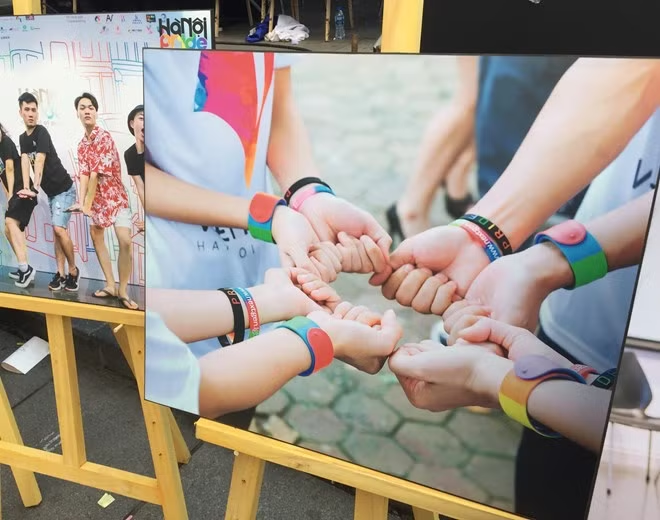
| A photo on display at an exhibition as part of "Steps for LGBT" event held by iSEE in Hanoi on May 6. The photo shows people wearing wristbands of rainbow, a symbol of LGBT community. (Photo: VNA) |
Just more than a decade ago, homosexuality wasn’t accepted widely. There was stigma and discrimination against LGBT people because of their sexual orientation or gender identity.
Things have changed.
Lawmakers slam anti-LGBT discrimination
Public attention turned to homosexuality and the LGBT community in 2012 when Minister of Justice Ha Hung Cuong became the first senior Vietnamese government official to publicly call for the end of prejudice against homosexual people and mentioned the once-taboo subject of same-sex marriage.
“Personally, I think that the recognition or non-recognition of same-sex marriage should be based on very basic studies, credible assessment of impacts on many social and legal aspects, such as personal freedom, compatibility with cultural practices of Vietnamese families and society, and sensitivity and social consequences of the regulations,” stated Cuong in an online public dialogue in July that year.
He further emphasised the need to protect the rights of gay couples. “The country should adopt a legal mechanism to protect their rights in terms of legal personality, property or children of cohabiting couples.”
For many LGBT people, the minister’s words were a bold step forwards, paving the way for their search for marriage equality, given that the previous Law on Marriage and Family specifically outlawed gay marriage.
The LGBT community did not have to wait long for the next supporter to step up.
“In the angle of human rights, gay people also have the right to live, eat, wear, love, and pursue happiness,” Vice Minister of Health Nguyen Viet Tien said publicly a few months later.
“In terms of citizenship, they have the right to work, study, receive medical check-ups and treatment, and register birth, death and marriage… in line with rights and obligations with the State and society.”
The ban made many homosexuals afraid to come out due to fear of discrimination from families, friends and colleagues and being abandoned, he stressed, calling for the legal recognition of same-sex marriage as it is a human right.
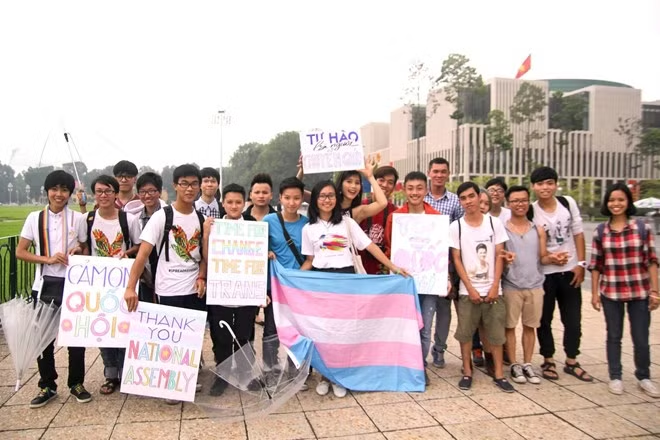 |
| Many LGBT activists flock to the streets in Hanoi to applaud the new legislation. They raise flags and boards, some of which read “Cam on Quoc hoi” (Thank you, National Assembly). (Photo courtesy of iSEE) |
Also in 2012, the Ministry of Justice (MoJ) activated a review of the Marriage and Family Law which, for the first time in Vietnamese history, brought up legal consideration of same-sex marriage.
The ministry asked all government agencies for opinions about revising the law again in an official letter sent in May, 2012, concerned that the community of gays and lesbians was expanding in the country but many lived together without registering a marriage.
“From the perspective of individual rights, marriage between people of the same sex should be recognised,” the letter said.
“The cohabitation of same-sex couples is a real social phenomenon, which results in binding relations and issues concerning property ownership and child custody.”
“The current law may not legalise their marriage but there must be a legal framework to address these issues.”
The MoJ launched a number of policy dialogues with LGBT groups during the formation of the bill.
It also engaged several organisations, including the Institute for Studies and Society, Economy and Environment (iSEE) and the Women’s Union, in civil society consultation to get insight and relevant expertise in the LGBT community and related issues, and to assess impacts of the bill on the society.
“We worked with the Ministry of Justice in many consultation workshops on this bill… We really appreciated the effort of the government in protecting the rights of LGBT people... and to show its acceptance of alternative lifestyle,” Le Phan Anh Thu, iSEE’s Acting Coordinator of LGBT Rights Programme told Vietnam News Agency.
The draft bill was submitted to the Vietnamese National Assembly for debate in 2013, making Vietnam the first country in Asia where the topic was discussed at parliamentary level.
June 19, 2014 was a special day for LGBT people.
After two years of discussion, the NA passed the revised law, with no clause prohibiting marriage between people of the same sex. The new law allowed same-sex couples to co-habit and have wedding ceremonies, but they are not considered a legal family.
Though the act does not recognise gay marriage, an activist called it “quite amazing change in such a short span of time,” given that the LGBT social movement was said to have only started a decade ago.
“The support of the MoH as well as iSEE clearly shows that the LGBT issue is becoming more and more salient in Vietnam, and that more and more officials and individuals are beginning to see the importance of empowering this community.”
According to H.H.T, his activist peers in the region are impressed with what Vietnam has achieved so far, referring to those from the Asian countries where gay marriage remains outlawed.
“This makes Vietnam one of the leaders in the region”, H.H.T said.
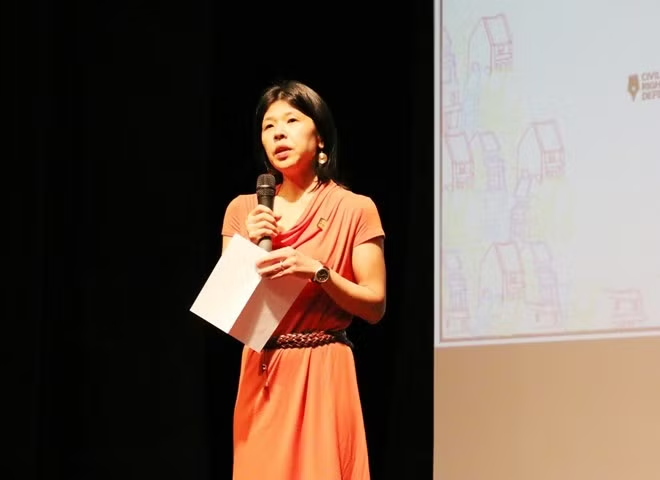 |
| Ambassador of Canada to Vietnam Ping Kitnikone makes an opening speech in Hanoi Pride 2017. (Photo courtersy of the Embassy of Canada) |
“During our interactions with fellow activists, Vietnam is always being referred to as a beacon of hope with regards LGBT rights in ASEAN,” said Ryan V. Silverio, Regional Coordinator of ASEAN Sexual Orientation and Gender Identity/Expression Caucus (ASC), a regional organisation of LGBT human rights activists in Southeast Asia.
“The revision of the civil code and the Vietnamese government's openness to LGBT organisations in crafting a new law on gender recognition was positively welcomed by activists.”
If Vietnam adopts the bill, the country will become the sixth in Asia and the second in Southeast Asia to have specific legislation on gender reassignment.
Anh Thu was convinced that it (the adoption of bill) reflects the government’s consistent view – LGBT rights are basic human rights.
“So protecting them is the right thing to do.”
Despite some disappointments about the outcome, many others felt optimistic. “It may be not completely there yet… but it is good to know it’s moving forward,” said H.H.T, an LGBT activist.
“The new law has positive effects on advocacy to change public awareness as it sends a message that same-sex marriage is not a bad thing.”
“Some were upset, but in return, many others have become more deeply engaged into the community’s activities because they understand if they do not advocate for their own rights, then nobody can,” he added.
“This might be a baby step towards equal marriage, but was an important one that brought us hope and motivation,” Anh Thu added.
“Practically, same-sex couples still are not protected by law but on the other hand, lifting the ban on same-sex marriage reflected a huge change in the mindset of policy makers.”
“LGBT people now can be more confident to not only present their visibility but also to talk about their rights to access services, such as education, legal and medical services”.
Vietnam well ahead in Asia
Vietnam grabbed big attention again in November 2015 when lawmakers took a major step by voting to pass the amended Civil Code that legalises sex reassignment surgery.
Previously, sex reassignment in Vietnam was limited to only those without complete sex organs and those with both male and female sex organs. Now anyone can have sex change surgery and can legally register under a new name and new gender.
The LGBT community is excited for more big changes in the next few years as the new Law on Gender Change is being crafted by the Ministry of Health (MoH) to protect the rights of transgender people.
The law is set to be submitted to parliament for review in 2019 at the latest.
“The bill stipulates how to identify a person whose gender identity is different from his/her assigned sex at birth through psychological evaluations... After that, doctors are allowed to perform medical interventions, such as hormone therapy or breast and genital surgeries,” said Nguyen Huy Quang, director of the MoH’s department of legal affairs.
“If passed, the bill will provide a basic and humane legal framework... for transgender people to live true to themselves and set their bodies free,” he said.
“It’s a work in progress and I am pleased to see the efforts that are going in to considering the different aspects of the bill on protecting the rights of transgender people in healthcare,” Ambassador of Canada to Vietnam Ping Kitnikone told Vietnam News Agency.