Vietnam bans animal slaughter at violent spring festivals

It remains to be seen whether locals are willing to abandon their traditional rituals.

With the spring festival season nearly upon us, Vietnam’s Ministry of Culture, Sports and Tourism has ordered an end to all performances that include either violent or offensive rituals, such as killing animals.

Several festivals still feature violent rituals that involve slaughtering pigs and bull fighting, and that has to stop, the ministry said in a new statement.

Most spring-time rituals in Vietnam were created centuries ago to commemorate ancient war heroes, show respect to the gods and to pray for good health, peace and prosperity -- all honorable causes.

But how people celebrate and perform these rituals is another question.

Sometimes that involves the brutal killing of animals in public, like the pig slaughtering festival in the northern province of Bac Ninh.

Nem Thuong villagers celebrate the festival on the sixth day of the first lunar month, which is February 5 next year, to commemorate a general who took refuge in the area while fighting invaders a thousand years ago. He killed wild hogs to feed his soldiers, hence the tradition of slaughtering pigs.

Traditionally, villagers parade two pigs around before beheading them and collecting their blood. Then they soak money in the fresh blood and place it on the altars in their houses to pray for good crops and health.

The festival has been facing criticism and opposition since 2012, including a petition from the Hong Kong-based Animals Asia Foundation, which said the festival was “extremely cruel”. But the villagers have refused to give up their tradition.
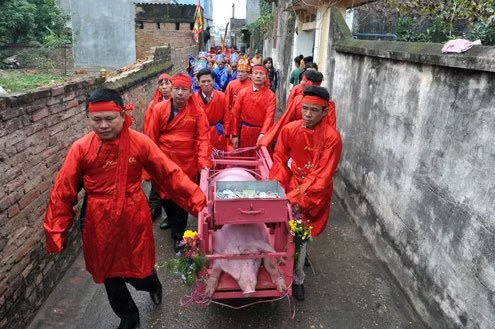
A pig is paraded before being slaughtered in a spring festival in Bac Ninh Province. Photo: Animals Asia

In the past the ministry said that local communities should have the right to conduct their traditional festivals, and this is the first time it has taken such a tough stance.

The statement also asked local authorities to stop any fighting, gambling or begging at the upcoming spring festivals.

Many spring festivals involve hundreds of people scrambling to touch good luck charms, and this can break out into fighting.

At a festival in Hanoi in February 2015, many people were beaten with sticks and poles when a frenzied rush to snatch up sacred offerings turned into violent clashes. At another in the nearby Phu Tho Province early this year, several men passed out after being crushed by hundreds of people trying to catch sacred balls tossed into the crowd after a spiritual ceremony. The game was created to train soldiers during ancient times and those who manage to seize or just touch one of the balls believe it brings good luck for the year.

The ministry also said that the number and the scale of spring festivals must be scaled down.

Official statistics show that every year, more than 7,300 festivals take place around Vietnam, mostly in the spring.

VnExpress

Other News

Vietnam secure berth at FIFA U17 World Cup 2026 for first time

Vietnam secure berth at FIFA U17 World Cup 2026 for first time

Vietnam national U17 football team secured a place at the FIFA U17 World Cup 2026 for the first time after defeating United Arab Emirates national U17 football team 3-2 on in the final Group C match of the AFC U17 Asian Cup 2026 in Saudi Arabia on early May 14 (Vietnam time).

Vietnam’s most beautiful railway station twins with French counterpart

Vietnam’s most beautiful railway station twins with French counterpart

A twinning agreement between Da Lat Railway Station in Vietnam and Trouville-Deauville Railway Station in France was signed at the French Embassy in Vietnam on May 7, creating new opportunities for cooperation in station management and operations, as well as cultural and tourism promotion between the two sides.

Hanoi gains two more craft villages in World Crafts Cities network

Hanoi gains two more craft villages in World Crafts Cities network

The recognition of Chuyen My and Son Dong craft villages as members of the World Crafts Cities network represents international acknowledgement of the cultural value, artisanal techniques, creativity and sustainable vitality of Vietnam’s traditional craft villages, he said.

Thang Long - Hanoi Festival 2026 to return in September

Thang Long - Hanoi Festival 2026 to return in September

Co-hosted by the municipal People’s Committee, the Department of Culture and Sports, and domestic and foreign agencies, the whole spectacle is meant to honour the city’s millennia-old heritage while reafffirming its strategy of establishing culture as a development engine.

Spreading Vietnamese cultural identity in digital space

Spreading Vietnamese cultural identity in digital space

In the context of deep international integration, cultural identity serves as both a “shield” against assimilation and a defining marker of a nation’s image. Protecting and promoting uniquely Vietnamese cultural values has therefore become a pressing task, particularly in an increasingly complex digital environment.

ITE HCMC 2026 to promote Vietnam’s tourism on global map

ITE HCMC 2026 to promote Vietnam’s tourism on global map

With its large scale, the ITE HCMC 2026 aims to promote tourism cooperation between Vietnam and priority markets such as Northeast Asia, Western Europe, North America, Southeast Asia, and Oceania while also boosting visitor arrivals from the Indian market

Vietnamese puppetry seeks renewal amid preservation challenges

Vietnamese puppetry seeks renewal amid preservation challenges

Although widely regarded as a cultural “speciality” attracting tourists, Vietnamese puppetry is facing multiple challenges in preservation and development, requiring renewed efforts to both safeguard its identity and adapt to contemporary cultural currents.

Project on digital transformation in cultural sector approved

Project on digital transformation in cultural sector approved

By 2030, the project targets the establishment of shared digital platforms across 100% of cultural sectors. All digitised cultural heritage will be standardised under the national data framework and shared in accordance with regulations, while 80% of public digital heritage assets are expected to receive digital identifiers to clarify ownership and management, encouraging organisations and individuals to do the same and support market development.

Vietnam eyes becoming region’s leading tourism destination

Vietnam eyes becoming region’s leading tourism destination

Vietnam has in recent years undergone a notable transformation in its tourism development strategy, placing a strong emphasis on nature-based and eco-tourism. This shift is not merely aligned with global trends, but represents a necessary step towards safeguarding valuable natural resources, while appealing to a growing segment of environmentally conscious travellers.