Vietnam has among the most progressive gender equality laws in Asia

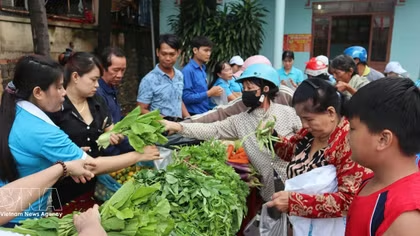
Vietnam was among the first countries to ratify the UN’s CEDAW convention on women’s rights in 1982, and Vietnamese women’s labour force participation of over 73% is one of the highest in the region. 

"As regional business leaders convene in Hanoi next week (11-13 September 2018) for the World Economic Forum on ASEAN, they have an opportunity to learn from Vietnam’s successes and shortcomings on promoting equality between men and women", Babeth Ngoc Han Lefur, Country Director, Oxfam in Vietnam said.

In her opinion, Vietnam has among the most progressive gender equality laws in Asia. It was among the first countries to ratify the UN’s CEDAW convention on women’s rights in 1982, and Vietnamese women’s labour force participation of over 73% is one of the highest in the region. 

There is compelling evidence that women in leadership in companies drives profits and gives businesses a competitive edge. On a national level, greater gender equality in the workforce provides enormous macroeconomic opportunity. 

The McKinsey Global Institute asserted in 2015 that if women participated equally in the global economy, they could generate additional GDP worth $28 trillion by 2025. That amount is roughly equivalent to the size of the Chinese and US economies combined.

In order for government and business leaders to do better, they must begin by addressing three key barriers to economic equality: Agree that the idea that ‘our economic model is gender-neutral’ is a myth; Women’s economic empowerment is a practical selling point for companies and business; The biggest barrier to change is often the deeply held social norms, beliefs and behaviours within companies and organisations’ own practices. 

In Vietnam, the legal environment provides a good foundation for companies to develop comprehensive gender policies within their organisations as well as in business operations. The bigger and more complex task is to enhance gender diversity thinking and culture at the workplace, such as discouraging gender stereotyping, penalising gender discrimination, and promoting values and behaviours of equality and diversity. 

Businesses that genuinely strive for inclusion tackle the solution with a comprehensive inside/outside strategy, including good policies, a business culture that values women’s leadership, and contributions to shared prosperity in society. Businesses’ competitive edge does not come only from the maximisation of profits; it lies in gender diversity and environmental sustainability that drive business growth.

On the occasion of the World Economic Forum on ASEAN, Oxfam launches a discussion paper entitled ‘The Future of business: Shaping inclusive growth in South East Asia’ that presents a spectrum of responsible business models that can help to deliver more sustainable and inclusive economic development, zooming into gender equalities at work. 

PSNews

Other News

Hanoi ready to implement Capital Law 2026, unlocking new development momentum

Hanoi ready to implement Capital Law 2026, unlocking new development momentum

The effectiveness of the Capital Law 2026 will be measured not by the number of legal documents issued but by tangible improvements in governance and public administration, better services for people and businesses, faster administrative procedures, stronger investment attraction and higher economic growth.

Vietnamese students earn honours at ROBOG Asia Cup 2026

Vietnamese students earn honours at ROBOG Asia Cup 2026

Three teams from Chu Van An Secondary School in Vietnam’s Thai Nguyen province have earned First Prize honours and advanced to the quarterfinals at the ROBOG Asia Cup 2026, a regional robotics and artificial intelligence (AI) competition for students held in Hong Kong, China.

Hanoi sets out new investment blueprint with century-long development vision

Hanoi sets out new investment blueprint with century-long development vision

As of early June, Hanoi had attracted 74.6 billion USD in foreign direct investment (FDI) through more than 9,250 valid projects. FDI inflows in the first six months were projected at 3.2 billion USD, surpassing the annual target by 116%, while nearly 16,000 new businesses were established in the first five months, up 34.4% year-on-year.

Vietnam promotes legal cooperation and rule of law at global forum

Vietnam promotes legal cooperation and rule of law at global forum

Vietnam’s development and international integration have gone hand in hand with the improvement of its legal system, the incorporation of international commitments into domestic legislation, and legal reforms aimed at fostering development, openness and global integration. The country regards international law as an essential instrument for building fair, mutually beneficial relations among nations.

Hanoi to hold investment promotion event on June 29

Hanoi to hold investment promotion event on June 29

At the event, Hanoi authorities plan to grant investment policy decisions and investment registration certificates to 20 exemplary projects in the fields of transportation infrastructure, industrial parks, urban development, social housing, environment, science and technology, and foreign investment attraction.

Hanoi's Red River urban area development draws widespread attention

Hanoi's Red River urban area development draws widespread attention

Located south of the Red River and extending from the historic inner city to newly developing areas in the south and the west, the central urban area along Red River’s right bank covers approximately 45,317 hectares and is projected to accommodate around 6.365 million residents by 2045 and 6.455 million by 2065.

Hanoi's Red River urban area development draws widespread attention

Hanoi's Red River urban area development draws widespread attention

Located south of the Red River and extending from the historic inner city to newly developing areas in the south and the west, the central urban area along Red River’s right bank covers approximately 45,317 hectares and is projected to accommodate around 6.365 million residents by 2045 and 6.455 million by 2065.

Regional cooperation strengthened to combat cross-border drug crime

Regional cooperation strengthened to combat cross-border drug crime

Vietnam, China, Laos and Myanmar face common challenges as drug syndicates increasingly exploit the Mekong River, cross-border transport networks, e-commerce platforms, international logistics services, cyberspace and cryptocurrencies to organise drug transactions and smuggling operations.