Vietnam land use efficiency remains low

Land use efficiency in cities in Vietnam remains low due to delayed projects, unused houses and improper land use planning, according to experts.
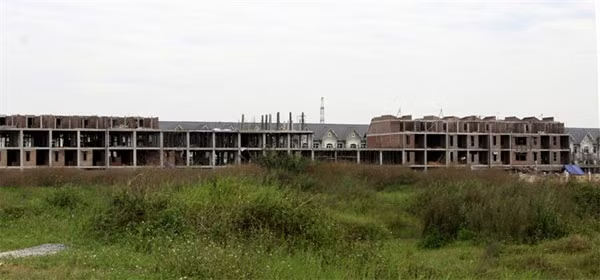
An abandoned apartment complex project in the Nam An Khanh urban area in the capital city’s Hoai Duc District. — VNA/VNS Photo

Chairman of Vietnam Construction Association Tran Ngoc Hung said that on average, every square kilometre of urban land in Vietnam was used by about 2,100 people, while in other Asian countries, the rate was about 10,000 people per square kilometre.

Delayed projects accompanied by unused land and unused houses caused significant wastage and low land use efficiency, he said.

He added that Vietmam gave up too much land and investment on housing projects in cities, which hindered the development of new urban areas or satellite cities.

In Hanoi alone, major central hospitals like Bach Mai, Viet Duc or Military Hospital 108 have been expanded to meet increased demand. Many State and Government offices are based in the city centre, and big hotels are built on crowded streets.

The move of factories from inner-city districts was expected to make room for public infrastructure like parks, schools or play grounds. However, so-called high profit housing projects have typically been developed on the land where the factories used to be.

“Once new urban areas and satellite cities fail to attract people to live and work, projects there faced risks of being halted or delayed,” Hung told a meeting on urban land use efficiency held by the association late last month. He cited examples of projects along Thang Long Boulevard or National Highway 32 in Ha Noi, the urban area to the east of Hai Phong City.

“Increased land use efficiency in cities is an important factor to develop green and modern cities,” he said.

Dao Trung Chinh, vice head of the Land Management Department under the Ministry of Natural Resources and Environment said the Government had approved land use plans but such plans were not implemented strictly.

Investors were not interested in projects in old urban areas because of modest available land, high prices, and high population density, he said.

“Vietnam still needs a better legal framework on urban development control to attract investors,” he said.

Associate Professor and Dr Tran Trong Hanh, former principal of Hanoi Architecture University said that in order to increase land use efficiency in urban areas, it was necessary to classify land for urban construction, identify optimal capacity of urban areas, and select land for urban construction.

Hanh suggested that a sustainable immigration policy could pave the way to higher land use efficiency in urban areas.

Land use planning should be in accordance with urban planning, he added.

VNS

Other News

Hanoi ready to implement Capital Law 2026, unlocking new development momentum

Hanoi ready to implement Capital Law 2026, unlocking new development momentum

The effectiveness of the Capital Law 2026 will be measured not by the number of legal documents issued but by tangible improvements in governance and public administration, better services for people and businesses, faster administrative procedures, stronger investment attraction and higher economic growth.

Vietnamese students earn honours at ROBOG Asia Cup 2026

Vietnamese students earn honours at ROBOG Asia Cup 2026

Three teams from Chu Van An Secondary School in Vietnam’s Thai Nguyen province have earned First Prize honours and advanced to the quarterfinals at the ROBOG Asia Cup 2026, a regional robotics and artificial intelligence (AI) competition for students held in Hong Kong, China.

Hanoi sets out new investment blueprint with century-long development vision

Hanoi sets out new investment blueprint with century-long development vision

As of early June, Hanoi had attracted 74.6 billion USD in foreign direct investment (FDI) through more than 9,250 valid projects. FDI inflows in the first six months were projected at 3.2 billion USD, surpassing the annual target by 116%, while nearly 16,000 new businesses were established in the first five months, up 34.4% year-on-year.

Vietnam promotes legal cooperation and rule of law at global forum

Vietnam promotes legal cooperation and rule of law at global forum

Vietnam’s development and international integration have gone hand in hand with the improvement of its legal system, the incorporation of international commitments into domestic legislation, and legal reforms aimed at fostering development, openness and global integration. The country regards international law as an essential instrument for building fair, mutually beneficial relations among nations.

Hanoi to hold investment promotion event on June 29

Hanoi to hold investment promotion event on June 29

At the event, Hanoi authorities plan to grant investment policy decisions and investment registration certificates to 20 exemplary projects in the fields of transportation infrastructure, industrial parks, urban development, social housing, environment, science and technology, and foreign investment attraction.

Hanoi's Red River urban area development draws widespread attention

Hanoi's Red River urban area development draws widespread attention

Located south of the Red River and extending from the historic inner city to newly developing areas in the south and the west, the central urban area along Red River’s right bank covers approximately 45,317 hectares and is projected to accommodate around 6.365 million residents by 2045 and 6.455 million by 2065.

Hanoi's Red River urban area development draws widespread attention

Hanoi's Red River urban area development draws widespread attention

Located south of the Red River and extending from the historic inner city to newly developing areas in the south and the west, the central urban area along Red River’s right bank covers approximately 45,317 hectares and is projected to accommodate around 6.365 million residents by 2045 and 6.455 million by 2065.

Regional cooperation strengthened to combat cross-border drug crime

Regional cooperation strengthened to combat cross-border drug crime

Vietnam, China, Laos and Myanmar face common challenges as drug syndicates increasingly exploit the Mekong River, cross-border transport networks, e-commerce platforms, international logistics services, cyberspace and cryptocurrencies to organise drug transactions and smuggling operations.