 |
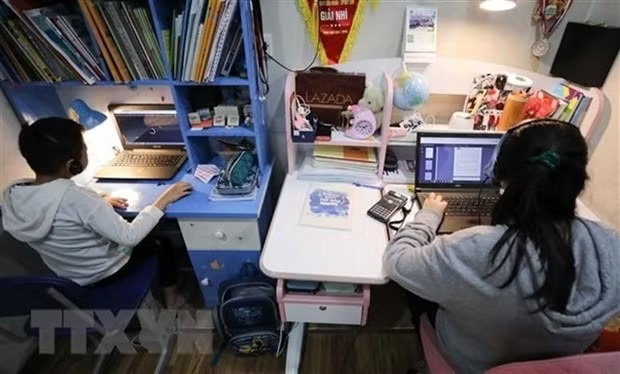
| Children access the internet to study online after the COVID-19 fourth wave broke out in Hanoi. The internet has become the only way for many children to access education during the pandemic (Photo: VNA) |
Vietnam has for the first time launched a national programme to protect children online in an attempt to make the internet a healthy and safe place for children to learn, socialise and express themselves.
Under Decision No 830 signed by Prime Minister Pham Minh Chinh, the national programme on child protection online - the first national-level programme on this issue in Vietnam - aims to protect the privacy of children and prevent and handle acts of abuse.
Specifically, the programme focuses on supplying children with age-appropriate knowledge and skills so that children can self-identify and be able to protect themselves when online.
It will also maintain a healthy network environment, develop an ecosystem of Vietnamese applications for children to learn, socialise and express themselves in a safe and creative way.
The programme includes initiatives in deploying new technologies such as artificial intelligence and big data to automatically collect and analyse early warnings on content not suitable for children.
Websites with the national “.vn” domain and those with IP addresses in Vietnam will be required to self-categorise content suitable for children's ages. Those who provide online services and applications for children have to self-deploy solutions to protect children and assist parents or caregivers in managing children's use of applications and services.
Network operators and digital platform providers such as Google, Facebook, and Zalo will apply artificial intelligence technology and big data analysis to filter videos and clips with malicious content.
Under the programme, businesses will be encouraged to develop information security solutions to protect children on the internet.
The programme also integrates online notification channels on issues related to children with the national child protection hotline at 111. This will become the only application on the network environment to reflect and share issues related to children.
In addition, the programme includes building and integrating into the educational programme the training of digital skill sets for children by age. Children will be taught a number of skills such as common knowledge of the internet and social networks; information security skills; personal information protection; and how to recognise abuse.
The implementation of digital skill sets will be piloted in five cities of Hanoi, Ho Chi Minh City, Hai Phong, Da Nang and Can Tho.
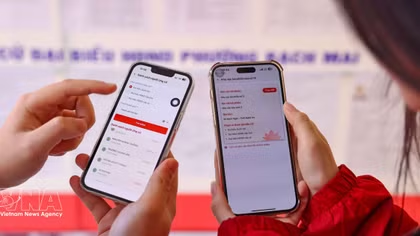
Children can visit the website: http://bvte.vncert.vn to share issues of online abuse and help them express their own voices.
A UNICEF survey of children and young people in Vietnam showed that one-fifth of the total number of children surveyed said they have been victims of cyberbullying.
Reports from the Department of Child Affairs under the Ministry of Labour, Invalids and Social Affairs showed that after nearly 16 years of operating the hotline 111, the department has received over 4 million calls to discuss issues related to children.
There were more than 700,000 cases of child sexual abuse images and videos appearing online in Vietnam last year. On average, more than 60 percent of children in the country have access to an internet-connected device.
When the programme is implemented, the network to protect children in the online environment will be deployed by inter-agencies of the Ministry of Public Security, the Ministry of Information and Communications, the Department of Child Affairs and legal consulting units.
When children call the hotline 111, information will be received and supported in a timely manner. All children who are victims of abuse on the internet will be supported and intervened at the request of children themselves or from their relatives and the community as well.
All primary, secondary and high schools will be required to teach knowledge and skills for students to participate in a safe online environment.