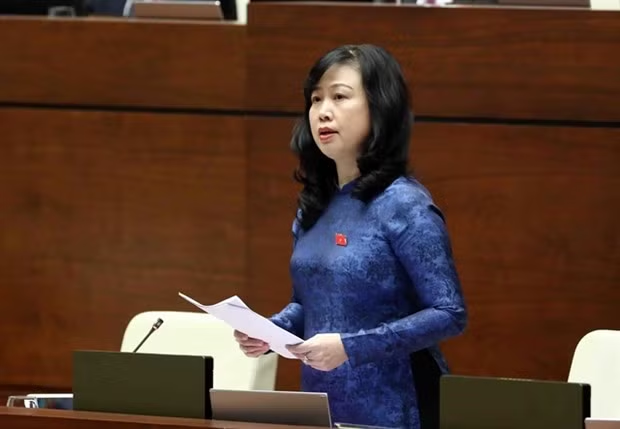
Minister of Health Dao Hong Lan has said that Prime Minister Pham Minh Chinh would chair a meeting of the National Steering Committee for COVID-19 Prevention and Control this weekend to deliberate the downgrading of COVID-19 from its current placement in Class A infectious diseases down to Class B.
Lan told the National Assembly that on May 29 that the World Health Organisation (WHO) announced that COVID-19 no longer constituted a Public Health Emergency of International Concern, the designation that was attached to the viral disease more than three years ago, but the pandemic is not over yet.
In accordance with the guidance of the Government leader, the Ministry of Health was also coordinating with other ministries and agencies to review the legal regulations, consult the experience of other countries, and review practical measures for the prevention and control of COVID-19 in Vietnam, Lan noted.
The Ministry of Health had taken the lead in working with other ministries and agencies to build a dossier to reclassify infectious diseases from Class A to Class B, she said.
Vietnam classifies infections into three classes A, B, and C, mostly according to the severity.
Group A includes highly dangerous infectious diseases that can spread rapidly, widely, and have a high death rate or the cause of the disease is not yet known.
Examples are Polio, Avian influenza A-H5N1, Plague, Hemorrhagic fever caused by Ebola, Lassa or Marburg viruses, West Nile fever, Yellow fever, Cholera, Severe Acute Respiratory Syndrome, and new dangerous infectious diseases that have newly emerged with unknown/unclear pathogens.
Class B includes dangerous infectious diseases that can be rapidly transmittable and fatal, which include Adenovirus disease, Human immunodeficiency virus/acquired immunodeficiency syndrome (HIV/AIDS), Influenza, Rabies, Whooping cough (pertussis), Tuberculosis, Shigellosis, Mumps, Dengue fever, Malaria, Measles, Hand-foot-mouth disease, Anthrax, Smallpox, Typhoid fever, Rubella, Viral hepatitis, Viral encephalitis, and Zika, etc.
And Class C embraces less dangerous and not rapidly transmittable infectious diseases, which include chlamydia.
The Minister of Health has the competence to revise the list of infectious diseases in each class.
Tran Dac Phu, former Director of the Preventive Medicine Department and Senior Advisor to the Public Health Emergency Operations Centre (under the Ministry of Health), has told local media that the COVID-19 situation in Vietnam is still under control, with the majority of new cases having mild or no symptoms, and the healthcare system is not being overloaded.
The most severe and fatal cases are still concentrated among those with underlying health problems, the elderly, the unvaccinated, and those with compromised immune systems.
These individuals are also at risk of developing more severe illness and death from other infectious diseases, such as influenza, not just COVID-19, according to Phu.
When these individuals contract diseases that weaken their immune systems, they become vulnerable to other diseases, leading to more severe illness and death.
Vietnam has already moved on to flexible, safe and effective adaptation and control of COVID-19 strategy since late 2021, thanks to the high vaccination rate.
Although we have not yet reclassified COVID-19 from Group A to Group B, Phu observed, many activities have returned to normal, such as reopening borders, lifting travel restrictions, organising meetings and events without mandatory testing, and loosening quarantine measures to ensure economic activities and social welfare.
However, Phu stressed that COVID-19 still has its unique characteristics as the WHO has not declared the end of this pandemic and the body still advises countries to be cautious and shift from emergency response to sustainable and long-term disease control strategies.
Therefore, in terms of policy and planning for COVID-19 prevention and control, Phu underlined the need to closely monitor the epidemiological situation to have appropriate responses, without being taken by surprise, to control the disease in all situations while minimising costs, protecting the health and rights of the people.
"It is especially important to note that disease surveillance efforts, personal prevention measures, vaccination, communication, and protecting vulnerable groups should be prioritised," the health expert said.
According to the Ministry of Health's statistics, Vietnam has so far recorded over 11.6 million COVID-19 infections, with total recoveries logged at 10.63 million.
Over 43,200 deaths have been attributed to COVID-19, about 0.4% of the total caseload.
More than 266.4 million doses of COVID-19 vaccines have been administered across the country.