Vietnamese Cambodians build lives far from home country

A Vietnamese-Cambodian community has been building their lives solely on the production of dried fish on the outskirts of Phnom Penh, trying to remember their origin while living in a foreign country.

About 3,000 residents of a raft village, located in the outlying Prek Phnov district of the Cambodian capital, settle down along the Mekong River with their primary livelihood being dried fish production.

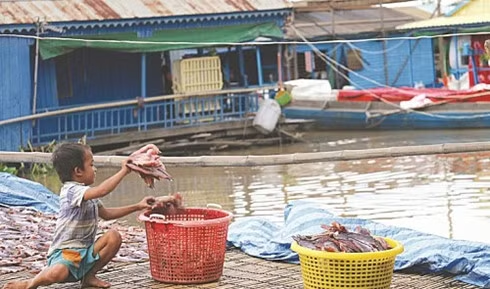
Houses tied together to form rafts float side by side along the riverbank, each connected with the land by a makeshift bridge, often made from wooden planks or steel sheets.

According to Pham Van On, head of the local people’s union, each raft costs at least US$4,000-5,000, despite their rustic appearance.

Dried fish has long provided a stable source of income for local residents, On said, adding that it is easy to spot the fish being dried on each of their ‘front yards.’

Le Van Sau, 56, hailing from the southern Vietnamese province of Dong Thap, who has resettled in the Cambodian territory along with his five children, said that the fish were mainly imported from Vietnam.

Producing dried fish is an easy job, Sau stated, adding that even young children from five to six years old are able to help their family out.

“It is my daily task to lay the fish on the ground to dry them, just like playing with toys,” Nguyen Van Nam, a six-year-old boy, remarked.

Nguyen Thi Nho, 52, whose hometown is in the Mekong Delta province of Bac Lieu, recalled that she has earned a living in Phnom Penh since 1979, along with her husband and four siblings.

“We all smell like fried fish,” she joked. “It is, however, our only source of income.”

Unstable lives

According to Sau, he was born in the Cambodian city as his parents had moved there a long time ago.

Many Vietnamese people have chosen to resettle in the city for generations, living mainly on aquaculture.

The Vietnamese community was forced to return to their home country in 1975 before coming back to Phnom Penh four years later, struggling to rebuild their lives.

“Our life was basically stable up until the 1990s,” Sau continued.

“As much as I want to live in Vietnam, there is nothing there for me to build my life on as my career and children are all here in Cambodia,” he added.

Truong Thi Nham, 34, and her five siblings followed their neighbors from the southern Vietnamese province of An Giang to the Cambodian city many years ago, without knowing much about what life was going to be there.

The orphaned sisters managed to earn a living by selling both fresh and dried fish, and later got married and started building their own families.

“Our home is here as we have no relative back in Vietnam. We owe this community as it has provided us with a place to live and things to eat,” Nham said,

Remembering the root

Following decades of hard work, the Vietnamese Cambodians have been able to build a steady life, many of whom are now happy to see their children grown up and get married.

However, the residents have not gone through a single day without remembering their hometown in Vietnam.

Despite his limited budget, Sau still puts aside some tens of millions of dong (VND10 million = US$440) every year to return to Vietnam for Lunar New Year celebration.

Like some other families, he decided to send his 12-year-old grandson back to Vietnam for education.

“He can stay in Vietnam if he wishes to. After all, we need someone in the family to preserve our root,” Sau said.

Meanwhile, Nham has been teaching Vietnamese to her children despite being married to a Cambodian man.

Tuoitrenews

Other News

Hanoi ready to implement Capital Law 2026, unlocking new development momentum

Hanoi ready to implement Capital Law 2026, unlocking new development momentum

The effectiveness of the Capital Law 2026 will be measured not by the number of legal documents issued but by tangible improvements in governance and public administration, better services for people and businesses, faster administrative procedures, stronger investment attraction and higher economic growth.

Vietnamese students earn honours at ROBOG Asia Cup 2026

Vietnamese students earn honours at ROBOG Asia Cup 2026

Three teams from Chu Van An Secondary School in Vietnam’s Thai Nguyen province have earned First Prize honours and advanced to the quarterfinals at the ROBOG Asia Cup 2026, a regional robotics and artificial intelligence (AI) competition for students held in Hong Kong, China.

Hanoi sets out new investment blueprint with century-long development vision

Hanoi sets out new investment blueprint with century-long development vision

As of early June, Hanoi had attracted 74.6 billion USD in foreign direct investment (FDI) through more than 9,250 valid projects. FDI inflows in the first six months were projected at 3.2 billion USD, surpassing the annual target by 116%, while nearly 16,000 new businesses were established in the first five months, up 34.4% year-on-year.

Vietnam promotes legal cooperation and rule of law at global forum

Vietnam promotes legal cooperation and rule of law at global forum

Vietnam’s development and international integration have gone hand in hand with the improvement of its legal system, the incorporation of international commitments into domestic legislation, and legal reforms aimed at fostering development, openness and global integration. The country regards international law as an essential instrument for building fair, mutually beneficial relations among nations.

Hanoi to hold investment promotion event on June 29

Hanoi to hold investment promotion event on June 29

At the event, Hanoi authorities plan to grant investment policy decisions and investment registration certificates to 20 exemplary projects in the fields of transportation infrastructure, industrial parks, urban development, social housing, environment, science and technology, and foreign investment attraction.

Hanoi's Red River urban area development draws widespread attention

Hanoi's Red River urban area development draws widespread attention

Located south of the Red River and extending from the historic inner city to newly developing areas in the south and the west, the central urban area along Red River’s right bank covers approximately 45,317 hectares and is projected to accommodate around 6.365 million residents by 2045 and 6.455 million by 2065.

Hanoi's Red River urban area development draws widespread attention

Hanoi's Red River urban area development draws widespread attention

Located south of the Red River and extending from the historic inner city to newly developing areas in the south and the west, the central urban area along Red River’s right bank covers approximately 45,317 hectares and is projected to accommodate around 6.365 million residents by 2045 and 6.455 million by 2065.

Regional cooperation strengthened to combat cross-border drug crime

Regional cooperation strengthened to combat cross-border drug crime

Vietnam, China, Laos and Myanmar face common challenges as drug syndicates increasingly exploit the Mekong River, cross-border transport networks, e-commerce platforms, international logistics services, cyberspace and cryptocurrencies to organise drug transactions and smuggling operations.