WHO declares end of Zika emergency but says virus remains a threat

The World Health Organization on November 20 declared that Zika no longer constitutes an international emergency, but it stressed a need for a long-term effort to address the virus, which has been linked to birth defects and neurological complications.

Officials on WHO's Emergency Committee made clear the Zika still constitutes a global public health threat. They warned the virus, which has been found in 60 countries since the outbreak was identified last year in Brazil, will continue to spread where mosquitoes that carry the virus are present.
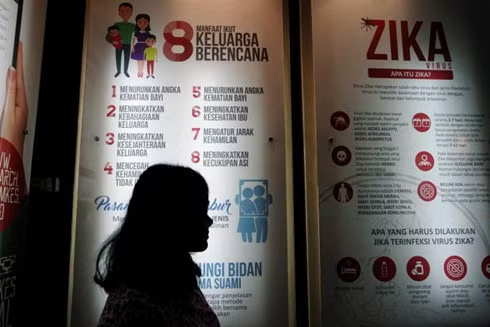
A woman stands near a poster explaining about the Zika virus. (Photo: Reuters)

Removing the international emergency designation will put Zika in a class with other diseases, such as dengue, that pose serious risks and require continued research, including efforts to develop effective vaccines.

But some public health experts worried that losing the "international emergency" label could slow research into the virus, which continues to cause infections in the United States and elsewhere.

WHO in February declared Zika a public health emergency of international concern - a designation under international law that compels countries to report outbreaks. The moved was part of an effort to determine if Zika was linked to reports in Brazil of the severe birth defect microcephaly and the neurological disorder Guillain-Barre Syndrome. Traditionally, Zika had only been thought to cause mild symptoms.

That goal has been met, said Dr David Heymann, chair of the Zika Emergency Committee and a professor of infectious disease at the London School of Hygiene and Tropical Medicine, in a conference call with reporters following the committee meeting in Geneva.

Because research has now shown that Zika and microcephaly are linked, "the committee felt that what is best now is a very robust technical response to the virus, and that would require work within WHO," he said.

The UN health agency maintained recommendations including that people exposed to the Zika virus should take preventive measures for six months to avoid sexual transmission.

"It remains crucially important that pregnant women avoid traveling to areas with local transmission of Zika, because of the devastating complications that can occur in fetuses that become infected during pregnancy," the US Centers for Disease Control (CDC) said in a statement.

Some experts, expressed concern that losing the "international emergency" designation might result in less support for research into the virus.

"I think WHO's decision is unwise," said Lawrence Gostin, a global health law expert from Georgetown University.

"Although Zika's spread has waned, it still holds the potential for an explosive epidemic. If it were to reemerge in the Americas or jump to another part of the world, it would significantly threaten a new generation of children born with disabilities such as microcephaly."

Gostin said the international response to Zika has been "lethargic" and WHO's decision will give countries even less reason to invest in preparedness and research.

At the press conference, Dr. Peter Salama, executive director of WHO's Health Emergencies Programme, insisted that WHO is "not downgrading the importance of Zika."

By framing Zika as a longer program of work, Salama said "we are sending the message that Zika is here to stay and WHO's response is here to stay in a very robust manner."

Dr. Amesh Adalja, an infectious diseases expert at the University of Pittsburgh Medical Center, said public health emergency declarations help direct the world's attention to a disease, and the Zika emergency designation accomplished that goal.

But much work remains to be done, including the development of a vaccine, he added. The removal of the emergency declaration "doesn't change that fact."

VOV

Other News

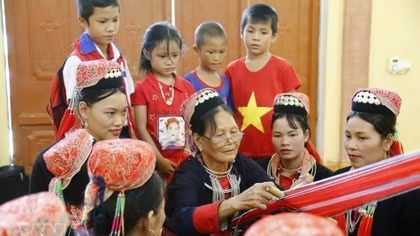
Vietnam steps up implementation of ethnic affairs strategy through 2030

Vietnam steps up implementation of ethnic affairs strategy through 2030

To accelerate the implementation of the the Ethnic Affairs Strategy by 2030, with a vision toward 2045, the Prime Minister requested ministries, agencies and local authorities to continue thoroughly carrying out the Party and State’s policies on ethnic affairs, enhancing the effectiveness of State management and strengthening oversight of policy implementation.

Security preparations reviewed for APEC 2027 in Phu Quoc

Security preparations reviewed for APEC 2027 in Phu Quoc

The team examined the APEC 2027 Convention Centre, where main conference activities are scheduled; Sun Serenia Hospital, designated to provide healthcare and emergency medical services for delegates; provincial road DT.975, which connects Phu Quoc International Airport to the convention centre; and the area surrounding Phu Quoc International Airport.

Hanoi accelerates seven Red River bridge projects, many exceed 70% completion

Hanoi accelerates seven Red River bridge projects, many exceed 70% completion

According to the municipal Transport Construction Investment Project Management Board, the city is simultaneously implementing seven projects, namely Tu Lien, Ngoc Hoi, Tran Hung Dao, Thuong Cat, Van Phuc, Hong Ha and Me So bridges. Construction is being carried out on multiple fronts, focusing on bored piles, pile caps, piers and superstructure works.

Dien Bien battlefield legacy powers tourism revival

Dien Bien battlefield legacy powers tourism revival

Seventy-two years after the Dien Bien Phu Victory, its legacy still reverberates. The unity, self-reliance, and resilience forged in that historic triumph remain a powerful internal engine, now propelling Dien Bien toward fast and sustainable development.

Hanoi accelerates shift to green buses, targets 100% by 2030

Hanoi accelerates shift to green buses, targets 100% by 2030

In the 2027–2030 period, the city will accelerate the transition towards the complete phase-out of fossil fuel-powered buses. The share of electric and green energy-fueled buses is projected to reach 79–89% by 2029 and 100% by 2030.

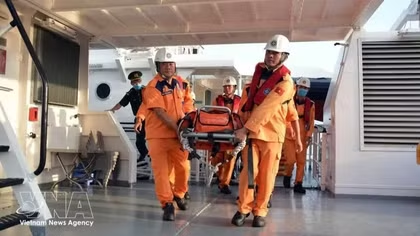
36 fishermen safely rescued after boat breaks down near Truong Sa

36 fishermen safely rescued after boat breaks down near Truong Sa

At 8:00 the same day, KN475 began towing the disabled fishing boat toward Da Tay A island. The towing operation was carried out safely, and by 18:30 both the vessel and its crew had arrived at the island without incident, where repairs and additional support procedures were arranged.

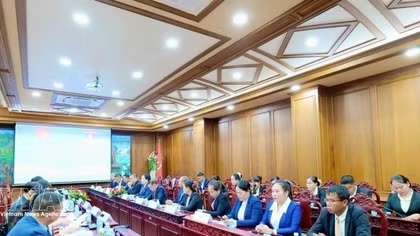
Vietnamese language contest in Laos strengthens youth ties, bilateral friendship

Vietnamese language contest in Laos strengthens youth ties, bilateral friendship

Held in response to the launch of the Vietnamese Language Day among overseas Vietnamese communities, the event aimed to enhance the quality of Vietnamese language teaching and learning in Laos while contributing to the great friendship, special solidarity, comprehensive cooperation and strategic cohesion between the two countries.

Vietnamese language contest in Laos strengthens youth ties, bilateral friendship

Vietnamese language contest in Laos strengthens youth ties, bilateral friendship

Held in response to the launch of the Vietnamese Language Day among overseas Vietnamese communities, the event aimed to enhance the quality of Vietnamese language teaching and learning in Laos while contributing to the great friendship, special solidarity, comprehensive cooperation and strategic cohesion between the two countries.

Hanoi launches 10 electric bus routes from April 1

Hanoi launches 10 electric bus routes from April 1

By the end of April, the number of buses using electricity and other green energy sources in the city is expected to reach 822, including 683 electric buses and 139 compressed natural gas (CNG) buses, representing 42.1% of the total number of vehicles.