 |
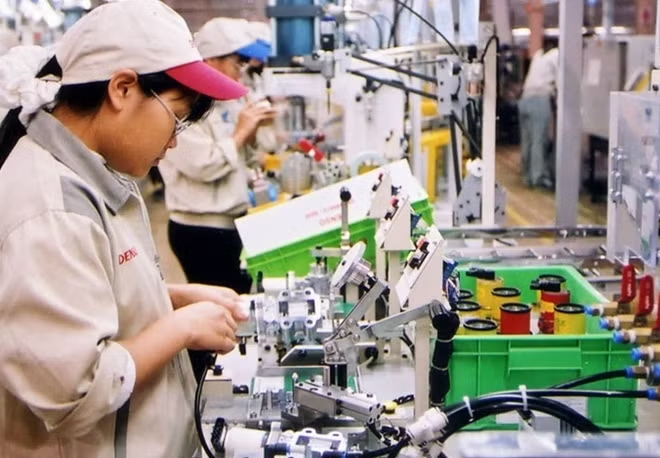
| Workers at the Denso Việt Nam Co Ltd in the Bắc Thăng Long Industrial Zone in Hà Nội. In the first four months of 2017, 10,441 workers over 35 years old registered their unemployment status. |
There was no notice given, whatsoever. The reason given was that the company was facilitating technical innovations, but Lan is not buying it.
“Actually, it is just an excuse, since they are recruiting hundreds of new workers. The main reason is that we are over 30.
“I went to the Bắc Thăng Long IZ, trying to find work in some foreign company, but they only accept people between 18 and 30. Now, there is just no more chance for me,” she said sadly.
This shocking information of workers being sacked just because they have turned 30 appears to be backed by figures from the Hà Nội Centre of Employment Service (HCES). It says that in the first four months of 2017, 10,441 workers over 35 years registered their unemployment status, accounting for about 90 per cent of the total.
Nguyễn Thị Kim Loan, Head of Unemployment Insurance Department under HCES said that job layoffs of over-30 workers were occurring mostly in foreign-invested factories in Quang Minh, Sóc Sơn, Thăng Long and other industrial zones.
Thirty-year-old Đinh Thị Hương of Ninh Bình Province, who works for a Japanese electronics company, is worried.
“In my assembly line, there is only one leader at 39, other workers are mostly under 30. I have been working here for three years, but I haven’t had a permanent contract yet. I don’t know if I can sign it next year.”
Đinh Văn Hải, an employee of Panasonic Việt Nam, said he was not thinking too much ahead. “In our twenties, our priorities are a job and a salary to raise kids.”
A survey result released in late May by the Institute for Workers and Trade Unions under Việt Nam General Confederation of Labour showed that the average age of workers in IZs across the country was 35.
It also found that some industries prefer young labour, with averages reading 27 years old for electronics, 29 for textiles or 34 chemicals.
‘Forever young’
“Five or 10 years ago, we noticed that workers at IZs were very young. Now, they are still 25 to 30 years old. Where did the older ones go, then? Three years later, when we return, we’ll find that worker are forever young,” said Vũ Minh Tiến, Deputy Head of Institute for Workers and Trade Unions.
Data compiled by HCES shows that companies do not conduct massive jobs cuts, but dismiss roughly 100 workers a month.
At the second or third salary increase period, companies start screening and ousting older employees.
Nguyễn Xuân Dương, Head of Hưng Yên Province Textile Union, said keeping long-time workers will increase wages and insurance payments while productivity doesn’t improve.
Companies use examinations, increasingly demanding criteria or position changes as tactics to weed out older workers.
With these methods, they can force employees to give up their jobs, without violating labour law themselves.
Explaining this situation, Vũ Quang Thọ, Head of Institute for Workers and Trade Unions, said that workers currently aged 30 to 40 were the first generation to work in foreign- invested industrial zones.
After 10 to 15 years, companies started to replace them with younger, stronger and basically trained workers.
He said companies are not fond of those who fully comprehend the union system and labour laws.
“The leaders of some companies told me they prefer young employees since they are obedient. Long-time workers pose the threat of strikes.”
Illness risks
High work pressure and a hazardous working environment in manual labour jobs can lead to occupational diseases.
Đinh Thị Hiền of the central province Hà Tĩnh quit her job two months ago.
“I had worked for a textile company at Quang Minh IZ for ten years and started suffering from allergic rhinitis some years ago. Because of poor health, I was regularly absent for check-ups, then the company dismissed me,” she said.
Hiền is one among thousands of workers with health problems.
Mai Đức Chính, Deputy Head of the labour confederation, said assembly line workers can only work for five to seven years before having to quit because of occupational diseases.
According to Nguyễn Ngọc Ngà of the Việt Nam Nam Association of Medicine and Labour, most workers are young and physically fit when they start working.
To earn more money, they sacrifice their time and health for work, leaving barely any time (or desire) for entertainment or sport activities, which is crucial for restoring labour power.
While this does not look like much of a problem immediately, the consequences can are evident over the next five years or so.
“The longer they work at factories, the more they suffer from toxicity in the working environment. Money and time, additionally, are burdens for married workers, bringing about neuropathy or endocrine diseases,” Ngà said.
Struggling to find work
Most workers in the IZs are those who have migrated from rural areas and are breadwinners of their families.
When they are dismissed, they find it very difficult to find other jobs.
After leaving a wood processing factory in Bình Dương Province, Tạ Hữu Sơn and his wife returned home to the northern province of Nam Định.
“We used to get food and transportation allowances. After we were dismissed, we wanted to continue to stay there but had no money. Back home, we cannot make ends meet. So we plan to take out a loan for my wife to go to Taiwan as an exported labourer,” he said.
Similarly, Nguyễn Thị Nguyệt from the central province of Thanh Hoá faces unemployment after leaving the Bắc Thăng Long IZ.
Nguyệt said: “My husband stays in the city, working as a guard. It is difficult to find a job since I’m not young, even if I am not old.”
Some of her colleagues are working as waitresses in restaurants or selling water, clothes, etc. at night markets after being dismissed from work
Hoàng Đức Khang, Deputy Head of Kim Chung Commune People’s Committee, Đông Anh District, Hà Nội, said: “Several dismissed workers stay in industrial zones to serve employees and local people.”
He said workers do not have basic knowledge of labour law. Local authorities have recommended that the city conducts courses to equip workers with knowledge of their legal rights under labour laws, but their proposal has not yet been approved.
Nguyễn Toàn Phong, Director of HCES, said it is next to impossible for over-35 workers to find a job. At this age, only engineers and managers can find work.
“We are struggling with unemployment of workers over 30,” he said.
Legal protection needed
Thọ said Revolution 4.0, or the fourth industrial revolution, was a threat for over-30 workers. “Now, we are not seeing that many people (in the 30+ age group) seeking jobs. In the near future, there will be a wave of unemployment,” he said.
He said that without proper forecasts and protective policies for workers, employees will continue to be dismissed easily.
Khang also said that workers should keep abreast of new developments and continue to improve their skills so that companies cannot fire them.
Phạm Minh Huân, former Deputy Labour Minister, said that in other countries, different vocations are available for workers who can switch if needed.
The Labour Ministry estimates that there are 6 million workers aged 18 to 30 working in the nation’s industrial zones. It also expects two to three million workers over the next ten years.
Huân said that, at present, Việt Nam’s legal system cannot prohibit companies from cutting jobs.
“All we can do is to encourage their social responsibility to not abandon their workers,” he said.
To protect labourers, amendments are needed to the 2012 Labour Law, said Nguyễn Đình Thắng, Deputy Head of Hà Nội Industrial zone Trade Unions.
Bùi Văn Cường, Chairman of the Việt Nam General Confederation of Labour, said they were taking this problem seriously.
“We are promoting an educational programme for workers so that they can fully understand challenges posed by Industrial Revolution 4.0. We are also conducting surveys and analyses of job layoffs at IZs. It is not enough that we encourage companies to protect older workers, this has to be written into law.”