- Food safety violations in Hanoi sharply increases in 2017
- Hundreds of tasty dishes presented at 2017 International Food Festival
- Hanoi's street food gets a contemporary makeover
It is a breakfast favourite, and the most popular snack or meal at late night or in early dawn.
It is sold by vendors in early morning markets and it can be found in fanciest restaurants serving traditional Vietnamese food.
There are any numbers of specialty xoi restaurants, as well as push carts that stand on street corners or bicycles that go around the streets well past midnight, long after restaurants and other eateries have closed.
Xoi, as the name suggests, is made with glutinous rice, steamed or cooked. There are those who love having this regularly for breakfast and those who have it at any time of the day or night, but almost every Vietnamese will have it at least once a month.
But xoi is not one dish. There are many varieties, each with its distinct taste, colour and/or flavour.
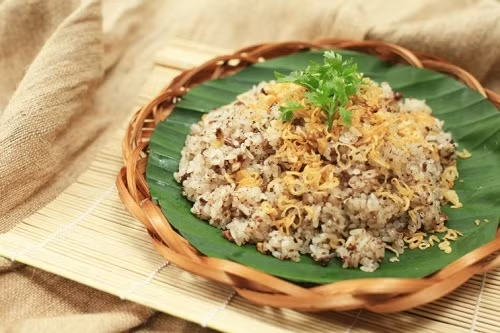 |
Each region has its own special xoi dishes. Vegans and vegetarians can enjoy xoi with muoi vung (ground sesame and peanuts) or sugar, while others have a wide range of meat choices, including xoi thit kho tau (sticky rice with Chinese braised pork) and xoi with liver pate, sausage, fried eggs, char siu, chickens or roasted pigeons.
On full moon days, New Year holidays, weddings, death anniversaries and other occasions, xoi is a must-have dish on the feast’s platters.
The ways to make sticky rice depend on the variety, family recipes or individual creativity that housewives bring into play.
However, the most popular method is to soak the glutinous rice in warm water for many hours until it expands; wash and mix the rice with a little salt and other ingredients separately; place them in an autoclave; pour boiling water into the bottom of the autoclave and place it on a pot so that the ingredients are steamed without touching the water.
Later, the sealed autoclave and the pot are placed on a stove and boiled over low heat until the sticky rice is well-cooked and limber.
Now, busy women use electric rice cookers with the steaming function, but the majority preference is for xoi cooked the traditional way.
Among the numerous types of xoi, Xoi dau xanh (green bean sticky rice) is one of the most popular because it can be served with many different ingredients, including meat. Since it is easy to cook, it is a popular choice among housewives as well.
This dish is made by chafing the green beans (mung beans), soaking them in water for around five hours (often left overnight), hulling (or not), mixing them with glutinous rice, and steaming them in an autoclave.
Other popular xoi varieties include xoi xeo (turmeric flavoured sticky rice served with powdered green beans and topped with fried shallots), xoi lac (sticky rice with peanuts), xoi ngo (stick rice with corn) and xoi dau den (sticky rice with black beans).
Another reason for its popularity is that while it is very tasty, it is also healthy, starched but not fatty.
Xoi ngu sac (five-coloured sticky rice) is usually made by several ethnic minority communities, in the northern region.
The five colours of the dish symbolise five elements: yellow is the colour of land; green the colour of wood; red, fire; white, metal; and black, water. These communities have their own secrets, using different herbs and wild vegetables to dye the sticky rice and create these colours.
In the past, xoi ngu sac was only served on important occasions like festivals, ceremonies and weddings. It has become a very popular daily dish now, and a marker of the host’s hospitality.
For making the red-coloured sticky rice, the bright red flesh of the ripe gac (spiny bittergourd or cochinchin gourd) fruit is used. This fruit has been traditionally used as both food and medicine in Vietnam.
Turmeric is used to make the yellow sticky rice, la cam (a herb) for purple, the ash of burned ginger leaves for black, and the pandan leaf for green. The glutinous rice is soaked in water mixed with the above ingredients.
Xoi ga (chicken sticky rice) is particularly liked in the central region. Visitors to Da Nang, Hoi An and Hue also favour this dish because it is delicious and can be packed easily.
The dish is fatty and nutritious. Chicken is boiled with a pinch of turmeric. The chicken broth is then used to cook the glutinous rice, giving the rice its yellow colour and its butter taste.
The boiled chicken is shredded by hand into thin slices and mixed with salt, pepper, sliced onions and Vietnamese mint. The dish is finally topped with scallion oil.
This is a balanced dish, with protein from the chicken, lipid from the chicken broth, starch from glutinous rice and vitamins from herbs and the accompanying salad.
Xoi man is a southern treat, favoured again for its taste, nutritional values and affordable prices.
“Man” means salty, literally, but here it means savory, distinguish it from the several sweet sticky rice recipes.
This is a hearty all-in-one meal with sticky rice and various kinds of meat including Chinese sausage, shredded chicken, liver pate, char siu, ruoc or cha bong (dried shredded pork/chicken), and dried shrimp.
Although styrofoam boxes and plastic is used to pack xoi now, most of the individual sellers, in the morning in particular, offer the choice of getting your xoi fix in a banana leaf, which adds an extra flavour to the dish.