2020 key for tech start-ups in Vietnam

Like many other Asian countries, Vietnam is racing its regional counterparts to spur economic innovation with artificial intelligence (AI). Experts say voice recognition technology, AI, blockchain and big data will be major trends in 2020.
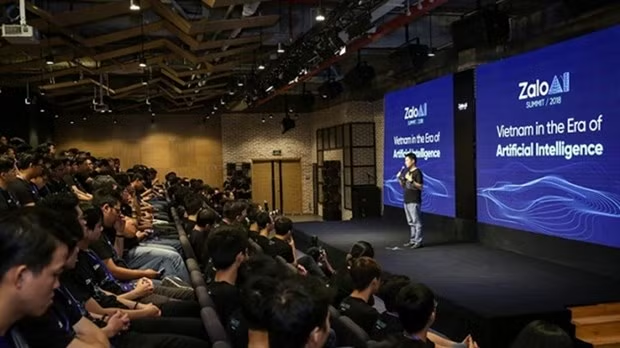
Ki-Ki, the first Vietnamese chatbot, was presented at Zalo AI Summit 2018 in late December 2018, where Vietnam’s AI community showed optimism about the development of AI (Photo: brandsvietnam.com)

Ki-Ki, the first Vietnamese chatbot, was presented at Zalo AI Summit 2018 in late December 2018, where Vietnam’s AI community showed optimism about the development of AI (Photo: brandsvietnam.com)

Like many other Asian countries, Vietnam is racing its regional counterparts to spur economic innovation with artificial intelligence (AI). Experts say voice recognition technology, AI, blockchain and big data will be major trends in 2020.

Although Vietnam is on the back foot in terms of AI and faces huge challenges, including a weak technology sector and lack of human resources, the country has managed to build a vibrant AI ecosystem and set up a plan for research and development with breakthrough strategies.

At the same time, many organisations and businesses in Vietnam are now trying to keep up with their foreign rivals by building technical skills to shape raw ideas into fully serviceable and effective AI applications.

Viettel Cyberspace Center (VTCC), established in 2014, has focused research on AI. VTCC.AI focuses on providing three services for speech processing, including TTS (Text to Speech), Speech to Text, and Voice Wake-up. The products can be applied to a variety of platforms, such as reading newspapers, books, or in automated customer care systems.

Zalo AI plans to develop applications such as Zalo Brain and Zalo Assistant.

At the Zalo AI Summit conference held at the end of 2018, the Ki-Ki virtual assistant was officially launched with the ability to recognize the voice of Vietnamese people and answer with northern, central and southern accents.

ELSA is an English pronunciation training application founded by Van Dinh Hong Vu. The application uses AI to recognize voice accuracy and help users improve their skills.

AI is also providing strong support in the field of transport. Self-driving cars with AI can automatically avoid people or obstacles, and are being used in the Ecopark urban area in Hanoi. In HCM City, AI has been used to help monitor traffic cameras and adjust traffic lights.

In health, AI is also being employed to improve quality, efficiency, overcome risks, medical incidents and reduce hospital overcrowding.

The 115 People's Hospital and Gia An 115 Hospital in HCM City are the first two hospitals in Vietnam to apply Rapid Artificial Intelligence software in stroke diagnosis and treatment.

According to Ngo Quoc Hung, Creative Director of COTAI – the center for talents in AI – who has been teaching AI to students of the Le Hong Phong High School for the Gifted in HCM City, AI is no longer unfamiliar to high school students. In their eyes, AI is now an interesting subject which offers useful information and applications.

“In several more years, Vietnam will have many good engineers in AI and the number of start-ups in AI will increase,” Hung said.

Tu Nguyen, managing director of VietA.I Community, who has been working for 10 years in emerging technologies, said there were 25 workers in the international payment division of HSBC five years ago.

Nowadays, when the work volume is five times higher, the division only needs three workers, because a big workload is now undertaken by computers.

Also according to the expert, at Minh Long II Technical Ceramics factory in Binh Duong province, 70 percent of work is being undertaken by robots.

“This shows that AI has penetrated into all areas in Vietnam, raising the need of developing the labor force in the field of AI,” he said.

Long way to go

Dang Hoang Vu, Science Director of the FPT Corporation, said that 2020 will be the year of "popularizing AI".

And while Vietnam has a lot of potential for AI development, most AI start-ups are still at a very early stage of development.

The country’s AI start-ups are still facing many difficulties when resources are limited, training is inadequate and many high-skilled workers choose to work overseas.

According to the 2018 Vietnam AI Landscape Report published by Nexus Frontier Tech initiative RubikAI, almost 60 percent of AI companies in Vietnam have been in business for less than two years, and only 34 percent have raised more than US$200,000 from external sources.

Also according to the report, two other big challenges for Vietnam are a shortage of talent and the ability to approach data.

Vu said that in order to develop faster than its competitors, the Government needs to have policies to socialize AI and encourage businesses to use artificial intelligence in business activities.

He also emphasized the importance of effective connection among the community and major businesses, among the components of the AI ecosystem.
VNA

Other News

SBV raises short-term capital lending cap to 40%

SBV raises short-term capital lending cap to 40%

The new circular will help credit institutions have more room to provide capital to businesses and investment projects to support high economic growth in the next few years, while increasing flexibility in the SBV’s monetary policy management.

Business confidence in Vietnam rebounds strongly: UOB

Business confidence in Vietnam rebounds strongly: UOB

The study found that 85% of Vietnamese enterprises reported positive business sentiment, a sharp increase from 48% in 2025, when business confidence was weighed down by uncertainties surrounding US tariff policies and related trade developments.

Bac Ninh seeks high-quality foreign investment for sustainable growth

Bac Ninh seeks high-quality foreign investment for sustainable growth

According to Vice Chairman of the provincial People’s Committee Pham Van Thinh, the province aims to maintain stable and sustainable growth, improve the competitiveness of both the economy and local businesses, and make better use of free trade agreements (FTAs) to expand and diversify export markets.

Green building trend flourishes in Ho Chi Minh City's real estate landscape

Green building trend flourishes in Ho Chi Minh City's real estate landscape

The International Finance Corporation (IFC) highlighted the city's dominance in green-certified building floor space in Vietnam, reflecting the rapid expansion of the green building market with 780 completed green buildings encompassing over 18.69 million sq.m by 2025, predominantly certified by EDGE and LEED.

UK supports Vietnam in wind power and green finance development

UK supports Vietnam in wind power and green finance development

The United Kingdom officially announced two new climate cooperation initiatives to support Vietnam in its energy transition and green growth journey. These programs focus on offshore wind power development and the creation of a sustainable green financial ecosystem.

Ample room remains for Vietnam–India logistics cooperation

Ample room remains for Vietnam–India logistics cooperation

The GTTCI expert noted that alongside logistics and integrated warehousing, e-commerce is expected to be a particularly high-growth sector in the coming years. He described it as a multi-billion-dollar market with significant untapped opportunities for cooperation between Vietnam and India.

Exports gain momentum from high-tech growth drivers

Exports gain momentum from high-tech growth drivers

According to the Ministry of Industry and Trade, Vietnam’s exports reached 215.66 billion USD in the first five months of 2026, up 19.5% year-on-year. Twenty-six export items generated more than 1 billion USD in revenue each, including seven with turnover exceeding 10 billion USD.

Vietnam–China crossings see spike in ASEAN fresh produce

Vietnam–China crossings see spike in ASEAN fresh produce

Since the start of the summer harvest season, China's two major border gates with Vietnam, Youyi Guan in Pingxiang and Beilun 2 Bridge in Dongxing, have entered their peak period for handling imports of fresh agricultural and seafood products from member states of the Association of Southeast Asian Nations (ASEAN).

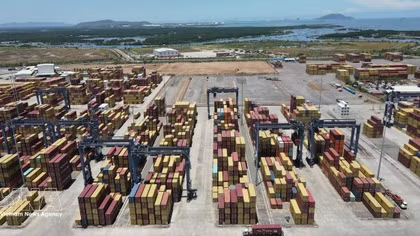
Cargo handling operations at Berths 3 and 4 of the Hai Phong International Gateway Port. (Photo: VNA)

AI reshapes logistics, raising bar for workforce skills

According to the Vietnam Logistics Business Association (VLA), the logistics sector will require around 2.2 million workers by 2030, including 1.6 million employees for logistics service providers and nearly 600,000 personnel supporting logistics operations in manufacturing and trading enterprises.

Robust dispute resolution framework key to Vietnam's IFC ambitions

Robust dispute resolution framework key to Vietnam's IFC ambitions

The development strategy for VIFC-HCMC envisions a comprehensive financial ecosystem encompassing green finance, carbon credits, financial technology (fintech), blockchain technology, digital assets, digital banking and other innovative business models. These highly internationalised sectors involve complex cross-border transactions and sophisticated legal structures.